The first modern novel in Japan, Futabatei …
Years: 1887 - 1887
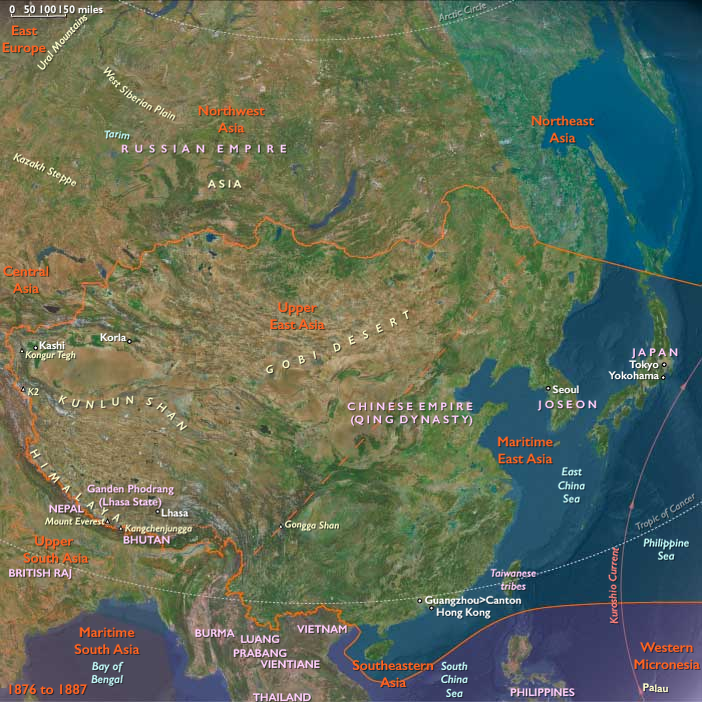
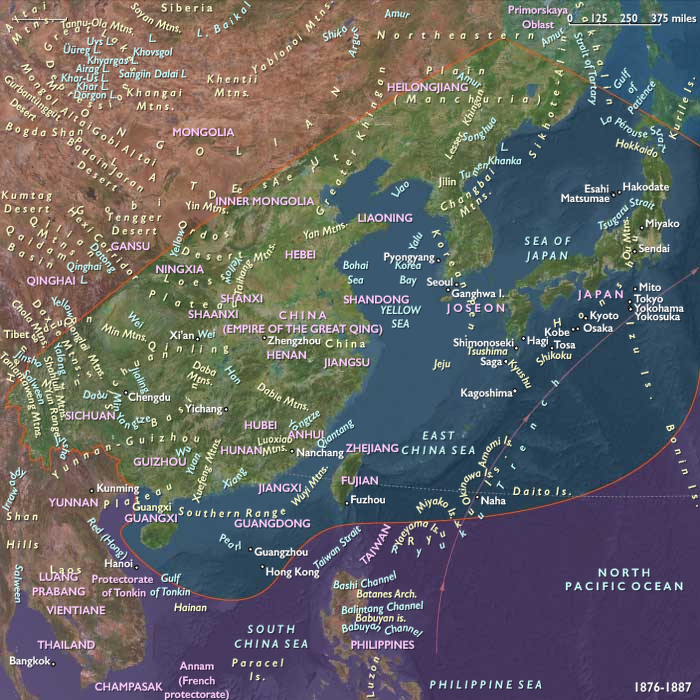
The first modern novel in Japan, Futabatei Shimei's Ukigumo (The Drifting Cloud), is published in two sections in 1887 and 1888, the novel only contains four characters, prioritizing the development of characters over plot.
The novel contains criticism of growing materialism in the Japanese society.
Locations
Groups
Subjects
Regions
Subregions
Related Events
Filter results
Showing 10 events out of 10792 total
With conflicting claims over discovery of hot springs in Banff, Canadian Prime Minister John A. Macdonald had decided to set aside a small reserve of twenty-six square kilometers (ten square miles) around the hot springs at Cave and Basin as a public park known as the Banff Hot Springs Reserve in 1885.
Under the Rocky Mountains Park Act, enacted on June 23, 1887, the park is expanded to six hundred an seventy-four square kilometers (two hundred and sixty square miles) and named Rocky Mountains Park.
This is Canada's first national park, and the second established in North America, after Yellowstone National Park.
Women in the Territory of Washington had been given the vote in 1883 by the Territorial Legislature, but the right is rescinded in 1887 by the Washington Territorial Supreme Court as a response to female support of prohibition.
Hawaii's Reform Party (also known as the Missionary Party) has grown very frustrated with Kalākaua by 1887.
They blame him for the Kingdom's growing debt and accuse him of being a spendthrift.
Some foreigners want to force King Kalākaua to abdicate and put his sister Liliʻuokalani onto the throne, while others want to end the monarchy altogether and annex the islands to the United States.
The people who favor annexation form a group called the Hawaiian League.
Members of the League, armed with guns, assemble in 1887 and impel a group of cabinet officials and advisors to Kalākaua, led by Lorrin A. Thurston, Minister of Interior, to force the king to promulgate a new constitution.
The impetus given for the new constitution is the frustration of the with growing debts, spending habits of the King, and general governance.
It is specifically triggered by the failed attempt by Kalākaua to create a Polynesian Federation, and accusations of an opium bribery scandal.
The constitution is proclaimed by the king after a meeting of three thousand residents, including an armed militia, demand he sign it or be deposed.
The document creates a constitutional monarchy like the United Kingdom's, stripping the King of most of his personal authority, empowering the legislature and establishing cabinet government.
It has since become widely known as the "Bayonet Constitution" because of the threat of force used to gain Kalākaua's cooperation.
The 1887 constitution empowers the citizenry to elect members of the House of Nobles (who had previously been appointed by the King).
It increases the value of property a citizen must own to be eligible to vote above the previous Constitution of 1864 and denies voting rights to Asians, who comprises a large proportion of the population.
Seventy-five percent of ethnic Hawaiians could not vote at all, because of the gender, literacy, property, and age requirements. (A few Japanese and some Chinese had previously become naturalized and now lose voting rights they had previously enjoyed.)
This guarantees a voting monopoly to wealthy native Hawaiians and Europeans.
With the new requirements, ethnic Hawaiians now amount to about two-thirds of the electorate for representatives and about one-third of the electorate for Nobles.
The rest of the voters ware male residents of European or American ancestry.
Kalākaua’s successor Queen Liliʻuokalani in her autobiography will call her brother's reign "a golden age materially for Hawaii".
Native Hawaiians feel the 1887 constitution has been imposed by a minority of the foreign population because of the king's refusal to renew the Reciprocity Treaty, which now includes an amendment that will allowed the U.S. Navy to have a permanent naval base at Pearl Harbor in Oʻahu, and the king's foreign policy.
According to bills submitted by the King to the Hawaiian parliament, the King's foreign policy includes an alliance with Japan and supports other countries suffering from colonialism.
Many Native Hawaiians oppose a U.S. military presence in their country.
The Reciprocity Treaty of 1875, as supplemented by convention on December 6, 1884, is ratified in 1887.
On January 20 of this year, the United States Senate allows the Navy to exclusive right to maintain a coaling and repair station at Pearl Harbor.
The U.S. takes possession on November 9.

An Auckland-dwelling British sea captain named Frederick Moss comes to Nauru in his schooner, the Buster, landing on Nauru while his ship is being reloaded with copra in 1887.
He will report that the inhabitants of Nauru are friendly and of good humor, although most of the boys and all of the men are armed with rifles and carbines.
The tribal war is still going on, although by this time it appears that many of the islanders have had enough.
Through his conversations with the natives, Moss notes that none of them wish to continue fighting, but no tribal group trusts the others to lay down their arms if it did so first.
They wish for a universal disarmament of the island.
Moss receives another report from Harris, who still lives on the island.
Harris says that two of his family members had already been shot, and that he wishes a Christian mission would come to the island to restore peace once again.
George Grey is returned for the Auckland Central electorate in the 1887 election.
Grey had been elected in Auckland East in the 1881 election, and re-elected in the 1884 election.
Prospectors Thomas Riseley and Mick Toomey find gold at Southern Cross in 1887, initiating the "Yilgarn gold rush".
The growth of the Australian sugar industry in Queensland in the 1870s had led to a search for laborers prepared to work in a tropical environment.
During this time, thousands of "Kanakas" (Pacific Islanders) have been brought into Australia as indentured workers.
This and related practices of bringing in nonwhite labor to be cheaply employed is commonly termed "blackbirding" and refers to the recruitment of people through trickery and kidnappings to work on plantations, particularly the sugar cane plantations of Queensland (Australia) and Fiji.
In the 1870s and 1880s, the trade union movement had begun a series of protests against foreign labor.
Their arguments are that Asians and Chinese take jobs away from white men, work for "substandard" wages, lower working conditions and refuse unionization.
Objections to these arguments have come largely from wealthy land owners in rural areas.
It is argued that without Asiatics to work in the tropical areas of the Northern Territory and Queensland, the area would have to be abandoned.
Despite these objections to restricting immigration, between 1875–1888 all Australian colonies enact legislation which excludes all further Chinese immigration.
Asian immigrants already residing in the Australian colonies are not expelled and retain the same rights as their Anglo and Southern compatriots.
Vietnam's independence has been gradually eroded by France—aided by large Catholic collaborator militias—in a series of military conquests between 1859 and 1885, after which the entire country becomes part of French Indochina, formed in October 1887 from Annam, Tonkin, Cochinchina (which together form modern Vietnam) and the Kingdom of Cambodia.
The French administration imposes significant political and cultural changes on Vietnamese society.
A Western-style system of modern education is developed, and Roman Catholicism is propagated widely in Vietnamese society.
Most of the French settlers in Indochina are concentrated in Cochinchina—the southern third of Vietnam—based around the city of Saigon.
Siam's princes and other conservatives had successfully resisted the reform agenda of the young Rama V, but as the older generation was replaced by younger and western-educated princes, resistance had faded.
The king can always argue that the only alternative is foreign rule.
He has found powerful allies in his brothers Prince Chakkraphat, whom he has made finance minister, Prince Damrong, who has organized interior government and education, and his brother-in-law Prince Devrawongse, who will serve as foreign minister for thirty-eight ears.
Devrawongse visits Europe in 1887, to study government systems.
On his recommendation, the king establishes a Cabinet government, an audit office, and an education department.
The semiautonomous status of Chiang Mai is ended and the army is reorganized and modernized.
The farmers living near the Yellow River have built dikes to contain the rising waters, caused by silt accumulation on the riverbed, for centuries.
This rising riverbed, coupled with days of heavy rain, overcomes the dikes on around September 28, 1887, causing a massive flood.
Since there is no international unit with which to measure a flood's strength, it is usually classified by the extent of the damage done, depth of water left and number of casualties.
The waters of the Yellow River are generally thought to have broken through the dikes in Huayankou, near the city of Zhengzhou in Henan province.
Owing to the low-lying plains near the area, the flood spreads very quickly throughout Northern China, covering an estimated fifty thousand square miles (one hundred and thirty thousand), swamping agricultural settlements and commercial centers.
After the flood, two million are left homeless.
The resulting pandemic and lack of basic essentials claims as many lives as those lost directly by the flood itself.
It is one of the worst floods in history, though the later 1931 Yellow River flood may have killed as many as four million.