
Ptolemy XII Auletes, facing serious opposition from …
Years: 59BCE - 59BCE
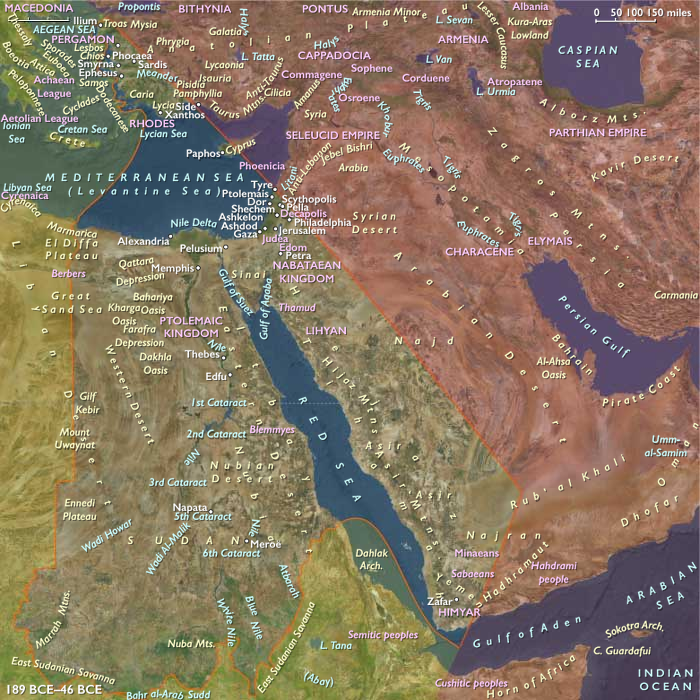
Ptolemy XII Auletes, facing serious opposition from the people of Alexandria and still unsure of his status at Rome, bribes Caesar with six thousand talents, in return for which Caesar passes a law acknowledging his kingship over Egypt.
Locations
People
Groups
Topics
Commodoties
Subjects
Regions

Subregions
Related Events
Filter results
Showing 10 events out of 62582 total
Rome has begun in recent decade to exercise stronger influence on the Getae.
Roman merchants have arrived to exchange goods, and the Getae have begun counterfeiting Roman coins.
The Getae, or Geto-Dacians, have revived their old tribal union under the leadership of Burebista (reigned 82-44 BCE), who has amassed formidable military power with the help of the high priest Deceneu.
Cogaionon, the sacred mountain of the Dacians, is at the center of the kingdom's nucleus in the area of the iron-rich Orastie mountains in the southern Carpathians.
In 60-59, Burebista campaigns successfully against the Celts who threaten his kingdom from the northeast.
Caesar, faced with inflexible opposition from such conservative Senators as Lucullus and Cato the Younger, now succeeds in organizing an irresistible coalition of political bosses.
He is already in Crassus' political debt, but he has also made overtures to Pompey, assiduously cultivating his friendship.
Pompey and Crassus have been at odds for a decade, so Caesar tries to reconcile them.
The three of them have enough money and political influence to control public business.
This informal alliance, known as the First Triumvirate ("rule of three men"), is cemented by the marriage of Pompey to Caesar's only child, Julia, in April 59.
This family alliance of its two great chiefs is regarded as the firmest bond between Caesar and Pompey, and is accordingly viewed with much alarm by the optimates (the oligarchal party in Rome), especially by Cicero and Cato the Younger.
Caesar also marries again, this time Calpurnia, As consul, Caesar champions a bill of Publius Servilius Rullus for the redistribution of Roman public lands in Italy to the poor, on which the first charge is to be a provision for Pompey's soldiers.
The proposal is supported by Pompey, by force of arms if need be, and by Crassus, making the triumvirate public.
Three tribunes of the plebs veto the bill, and Caesar's colleague Bibulus announces his intention of preventing the transaction of public business by watching the skies for portents whenever the public assembly is convened.
Pompey fills the city with soldiers, a move which intimidates the triumvirate's opponents.
Bibulus attempts to declare the omens unfavorable and thus void the new law, but is driven from the forum by Caesar's armed supporters.
His bodyguards have their ceremonial axes broken, two high magistrates accompanying him are wounded, and he has a bucket of excrement thrown over him.
In fear of his life, he retires to his house for the rest of the year, issuing occasional proclamations of bad omens.
These attempts to obstruct Caesar's legislation prove ineffective.
Roman satirists ever after referred to the year as "the consulship of Julius and Caesar."
In the same year, Clodius, who had been acquitted of the sacrilege charge in 61 by a jury probably bribed by Crassus, renounces his patrician status, is adopted into a plebian gens, and is elected a Tribune of the plebs.
Pompey's settlement of the East is ratified en bloc by an act negotiated by an agent of Caesar, the tribune of the plebs Publius Vatinius.
Caesar himself initiates a noncontroversial and much-needed act for punishing misconduct by governors of provinces.
Another act negotiated by Vatinius gives Caesar Cisalpine Gaul (between the Alps, the Apennines, and the Adriatic) and Illyricum.
When Metelus Celer, the governor-designate of Transalpine Gaul (southern France) suddenly dies, this province, also, is assigned to Caesar at Pompey's instance, giving him four legions.
Cisalpine Gaul gives Caesar a military recruiting ground; Transalpine Gaul gives him a springboard for conquests beyond Rome's northwest frontier.
The term of his governorship, and thus his immunity from prosecution, is set at five years, rather than the usual one; his tenure is to last until February 28, 54.
When his consulship ends, Caesar narrowly avoids prosecution for the irregularities of his year in office, and quickly leaves for his province.
Rome nevertheless divests Egypt of Cyprus the next year, when the Roman demagogue Clodius Pulcher annexes the island—driving its king to suicide when his brother in Egypt fails to support him—to pay for his massive grain distributions in Rome.
Cato the Younger is sent by a law of Clodius to oversee the annexation of the island.
Marcus Junius Brutus—whose mother, Servilia, is a half-sister of Cato the Younger and reputed mistress of Caesar—is adopted by Quintus Servilius Caepio and takes the name Quintus Caepio Brutus.
Brutus in 58 at the age of about twenty-seven accompanies Cato to Cyprus.
The Helvetii have planned and prepared themselves for three years, and emissaries have been sent out to various Gallic tribes assuring safe passages and alliances.
In 58 BCE, Orgetorix's ambitions are declared a ruse for personal power; this rumor is celebrated among the enemies of the Helvetii, especially those of Roman clientele.
This succeeds in causing confusion and feuds among the tribes, based mainly on the merits of Orgetorix versus his vices.
The conspiracy is denounced; Orgetorix is called to a hearing in chains before the government of the Helvetii.
There is an effort to seize him at council, however he is protected by his retinue and bodyguards.
During the preceding seasons he had called up a sizable force of men-at-arms and vassals said to have numbered ten thousand men, this in addition to his armed entourage.
Orgetorix is able to escape capture by his rivals and the councils labor at length to resolve the confusions and disputes; however, Orgetorix is murdered or slain during a dispute within his own encampment With many conflicts of interest settled, the Helvetii once again return to their long planned migration to safer pastures among the Santones tribe on the Atlantic seaboard.
Caesar dates their departure to the twenty-eighth of March, and mentions that they burned all their towns and their villages so as to discourage thoughts among undecided client tribes or enemies to occupy their vacated realm.
The Helvetii retain and arm their client tribes: the Rauraci, the Tulingi, the Latovici, and the Boii, from whom they have hired a contingent of horsemen.
There are two available routes for them: the first one is the difficult and dangerous Pas de l'Ecluse, located between the Jura mountains and the Rhône River.
The second, easier one will lead them to the town of Geneva, where Lake Geneva flows into the Rhone River and where a bridge allows passage over the river.
These lands belong to the Allobroges, a tribe that had been subdued by Rome, and are under the control of the Roman republic.
Meanwhile, Caesar is in Rome, and only a single legion is in Transalpine Gaul, the endangered province.
As he is informed of these developments, he immediately hurries to Cisalpine Gaul, leaving his single legion under the command of his second-in-command Titus Labienus.
Upon arrival, he takes command of the three legions which were in Aquileia and enrolls two new legions, the Legio XI and the Legio XII.
At the head of these five legions, he travels the quickest way through the Alps, crossing territories of several hostile tribes and fighting several skirmishes en route.
Arriving in Geneva, he orders a levy of several auxiliary units and the destruction of the bridge.
The Helvetii send an embassy under the new leadership of Nammeius and Verucloetius, to negotiate a peaceful passage, promising to do no harm.
Caesar stalls the negotiations while his troops fortify their positions behind the river with a sixteen foot high rampart and a parallel trench lined with ballistas; his legionaries are backed by mercenary archers and slingers and Caesar has also hired and/or conscripted a contingent of Gallic horseman from the Remi.
As the embassy returns, Caesar officially refuses their request and warns them that any forceful attempt to cross the river will be opposed.
Several attempts are quickly beaten off.
The Helvetii turn back and enter negotiations with the Sequani to let them pass in a peaceful manner.
Gaius Julius Caesar ends his consulship in Rome in 58 BCE.
Due to the costs of consulship, Caesar is still deeply in debt, and there is money to be made as a governor, whether by extortion or by military adventurism.
Having secured the governorship of both Cisalpine Gaul and Transalpine Gaul, Caesar initially has four veteran legions under his direct command: Legio VII, Legio VIII, Legio IX Hispana, and Legio X.
As he had been governor of Hispania Ulterior in 61 BCE and had campaigned successfully with them against the Lusitanians, Caesar knows personally most (perhaps even all) of these legions.
Caesar also has the legal authority to levy additional legions and auxiliary units as he sees fit.
His ambition is to conquer and plunder some territories to get himself out of debt, and it is likely Gaul was not his initial target, but that he was instead planning a campaign against the kingdom of Dacia located in the Balkans.
The nations of Gaul are civilized and wealthy.
Most have contact with Roman merchants and some, particularly those that are governed by Republics such as the Aedui and Helvetii, have enjoyed stable political alliances with Rome in the past.
Two of Caesar’s provinces border on unconquered territory, and parts of Gaul are known to be unstable.
Some of Rome's Gallic allies have been defeated by their rivals, with the help of a contingent of Germanic tribes.
The Romans fear these tribes are preparing to migrate south, closer to Italy, and that they have warlike intent.
The threat of invasion by the Helvetii, a German-Celtic tribe from the area that is now Switzerland, gives Caesar a pretext to advance his career through war.
His personal ambitions extending far beyond his proconsulship of Cisalpine and Transalpine Gaul, Caesar goes to war in Gaul, ostensibly to protect the Roman republic's Mediterranean holdings.
The majority of the Gallic tribes congratulate Caesar following his victory over the Helvetii, and seek to meet with him in a general assembly.
Diviciacus, the head of the Aeduan government and spokesmen for the Gallic delegation, expresses concern over Ariovistus’ conquests and the hostages he has taken.
Diviciacus demands that Caesar defeat Ariovistus and remove the threat of a Germanic invasion otherwise they would have to seek refuge in a new land.
Not only does Caesar have a responsibility to protect the long-standing allegiance of the Aedui, but this proposition presents an opportunity to expand Rome’s borders, strengthen the loyalty within Caesar’s army and establish him as the commander of Rome’s troops abroad.
As the Senate had declared Ariovistus a “king and friend of the Roman people” in 59 BCE, Caesar cannot declare war on the Suebi tribe.
Caesar, saying that he cannot ignore the pain the Aedui have suffered, delivers an ultimatum to Ariovistus demanding that no German cross the Rhine, the return of Aedui hostages and the protection of the Aedui and other friends of Rome.
Although Ariovistus assures Caesar that the Aedui hostages will be safe as long as they continue their yearly tribute, he takes the position that he and the Romans are both conquerors and that Rome has no jurisdiction over his actions.
With the attack of the Harudes on the Aedui and the report that a hundred clans of Suebi are trying to cross the Rhine into Gaul, Caesar has the justification he needs to wage war against Ariovistus in 58 BCE.
Learning that Ariovistus intends to seize Vesontio, the largest town of the Sequani, Caesar commences marching his troops toward Vesontio.
Some of Caesar’s officers hold their posts for political reasons only and have no war experience.
As a result, they suffer from poor morale which threatens Caesar’s campaign.
Caesar challenges the officers and their legions, saying that the only legion he can trust is the Tenth.
With their pride on the line, the other legions follow the Tenth’s lead, determined not to be outdone.
Consequently, Caesar arrives in Vesontio before Ariovistus.
They meet and rout the Germanic army in the land between the city and river, effecting a massacre as the Germans try to escape over the river.
Most of Ariovistus’ hundred and twenty thousand men are killed.
Some, including Ariovistus himself, manage to cross the river in boats or by swimming.
The rest are cut down by Roman cavalry, including both of Ariovistus's wives and one of his daughters; another daughter is taken prisoner.
Ariovistus and what remains of his troops escape and cross the Rhine, never to engage Rome in battle again.
Both Caesar's emissaries are rescued unharmed, to relate their harrowing adventures as the Germans debated (in their presence) whether they should be burned then or later.
Caesar said that encountering Procillus and freeing him from his chains gave him as much pleasure as the victory, which offers some insight into the emotional climate of Caesar's forces; the officers were a sort of family.
The fate of the twenty-four thousand Harudes is not known.
The Suebi encamped near the Rhine return home.
Caesar is victorious.
Pompey is supposedly infatuated with his bride.
The personal charms of Julia are remarkable: she is a woman of beauty and virtue; and although policy had prompted her union, and she is twenty-three years younger than her husband, she possesses in Pompey a devoted husband, to whom she is, in return, devotedly attached.
A rumor suggests that the aging conqueror is losing interest in politics in favor of domestic life with his young wife.
In fact, Pompey has been given the governorship of Hispania Ulterior, but has been permitted to remain in Rome to oversee the Roman grain supply as curator annonae, exercising his command through subordinates.
Ptolemy XII Auletes, fearing popular insurrection over the loss of Cyprus, flees in 58 BCE to Rome with his sister Cleopatra VII in search of political and military aid against Berenice's elder sister Cleopatra VI Tryphaena, who has become far too powerful.
He leaves his queen, Cleopatra V Tryphaena, and his eldest daughter, Berenice IV, as regents in Egypt.
Residing at Pompey's villa at Rome, he employs bribery to obtain the support of the Roman senators.
He also arranges the assassination of delegations sent by his opponents from Alexandria, where, following the death of his queen, the people have made Berenice IV sole ruler.
Aulus Gabinius, as praetor in 61, had tried to win public favor by providing games on a scale of unusual splendor, and in 58 manages to secure the consulship, although not without suspicion of bribery.
During his term of office, he aids Publius Clodius Pulcher, the tribune of the plebs, in introducing a law (the Leges Clodiae) threatening exile to anyone who executed a Roman citizen without a trial.
Cicero, having executed members of the Catiline conspiracy four years previously without formal trial, and having had a public falling out with Clodius, is clearly the intended target of the law.
Cicero argues that the senatus consultum ultimum indemnifies him from punishment, and he attempts to gain the support of the senators and consuls, especially of Pompey, who has become jealous of Cicero's prominence.
Caesar offers to protect Cicero in return for cooperation with the Triumvirate, but Cicero honorably refuses.
When legitimate aid is not forthcoming, Cicero goes into exile, arriving at Thessalonica, Greece, on May 23, 58 BCE.
The day Cicero leaves Italy into exile, Clodius proposes another law that forbids Cicero approaching within four hundred miles (six hundred and forty kilometers) of Italy and confiscates his property.
The bill is passed forthwith, and Cicero's villa on the Palatine is destroyed by Clodius' supporters, as are his villas in Tusculum and Formiae.
Cicero's property is confiscated by order of Clodius, his mall on the Palatine burned down, and its site put up for auction.
It is purchased by Clodius himself, who, not wishing his name to appear in the matter, had had someone else place the bid for him.
Clodius, becoming exhilarated with his power and importance, wastes no time enacting a substantial legislative program.
The Leges Clodiae include setting up a regular dole of free grain, which used to be distributed monthly at variously and heavily discounted prices, but is now to be given away at no charge, thereby increasing Clodius' political status.
Clodius also abolishes the right of taking the omens on a fixed day and (if they were declared unfavorable) of preventing the assembly of the comitia, possessed by every magistrate by the terms of the Lex Aelia Fufia.
He reestablishes the old social and political clubs or guilds of workmen, and the censors are forbidden from excluding any citizen from the Senate or inflicting any punishment upon him unless he has been publicly tried and convicted.
Out of personal hatred for the Lagid king Ptolemy of Cyprus, younger brother of Pharaoh Ptolemy XII Auletes, he passes a bill terminating his kingship and annexing Cyprus to the Empire.
He cleverly selects Cato the Younger to be sent to Cyprus with a special grant of praetorian command rights to take possession of the island and the royal treasures, and preside over the administrative incorporation of Cyprus into the Roman province of Cilicia.
This measure is planned both to remove Cato, potentially a serious and difficult opponent, from the City for some time (in the event, he is away for more than two years), and to turn him into an advocate for the legitimacy of Clodius' adoption and tribunate, which it also effects, later causing a great deal of friction between Cato and Clodius' bitterest enemies, especially Cicero.
Caesar’s Campaign Against the Helvetii (58 BCE): The Battle of Bibracte and Its Aftermath
In 58 BCE, the Helvetii had already crossed the territories of the Sequani and were pillaging the lands of the Aedui, Ambarri, and Allobroges. These tribes, unable to oppose the migrating Helvetian coalition, sought assistance from Julius Caesar, their Roman ally.
Caesar’s Initial Engagement at the Battle of the Arar
- The Cimbri's Helvetian descendants, seeking new lands, attempted to migrate en masse through Gaul into Roman-controlled regions.
- Caesar intercepted them as they were crossing the River Arar (modern Saône), surprising a quarter of their forces, the Tigurini clan, who had not yet crossed.
- Three Roman legions swiftly attacked and defeated the Tigurini, forcing the survivors to flee into the nearby forests.
- After the victory, the Romans constructed a bridge over the Saône, continuing their pursuit of the main Helvetian force.
Failed Negotiations and the Roman Pursuit
- The Helvetii sent an embassy, led by Divico, to negotiate with Caesar. However, the talks failed, and the migration continued.
- For two weeks, the Romans shadowed the Helvetian column, attempting to halt their movement.
- Caesar ordered 4,000 cavalry (Roman and Aedui allied riders) to track and harass the Helvetii, but they were unexpectedly defeated by just 500 Helvetian cavalry, exposing weaknesses in Rome’s auxiliary forces.
Dumnorix and the Aedui Betrayal
- Supplies promised to the Romans by their Aedui allies were delayed, likely due to Dumnorix, an influential Aeduan leader with Helvetian sympathies.
- Facing logistical difficulties, Caesar diverted his army to Bibracte, the Aedui capital, to obtain food and regroup.
The Battle of Bibracte (June 20, 58 BCE)
- The Helvetii, learning of Caesar’s movement from deserters, turned back to harass his rear guard.
- Caesar deployed his army in triplex acies (the standard triple battle line) at the base of a hill near Bibracte, securing his baggage train at the top.
- The Seventh, Eighth, Ninth, and Tenth Legions formed the front battle line, while the Eleventh and Twelfth Legions, along with auxiliaries, guarded the summit.
Phases of the Battle
-
Initial Roman Defense and Counterattack
- The Helvetii charged uphill but were repelled by a hail of pila (javelins) thrown from a distance of 10–15 yards.
- The legions counterattacked, forcing the Helvetii to retreat a thousand paces back to their baggage train.
-
Reinforcements Arrive
- The Boii and Tulingi, allies of the Helvetii, entered the battlefield with 15,000 warriors, attacking the Roman flank.
- The Helvetii regrouped and returned to the fight, creating a two-front engagement.
-
Roman Tactical Adaptation
- To counter the flanking maneuver, Caesar redeployed his third line, keeping the primary and secondary battle lines engaged with the retreating Helvetii.
- The Romans fought for many hours into the night before finally capturing the Helvetian baggage train, securing a decisive victory.
The Aftermath of the Battle
- The Helvetii and their allies fled into the night, suffering catastrophic losses.
- According to Caesar’s account:
- 368,000 Helvetii and allies had originally set out.
- 92,000 were able-bodied warriors.
- 110,000 survivors remained to return home.
- 238,000 had been killed or captured.
- Caesar rested his legions for three days, then pursued the fleeing Helvetii, who had reached the territory of the Lingones.
- Caesar issued a warning to the Lingones not to aid the Helvetii, forcing them to surrender unconditionally.
Final Resolution and Roman Strategy
- The Helvetii, Boii, and Tulingi survivors were ordered to return to their homeland to rebuild their settlements.
- Rome provided them with supplies, ensuring they remained a buffer state against future Germanic incursions.
- A faction of 6,000 Helvetii (Verbigeni) attempted to flee but were captured and executed by other Gallic tribes at Caesar’s orders.
- A census written in Greek was discovered in the captured Helvetian camp, confirming the demographic scale of the migration.
Significance of the Battle of Bibracte
- Rome’s victory secured its dominance in Gaul, allowing Caesar to turn his attention to other Gallic tribes.
- The defeat of the Helvetii demonstrated the effectiveness of Roman military tactics, particularly the triplex acies formation and logistical strategy.
- The Helvetian migration served as a prelude to the Gallic Wars, in which Caesar would conquer all of Gaul within the next seven years (58–51 BCE).
The Battle of Bibracte was a key moment in Roman expansion, marking the beginning of Caesar’s conquest of Gaul and setting the stage for his rise to power in Rome.
The Xiongnu, as their economic and military situation deteriorated, had been willing to renew peace during the reigns of Huyandi Chanyu (r. 85-69 BCE) and Xulüquanqu Chanyu (r. 68-60 BCE), but the Han court had given only one option, tributary submission.
After Xulüquanqu Chanyu's death in 60 BCE, a Xiongnu civil war had broken out in 57 BCE over the succession, which fully fragments the Xiongnu confederation with many contenders.
In the end, only Zhizhi Chanyu and Huhanye Chanyu survive the struggle to power.
After Zhizhi Chanyu (r. 56–36 BCE) inflicts serious losses against his rival Huhanye Chanyu (r. 58–31 BCE), Huhanye and his supporters debate whether to request military protection and become a Han vassal.
In 53 BCE, Huhanye decides to do so and surrenders to the reign of the Han empire.
Huhanye sends his son as a hostage to the Han capital in 53 BCE and personally pays homage to Emperor Xuan in 51 BCE.
Huhanye makes a second visit two years later.
With Han assistance, his strength grows, and Zhizhi, who had previously been stronger, is now forced to move west.
Burebista, king of the Dacians, conquers the economically important Greek cities on the Black Sea coast, from Apollonia to Olbia, after 55, forcing the retreat of the Scythians to …
Years: 59BCE - 59BCE
Locations
People
Groups
Topics
Commodoties
Subjects
Regions
Subregions