
Ptolemy, the son of King Juba II …
Years: 6 - 6
Ptolemy, the son of King Juba II and Queen Cleopatra Selene II of Mauretania, has a younger sister called Drusilla of Mauretania.
His father is the son of King Juba I of Numidia, who was descended from the Berber people of North Africa and was an ally to the Roman Triumvir Pompey.
His mother Cleopatra Selene II was the daughter of the Ptolemaic Greek Queen Cleopatra VII of Egypt and the Roman Triumvir Mark Antony.
Ptolemy is of Berber, Greek and Roman ancestry.
Ptolemy and his sister Drusilla are the only grandchildren of Juba I of Numidia and Cleopatra VII of Egypt and are among the younger grandchildren to Mark Antony.
Through his maternal grandfather, Ptolemy is distantly related to Julius Caesar and the Julio-Claudian dynasty.
Ptolemy is a first cousin to Germanicus and the Roman Emperor Claudius and a second cousin to the Emperor Caligula, the Empress Agrippina the Younger, the Empress Valeria Messalina and the Emperor Nero.
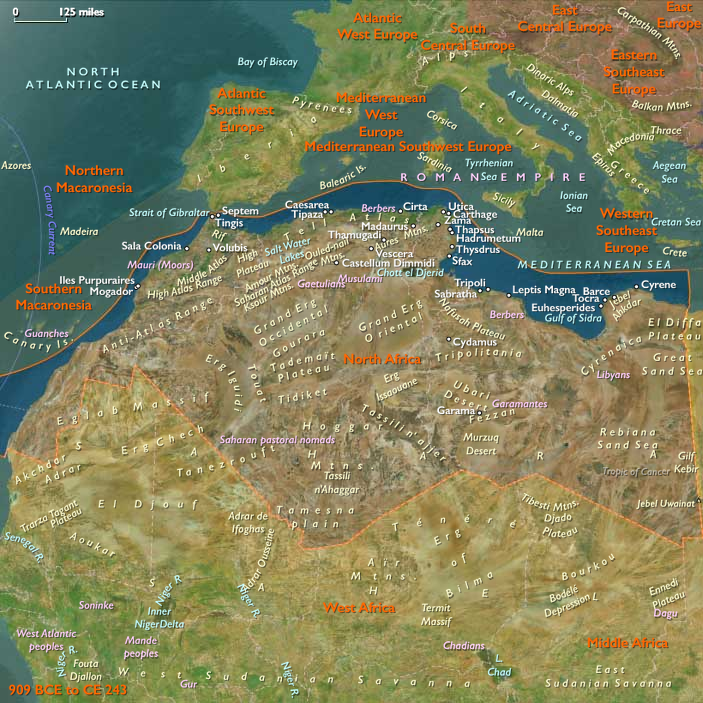
Ptolemy was most probably born in Caesaria, the capital of the Kingdom of Mauretania (modern Cherchell, Algeria) in the Roman Empire.
He was named in honor of his mother’s ancestors, in particular the Ptolemaic dynasty.
He was also named in honor of the memory of Cleopatra VII, the birthplace of his mother and the birthplace of her relatives.
In choosing her son's name, by-passing the ancestral names of her husband, Cleopatra Selene II had created a distinct Greek-Egyptian tone and emphasized her role as the monarch who will continue the Ptolemaic dynasty.
By naming her son Ptolemy instead of a Berber ancestral name, she offers an example rare in ancient history, especially in the case of a son who is the primary male heir, of reaching into the mother's family instead of the father's for a name.
This emphasizes the idea that his mother is the heiress of the Ptolemies and the leader of a Ptolemaic government in exile.
Through his parents, Ptolemy has Roman citizenship, and they sent him to Rome to be educated.
His mother dies in 6 CE and is placed in the Royal Mausoleum of Mauretania, built by his parents.
Locations
People
Groups
- Berber people (also called Amazigh people or Imazighen, "free men", singular Amazigh)
- Mauretania, Kingdom of
- Roman Principate (Rome)
Topics
Commodoties
Subjects
Regions
Subregions
Related Events
Showing 10 events out of 62050 total
Years: 6 - 6
Locations
People
Groups
- Berber people (also called Amazigh people or Imazighen, "free men", singular Amazigh)
- Mauretania, Kingdom of
- Roman Principate (Rome)
Topics
Commodoties
Subjects
Regions
Subregions