Ptolemy takes direct control of the Jewish …
Years: 301BCE - 301BCE
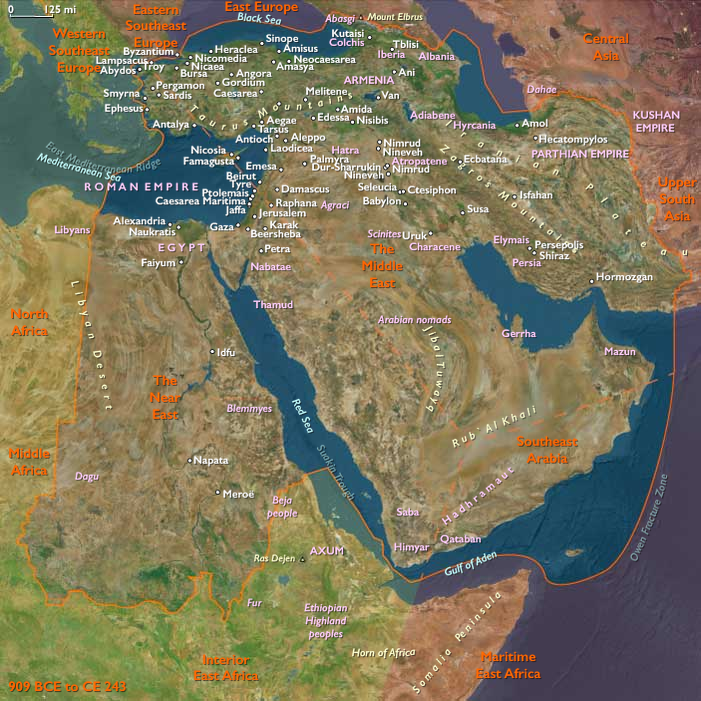
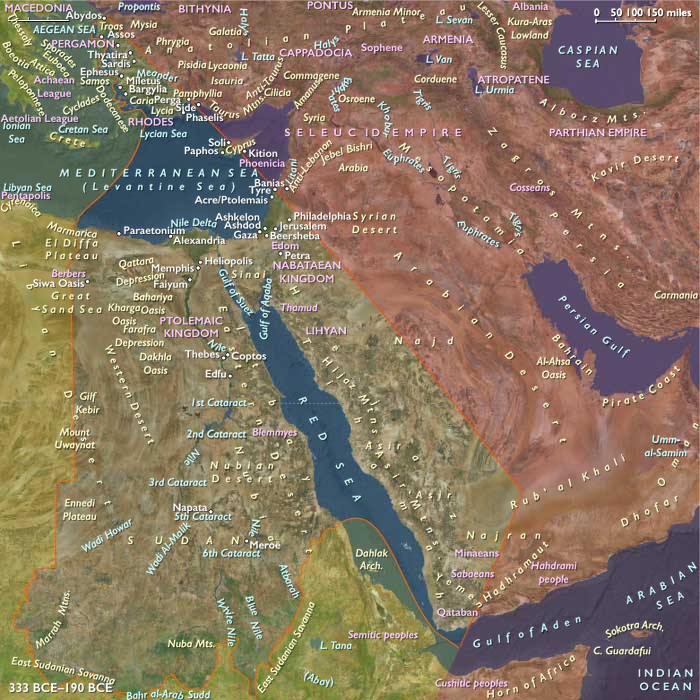
Ptolemy takes direct control of the Jewish homeland in 301 BCE, but he makes no serious effort to interfere in its religious affairs, permitting the Jews considerable cultural and religious freedom.
Jews first receive mention at the end of the fourth century from Greek writers, who praise them as brave, self-disciplined and philosophical.
Locations
People
Groups
Topics
Commodoties
Subjects
Regions
Subregions
Related Events
Filter results
Showing 10 events out of 64132 total
Lysimachus, occupied in Thrace for many years in wars against the local peoples, had taken little part in the struggles among Alexander's other successors in Greece and Asia, and only after the death of Antoginus and the routing of his forces at the Battle of Ipsus does he emerge as a power of the first rank.
He begins to consolidate his power in both Europe and Asia Minor against the threat posed by Demetrius, who retains Sidon and Tyre and command of the sea.
Seleucus had in 302 BCE joined the anti-Antigonus confederation led by Cassander and Lysimachus.
Ceding the claim on his Indian province to Chandragupta in exchange for an elephant corps, he has led his army (including the elephants) across half of Asia to link up with the coalition.
The united armies of Lysimachus and Seleucus engage the forces of Antigonus and Demetrius at Ipsus in Phrygia in 301 BCE.
Although the combined strength of Seleucus and Lysimachus in troops is only slightly inferior to the seventy thousand foot soldiers and ten thousand horses of Antigonus, it is the allies' superiority in elephants, courtesy of Seleucus, that prove invaluable for victory.
The Indian elephants prevent Demetrius, who has pursued too far after defeating the opposing cavalry, from returning to rescue his father.
The eighty-one-year-old Antigonus is killed by a javelin, Demetrius flees, and the greater part of Asia Minor is added to the European possessions of Lysimachus, who has shouldered most of the burden of the campaign.
The allied victory ends any plans the Antigonid court may have had of reuniting Alexander's empire.
Antigonus's kingdom is divided up, with most ending up in the hands of new kingdoms under Lysimachus and Seleucus.
The victors largely follow Antigonus's precedent and have themselves named as kings, but they do not claim power over the erstwhile empire of Alexander nor each other.
Instead, these kings establish a troubled (and in the end failed) modus vivendi with each other, and accept their kingdoms as separate realms.
Antigonus, successful in the field, had been unsuccessful in his diplomatic efforts to keep his enemies isolated: Cassander joins the coalition that defeats and kills Antigonus at Ipsus in 301 and confiscates much of his holdings.
Antigonus’ defeat secures Cassander's control of Macedonia.
Bands of Celts begin to penetrate southward into the Balkans at the beginning of the third century BCE.
Their superiority rests in part upon their mastery of iron technology, which they use to make both swords and plowshares.
The extent of Celtic settlement is indicated by coins, silverwork, and burial mounds.
Singidunum (now Belgrade), the name of the settlement referred to by the Romans, is partly of Celtic origin.
The northern boundary of the kingdom established in the late fourth century by Ptolemy I lies apparently slightly north of the modern Tripoli, perhaps on the course of the Kabir River.
Tripoli, founded after 700, becomes in 300 the capital of Tripolis, a Phoenician federation including Sidon, Tyre, and Aradus.
The victors divide the lands of their enemy among them, with Seleucus assuming control over Mesopotamia and Syria.
A dispute arises between Seleucus and Ptolemy, who had not taken part in the war, over Syria, particularly the southern Syrian ports, which serve as terminal points for the caravan routes.
This quarrel, however, is temporarily settled peacefully through compromise.
In addition to the southern part of Syria, Coele Syria, (Palestine), Ptolemy apparently also occupies Pamphylia, Lycia, and part of Pisidia in southern Asia Minor.
This will eventually give rise to a long series of Syrian wars between the Seleucids and Ptolemies.
For the time being, however, Seleucus declines to enforce his claim; he merely transfers his capital from Seleucia on the Tigris to …
…the newly founded city of Antioch on the Orontes (301 BCE-300 BCE).
The Arthasastra, which describes the authoritarian regime established by Chandragupta, offers advice to a ruler as to how to keep the throne.
A treatise on statecraft, economic policy and military strategy, it identifies its author by the names 'Kautilya' and 'Viṣhṇugupta', both names that are traditionally identified with the Brahmin Chāṇakya (about 350–283 BCE), who was a scholar at Takshashila and the teacher and guardian Chandragupta.
The Arthasastra will become the pattern for succeeding Indian kingdoms.
Thomas R. Trautmann and I.W. Mabbett have hypothesized that the 'Arthaśāstra' is a composition from no earlier than the second century CE, but is clearly based on earlier material.
Their explanation is that while the doctrines of the 'Arthashstra' may have been written by Chānakya in the fourth century BCE, the treatise we know today may have been edited or condensed by another author in the second century CE.
This would explain, some affinities with smrtis (Sanskrit: literally "that which is remembered," referring to a specific body of Hindu religious scripture; it is a codified component of Hindu customary law) and references in the Arthashastra that would be anachronistic for the fourth century BCE.
The Epirote king Pyrrhus, dethroned in 302 BCE by an uprising, had fought beside Demetrius in Asia and had been sent to Alexandria as a hostage under the treaty between Ptolemy and Demetrius.
Ptolemy, as a consequence of the defeats he suffered between 308 BCE and 306 BCE, now prefers to secure and expand his empire through a policy of alliances and marriages rather than through warfare.
Anxious to improve relations with Lysimachus, he concludes an alliance in 300 BCE.
The striking Temple of Apollo at Didyma, a temple within a temple that highlights the popular Ionic order, is completed around 300 BCE.
Seleucus I Nicator had brought the bronze cult image back to Didyma, the largest and most significant sanctuary on the territory of the great classical city Miletus, and the Milesians have begun to build a new temple, which, if it had ever been completed, would have been the largest in the Hellenic world.
Vitruvius records a tradition that the architects were Paeonius of Ephesus, whom Vitruvius credits with the rebuilding of the Temple of Artemis there, and Daphnis of Miletus.
The peripteral temple is surrounded by a double file of Ionic columns.
With a pronaos of three rows of four columns, the approaching visitor passes through a regularized grove formed of columns.
The usual door leading to a cella is replaced by a blank wall with a large upper opening through which one can glimpse the upper part of the naiskos in the inner court (adyton).
The entry route lies down either of two long constricted sloping passageways built within the thickness of the walls that give access to the inner court, still open to the sky but isolated from the world by the high walls of the cella: there is the ancient spring, the naiskos—which is a small temple itself, containing in its own small cella the bronze cult image of the god—and a grove of laurels, sacred to Apollo.
The cella's inner walls are articulated by pilasters standing on a base the height of a man (one point ninety-four meters).
The visitor, turning back again, sees a monumental staircase that leads up to three openings to a room whose roof is supported by two columns on the central cross-axis.
The oracular procedure, so well documented at Delphi, is unknown at Didyma and must be reconstructed on the basis of the temple's construction, but it appears that several features of Delphi were now adopted: a priestess and answers delivered in classical hexameters.
At Delphi, nothing is written; at Didyma, inquiries and answers are written; a small structure, the Chresmographion, features in this process: it will be meticulously disassembled in the Christian period.