Ptolemy IX Soter II remains entrenched in …
Years: 101BCE - 101BCE
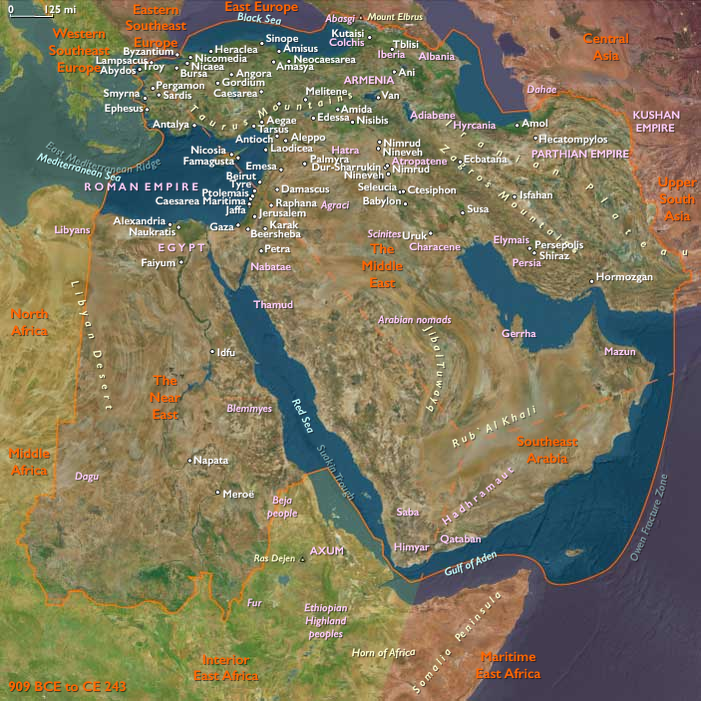
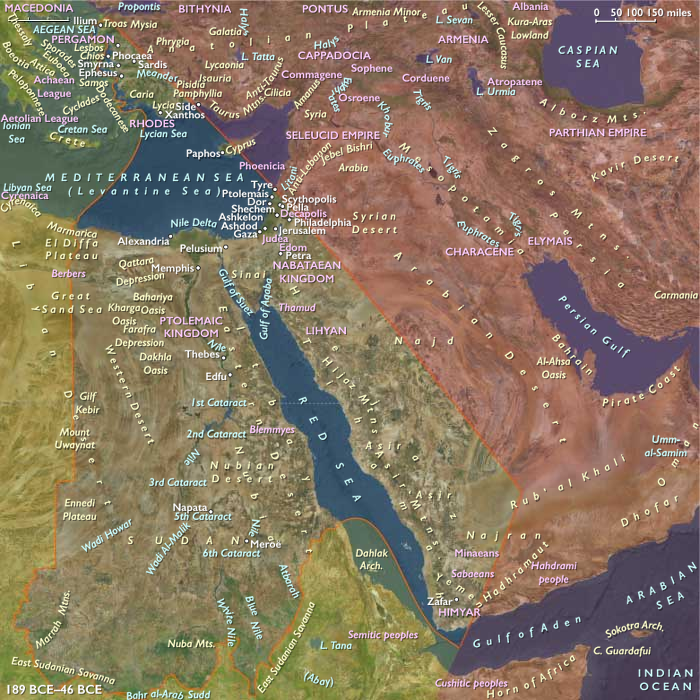
Ptolemy IX Soter II remains entrenched in Cyprus.
Locations
People
Groups
Topics
Subjects
Regions
Subregions
Related Events
Filter results
Showing 10 events out of 62877 total
Ptolemy X Alexander orders the death of his mother, Cleopatra III, in 101 BCE, and from this point rules either alone or with his niece/wife, Berenice III, the daughter of his brother Soter and either Cleopatra Selene or Cleopatra IV, who he marries following his murder of her grandmother.
The death of Cleopatra III effectively ends the protracted civil war in Syria.
Manius Aquillius, probably a son of the Manius Aquillius who was consul in 129 BCE, is a loyal follower of Gaius Marius.
During the election campaign for Marius' fourth consulship, Aquillius had been left in command of the army in case the migrating Cimbri attacked before Marius could return to command the army himself.
As a reward for his loyal services, Gaius Marius runs with Aquillius under a joint ticket for the consulship of 101 BCE.
After the consulship, with Rome struggling with famine caused by the slave revolt on Sicily, Aquillius is sent to put it down.
The Cimbri return to Gaul in 101 BCE and prepare for the final stage of their struggle with Rome.
For the first time they penetrate through the Alpine passes, which Catulus had failed to fortify, into northern Italy.
Catulus withdraws behind the Po River, leaving the countryside open to the invaders.
But the Cimbri take their time ravishing the fertile region, which gives Marius time to arrive with reinforcements—his same victorious legions from Aquae Sextiae.
At Vercellae, near the confluence of the Sesia River with the Po on the Raudine Plain, the superiority of the new Roman legions and their cavalry is clearly demonstrated.
In the devastating defeat, the Cimbri are virtually annihilated, and both their highest leaders, Boiorix and Lugius, fall.
The women kill both themselves and their children in order to avoid slavery.
Thus the war, which had begun with a mass migration, ends in defeat and mass suicide.
The Romans supposedly killed one hundred and forty thousand of the barbarian invaders, and took captive more than fifty thousand.
Sulla had served on Marius' staff as tribunus militum during the first half of this campaign, but by 101 had transferred to the army of Catulus to serve as his legatus, and is credited as being the prime mover in the defeat of the tribes (Catulus being a hopeless general and quite incapable of cooperating with Marius).
Contemporaries assign more credit for the victory to Marius than to Catulus.
Despite their joint success, the two commanders regard each other as bitter rivals and after the war build competing temples to demonstrate divine favor.
The revolt of the enslaved on Sicily has nearly managed to subdue the besieged Sicilian cities by starvation, but a second Roman army under the Roman consul Manius Aquillius succeeds in quelling the revolt, only after great effort, in 100; mopping-up operations in the so-called Second Servile War will continue until 99.
This is the second of a series of three slave revolts in the Roman Republic, fueled by the same abuse in Sicily and southern Italy.
Aquilius, having completely subdued Salvius and his insurgents, receives a triumph in Rome in 100 BCE.
Gaius Marius, having gained his sixth term as consul, has meanwhile revised the organization, training, and equipment of Roman armies by the introduction of a volunteer, semiprofessional army, its ranks open to the proletarians or common people.
With the German invaders annihilated (a third horde of barbarians has turned away without troubling Rome), the proletarian soldiers who have accomplished the task clamor for more land, but Rome’s ruling oligarchy refuses to recognize their demands.
Consequently, coalitions begin to form between destitute veterans and ambitious generals.
The popularist tribune Lucius Appuleius Saturninus and the praetor Glaucia propose and pass liberal land laws assigning land in the province of Africa to Marius’s veterans.
However, the radical nature of these bills and the forcible methods Saturninus and Glaucia have used in ensuring their passage alienate a large part of the Roman people.
Metellus Numidicus, now well established as a conservative leader in the Senate, refuses to accept Saturninus' agrarian law, and is consequently exiled from Rome.
Numidicus’ son, Quintus Caecilius Metellus, helps achieve his father’s return to Rome in about 98, earning for himself the surname Pius (which means filial devotion).
Eventually even Marius had become alienated to the legislative methods employed by Saturninus and Glaucia.
As a result Saturninus’s laws are repealed, and the Lex Caecilia Didia is introduced as an attempt to reduce hasty legislation passed in the comitia.
Put into effect by the consuls Q. Caecilius Metellus Nepos and Titus Didius in the year 98 BCE, this law has two provisions.
The first is a minimum period between proposing a Roman law and voting on it, and the second is a ban of miscellaneous provisions in a single Roman law—what might, in modern terms, be called omnibus bills.
The goal is to curb the passage of radical bills, with the assumption that the period of trinundium will give the citizens time to understand the proposed law or to be persuaded to vote against it.
The civil war in Syria, the rule of which is divided between the half-brothers and cousins Antiochus VII Grypus and Antiochus IX Cyzicenus, continues until Grypus is killed by his minister Heracleon in 96 BCE.
Later in the year, Cyzicenus is killed in battle by his half-nephew the son of Grypus, Seleucus VI Epiphanes, in revenge for his father’s death.
The kingdom of Cappadocia has maintained a faithful allegiance to Rome since the Roman victory at Magnesia in 190.
Ariarathes VII of Cappadocia had in his first years reigned under the regency of his mother Laodice, the eldest sister of the King Mithridates VI of Pontus.
During this period the kingdom had been seized by King Nicomedes III of Bithynia, who married Laodice.
Nicomedes is soon expelled by Mithridates, who restore Ariarathes to the throne, but when the latter objects to his father's assassin and ally of Mithridates, Gordius, the Pontian monarch has him killed and puts in his place a son of his as Ariarathes IX Eusebes Philopator.
Since the new king is only eight years old, he is put under the regency of Gordius.
He is early overthrown by a rebellion by the Cappadocian nobility, who replace him with Ariarathes VIII of Cappadocia, whom Mithridates promptly expels, restoring Ariarathes IX.
Mithridates is however deprived of his advantage over Nicomedes by the Roman Senate's instructions to Lucius Cornelius Sulla, as proconsul, to install a pro-Roman king here in 96.
Sulla becomes the first Roman magistrate to meet a Parthian ambassador, Orobazus, and by taking the seat between the Parthian ambassador and Ariobarzanes I of Cappadocia (the center seat being the place of honor), he seals, perhaps unintentionally, the Parthian ambassador's fate.
(Orobazus is executed upon his return to Parthia for allowing Sulla to outmaneuver him.)
It is at this meeting he is told by a Chaldean seer that he will die at the height of his fame and fortune.
This prophecy is to have a powerful hold on Sulla throughout his lifetime.
After the short period of direct Pontic rule, the brief restoration of Ariarathes VIII and an attempted instauration of a republic, Sulla seats on the throne a man chosen by the Cappadocians, who reject the idea of a Republic: the choice falls on Ariobarzanes I Philoromaios.
Supported by Sulla, Ariobarzanes will be in on-and-off control of a kingdom that is now considered a Roman protectorate.

Antiochus IX’s mother, Cleopatra Thea, upon the death of his father in Parthia and his uncle Demetrius II Nicator's return to power in 129 BCE, had sent him to Cyzicus on the Bosporus, thus giving him his nickname, Cyzicenus.
He had returned to Syria in 116 BCE to claim the Seleucid throne from his half-brother/cousin Antiochus VIII Grypus, with whom he had eventually divided Syria.
He is killed in battle by the son of Grypus, Seleucus VI Epiphanes, in 96 BCE.
Greek culture had taken root in Gaza following the siege and conquest by Alexander the Great, and the city-state has earned a reputation as a flourishing center of Hellenic learning and philosophy.
Gaza experiences another siege in 96 BCE by the Hasmonean king Alexander Jannaeus, who, after a yearlong investment, "utterly overthrew" the city, killing five hundred senators who had fled into the temple of Apollo for safety.
During the conflict, the besieged Gazans had requested help from "Aretas, King of the Arabs", but the Nabatean monarch had not come to their aid and the city is destroyed.
This victory gains the Hasmonean kingdom control over the Mediterranean outlet for the Nabataean trade routes.