
Ptolemy II Philadelphus of Egypt, not aiming …
Years: 249BCE - 249BCE
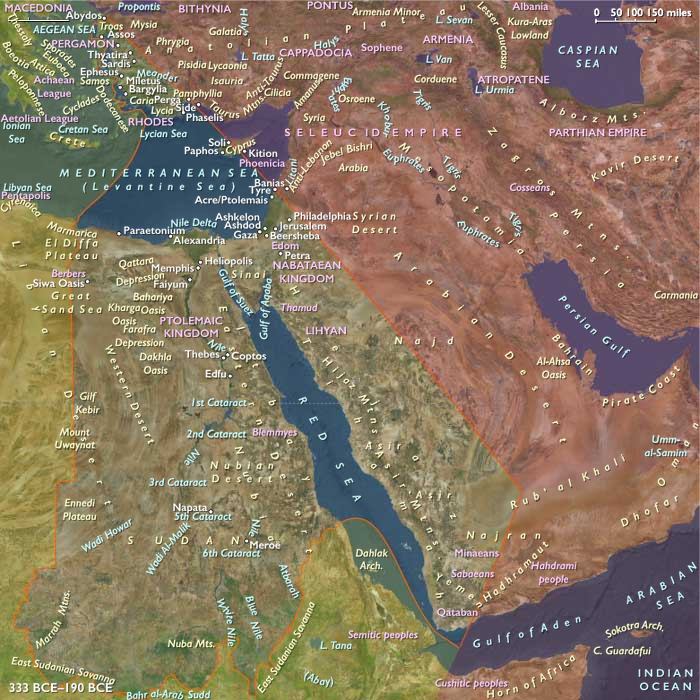
Ptolemy II Philadelphus of Egypt, not aiming at outright hegemony (even less imperialistic conquest) in the Hellenistic world of the eastern Mediterranean, has tried nonetheless to secure for Egypt as good a position as possible, holding at large his rivals beyond a wide buffer zone of foreign possessions.
Without being completely successful, he has managed to let his allies endure most of the heaviest reverses, healing his own military wounds with diplomatic remedies.
The influence on Ptolemy of his late wife and sister Arsinoe II, particularly in foreign affairs, is certainly substantial, though not as extensive as claimed by some contemporary authors.
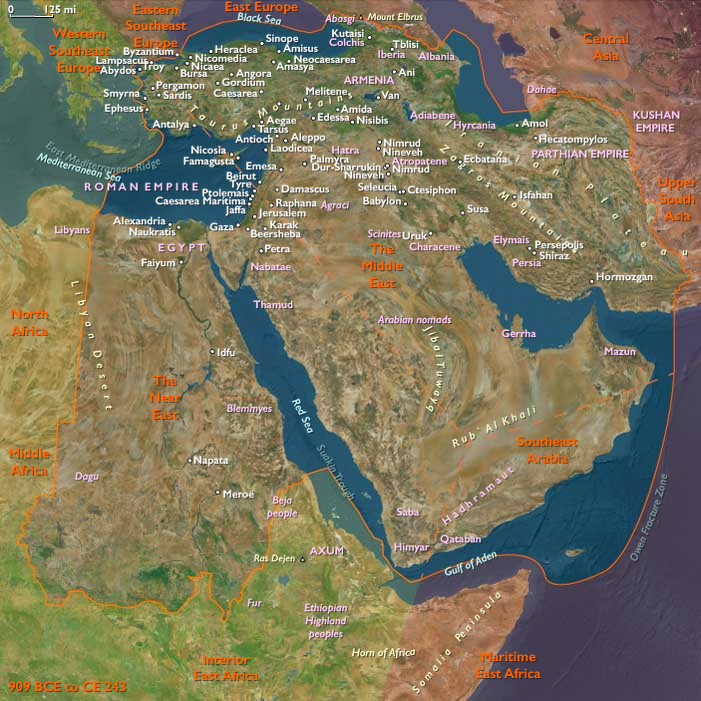
Like his father, Ptolemy II maintains an extensive empire, extending his influence into Nubia and the Arabian peninsula.
Egypt possesses Cyprus, Phoenicia, and Palestine for most of his reign, but control of Cyrenaica remains partial and intermittent.
Ptolemy further improves his position by arranging for the marriage of his son (and later successor) to the daughter of the late King Magas of Cyrene, who had proved a very troublesome neighbor before dying in 250.
Ptolemy II has enhanced the efficiency of state exploitation of Egyptian agricultural labor.
He has developed contacts with Rome, but has remained neutral in their war with Carthage.
Upon his death in 246, his son succeeds him as Ptolemy III Euergetes.
Callimachus, a Greek poet writing at the Alexandria library, produces a body of much-admired short polished, poems, famously defending his experimental style against attacks by his younger student Apollonius of Rhodes.
Due to Callimachus' strong stance against the epic, he and Apollonius—who favors epic and, using the Homerian epics as models, writes the Argonautica, the tale of Jason, Medea, and the quest for the Golden Fleece—have a long and bitter feud, trading barbed comments, insults, and ad hominem attacks for over thirty years.
The pedantic tone of the Argonautica typifies the self-conscious Alexandrian style.
Among the eight hundred volumes attributed to the versatile, productive and erudite Callimachus, of which some fragments survive, he produces a long narrative elegy (the Aetia), satires, lyrics, hymns, epigrams, and numerous scholarly prose works, including literary criticism.
Callimachus was the chief of the elegiac poets according to Quintilian (10.1.58); his elegies will be highly esteemed by the Romans and imitated by Ovid, Catullus, and especially Sextus Propertius.
Many modern classicists hold Callimachus in high regard for his major influence on Latin poetry.
His most famous prose work is the Pinakes (Lists), a bibliographical survey of authors of the works held in the Library of Alexandria.
The Pinakes is one of the first known documents that lists, identifies, and categorizes a library’s holdings.
A library patron consulting the Pinakes can find out if the library contains a work by a particular author, how it is categorized, and where it might be found.
Callimachus does not seem to have any models for his pinakes, and has invented this system on his own.
Locations
People
- Antigonus II Gonatas
- Antiochus II Theos
- Arsinoë II
- Callimachus
- Magas of Cyrene
- Ptolemy II Philadelphus
- Ptolemy III Euergetes
Groups
- Carthage, Kingdom of
- Cyrene
- Roman Republic
- Greeks, Hellenistic
- Egypt, Ptolemaic Kingdom of
- Seleucid Kingdom
Topics
Commodoties
Subjects
Regions
Subregions
Related Events
Showing 10 events out of 63859 total
Years: 249BCE - 249BCE
Locations
People
- Antigonus II Gonatas
- Antiochus II Theos
- Arsinoë II
- Callimachus
- Magas of Cyrene
- Ptolemy II Philadelphus
- Ptolemy III Euergetes
Groups
- Carthage, Kingdom of
- Cyrene
- Roman Republic
- Greeks, Hellenistic
- Egypt, Ptolemaic Kingdom of
- Seleucid Kingdom
Topics
Commodoties
Subjects
Regions
Subregions