Prussian peace with Austria forces the Italian …
Years: 1866 - 1866
August
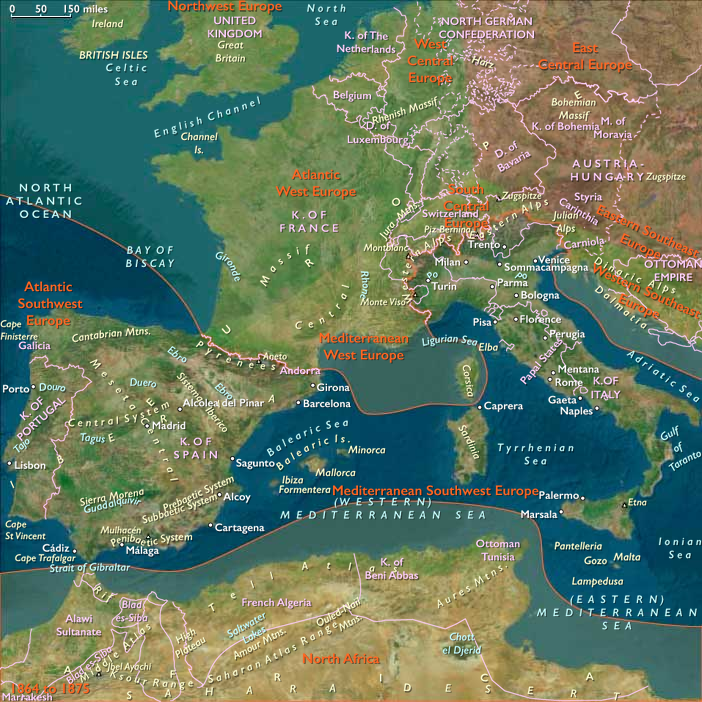
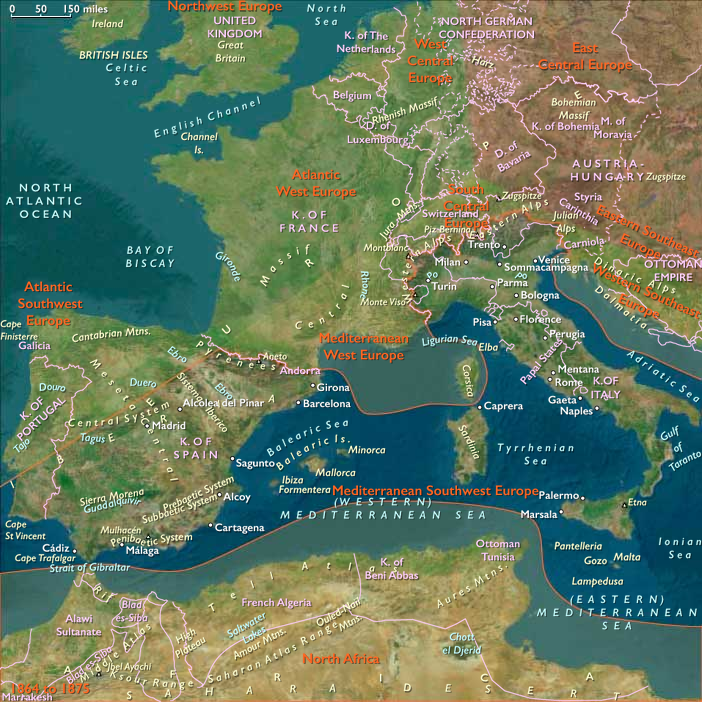
Prussian peace with Austria forces the Italian government to seek an armistice with Austria, on August 12.
Locations
People
Groups
Topics
- Italian Revolutions of 1864-1875
- Austro-Prussian War (Seven Weeks War)
- Italian War of Independence, Third
Subjects
Regions
Subregions
Related Events
Filter results
Showing 10 events out of 13367 total
Asa Mercer had decided to try again for willing brides on a larger scale in 1865, and again collected donations from willing men.
He had asked for $300 to bring a suitable wife and received hundreds of applications.
H is next trip east had gone wrong in the aftermath of Abraham Lincoln's assassination, until speculator Ben Holladay had promised to provide transport for the women.
However, the New York Herald had found out about the project and had written that all the women were destined to waterfront dives or to be wives of old men.
Authorities in Massachusetts were not sympathetic, either.
Due to the bad publicity by the time Mercer was to depart on January 16, 1866, he had fewer than one hundred recruits, when he had promised five times that many.
His ship, the former Civil War transport S.S. Continental, had sailed for the West Coast around Cape Horn.
Three months later, the ship stopped in San Francisco, where the captain had refused to go any further.
Mercer had failed to persuade him otherwise, and when he telegraphed to Washington governor Pickering to ask for more money, the governor could not afford it.
Finally, he had convinced crewmen on lumber schooners to transport them for free.
Among the financiers of the trip had been Hiram Burnett a lumber mill manager for Pope & Talbot, who is bringing out his sister and wants wives for his employees.
A few of the women had decided to stay in California instead.
When Mercer returns to Seattle, he has to answer a number of questions about his performance.
At a meeting on May 23, public dismay softens, probably because the women are with him.
Mercer ends up marrying one of the women, Annie Stephens, a week later, and most of the others find husbands as well.
A second major gold rush in the Cariboo region of the Colonial British Columbia had occurred in 1861-64, in the midst of a smaller ones, notably in the Omenica, Big Bend and on the Stikine.
The influx of gold miners into British Columbia's economy led to the creation of basic infrastructure in British Columbia, most notably, the creation of the Cariboo Wagon Road which linked the Lower Mainland to the rich gold fields of Barkerville.
However, the enormous costs of the road, and its predecessor the Douglas Road and services such as the Gold Escort, had left British Columbia in debt by the mid-1860s.
In 1866, because of the massive debt leftover from the gold rush, the mainland and Vancouver Island becomes one colony named British Columbia, with its capital in Victoria.
Growth in travel to the Hawaiian Islands increases during Kamehameha's reign.
Mark Twain, who arrives in in March 1866 aboard the Ajax, stays for four months under his real name, Samuel Clemens, writing letters back to the Sacramento Union describing the islands.
Twain describes the king: "He was a wise sovereign; he had seen something of the world; he was educated & accomplished, & he tried hard to do well by his people, & succeeded. There was no trivial royal nonsense about him; He dressed plainly, poked about Honolulu, night or day, on his old horse, unattended; he was popular, greatly respected, and even beloved." (Mark Twain (1997). Edgar Marquess Branch. ed. Mark Twain's Letters: 1872–1873. Volume 5. University of California Press. p. 565.)
Victoria adopts protectionist trade policies in 1866, followed by ...
...South Australia and ...
...Tasmania.
Hulu Klang has meanwhile enjoyed unprecedented growth due to tin mining.
Between 1849 and 1850, Raja Abdullah bin Raja Jaafar, Raja Jumaat's cousin, had been appointed by the sultan as Klang's administrator.
As Lukut's economic importance was slowly declining, that of Hulu Klang was rising.
This had attracted many laborers to relocate here, especially Chinese immigrants who had worked in Lukut.
One person responsible for persuading the Chinese to move from Lukut to Hulu Klang is Sutan Puasa from Ampang, who supplies the mining colonies in Hulu Klang with goods ranging from rice to opium.
As Hulu Klang prospers, several settlements have started to rise up by the late 1860s.
Two of them are Klang and ...
...Kuala Lumpur.
Chinese kapitan Cina Yap Ah Loy is instrumental in developing Kuala Lumpur.
As in Perak, this rapid development has attracted great interest from the British in the Straits Settlements.
King Mindon had tried to modernize the Burmese state and economy after the Second Anglo-Burmese War (1852).
His younger brother Kanaung, who had aided Mindon in the overthrow of their half-brother, Pagan, in 1854, has proved to be a great administrator and modernizer.
Mindon is dedicated to religion, but Kanaung is skillful in administration, serving as the leader of the Hluttaw, the kingdom's administrative body.
Under Kanaung's guidance, the following reforms are undertaken: centralization of the kingdom's internal administration, introduction of a salary system for the bureaucracy (to dampen the authority and income of bureaucrats), fixed judicial fees, comprehensive penal laws, reorganization of the financial system, removal of trade barriers including custom duties, reform of the thathameda taxes (to increase direct taxation), and modernization of the kingdom's army and introduction of new police forces.
Kanaung has tried to rebuild the Burmese Army with modern weapons.
He has sent men to study in Western countries to establish an up-to-date arms industry.
His efforts are well depicted in contemporary stories and poems.
One story relates to his effort in testing depth charges in order to repulse British troops sailing up the Irrawaddy.
Eventually, these tests had been thwarted by the head of the Buddhist Sangha, who had protested against them by asserting their harmful effects on aquatic lives.
Another story relates his visits to the factories on cold early winter mornings while wrapped in a blanket.
He is also known for his waywardness, as depicted in a famous love song called Seinchu Kya-nyaung bawlè written by his wife, Princess Hlaing Hteik-hkaung Tin.
In an unsuccessful palace coup by his nephews, the princes Myingun and Myinkhondaing (sons of King Mindon), Kanaung is killed at the Hluttaw, together with three of his sons, on August 2, 1866.
Nevertheless, he had managed to hold off the assassins to gain enough time for the King's escape.

Li Hongzhang succeeds Zeng Guofan in 1866 and sets up encirclement lines along the Huang Ho and the Grand Canal.
Years: 1866 - 1866
August
Locations
People
Groups
Topics
- Italian Revolutions of 1864-1875
- Austro-Prussian War (Seven Weeks War)
- Italian War of Independence, Third