
Proto-Austronesian culture is based on the south …
Years: 5085BCE - 4942BCE
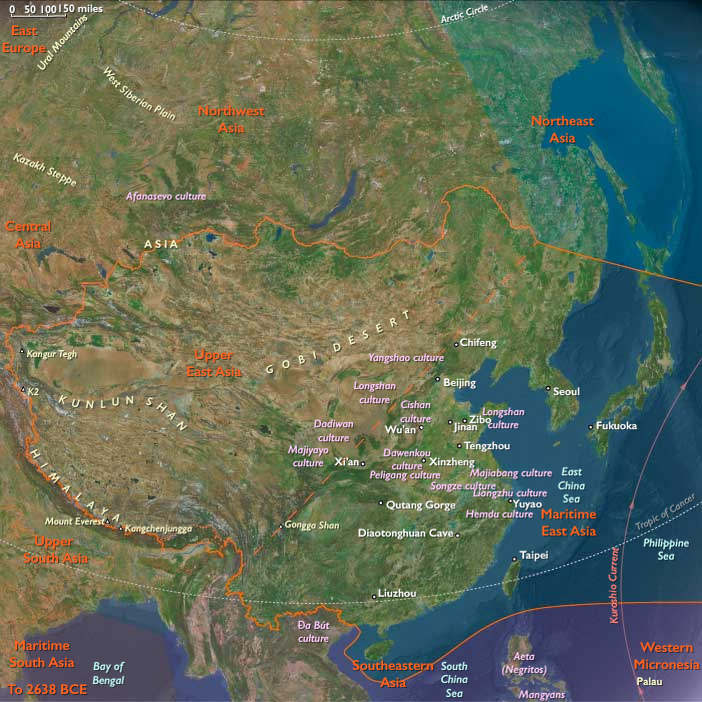
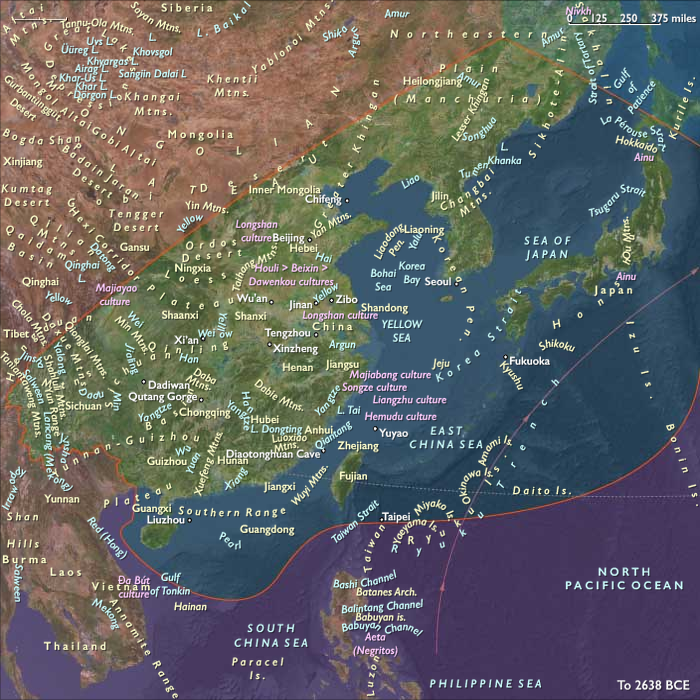
Proto-Austronesian culture is based on the south coast of China in about 5000 BCE, combining extensive maritime technology, fishing with hooks and nets, and gardening.
The protohistory of the Austronesian people can be traced farther back through time than can that of the Proto-Austronesian language.
From the standpoint of historical linguistics, the home (in linguistic terminology, Urheimat) of the Austronesian languages is the main island of Taiwan, also known as Formosa; on this island the deepest divisions in Austronesian are found, among the families of the native Formosan languages.
According to Robert Blust, the Formosan languages form nine of the ten primary branches of the Austronesian language family Blust (1999).
At least since Sapir (1968), linguists have generally accepted that the chronology of the dispersal of languages within a given language family can be traced from the area of greatest linguistic variety to that of the least.
While some scholars suspect that the number of principal branches among the Formosan languages may be somewhat less than Blust's estimate of nine (e.g., Li 2006), there is little contention among linguists with this analysis and the resulting view of the origin and direction of the migration.
For a recent dissenting analysis, see (Peiros 2004).
To get an idea of the original homeland of the Austronesian people, scholars can probe evidence from archaeology and genetics.
Studies from the science of genetics have produced conflicting outcomes.
Some researchers find evidence for a proto-Austronesian homeland on the Asian mainland (e.g., Melton et al. 1998), while others mirror the linguistic research, rejecting an East Asian origin in favor of Taiwan (e.g., Trejaut et al. 2005).
Archaeological evidence (e.g., Bellwood 1997) is more consistent, suggesting that the ancestors of the Austronesians spread from the South Chinese mainland to Taiwan at some time around eight thousand years ago.
Locations
Topics
Commodoties
Subjects
Regions
Subregions
Related Events
Showing 10 events out of 68999 total
Years: 5085BCE - 4942BCE
Locations
Topics
Commodoties
Subjects
Regions
Subregions