
Filters:
The Muslim privateer brothers Aruj and Khair …
Years: 1540 - 1683
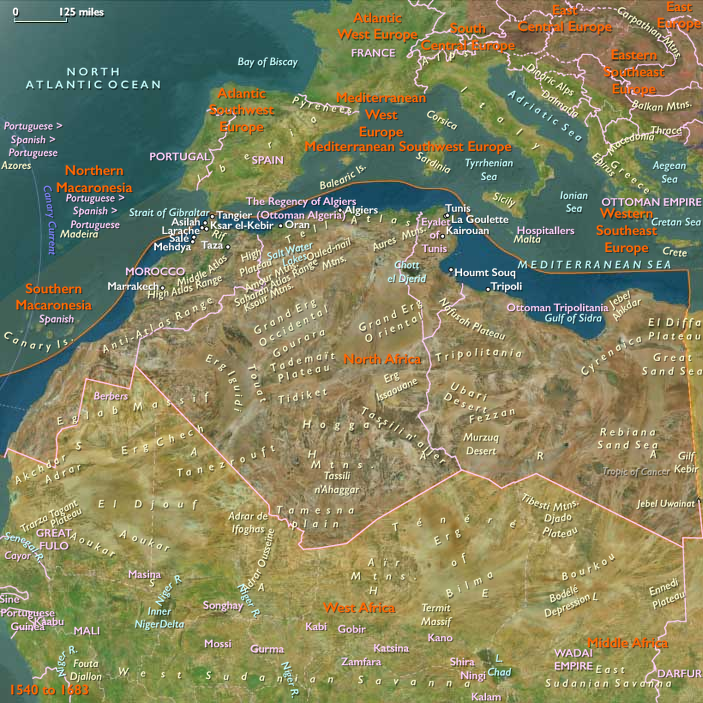
The Muslim privateer brothers Aruj and Khair ad Din—the latter known to Europeans as Barbarossa, or Red Beard—had been operating successfully off Tunisia at about the time Spain was establishing its presidios in the Maghrib.
Aruj had moved his base of operations to Algiers in 1516 but was killed in 1518.
Khair ad Din had succeeded him as military commander of Algiers, and the Ottoman sultan had given him the title of beylerbey (provincial governor)and a contingent of some two thousand janissaries, well-armed Ottoman soldiers.
With the aid of this force, Khair ad Din had subdued the coastal region between Constantine and Oran (although the city of Oran will remain in Spanish hands until 1791).
Under Khair ad Din's regency, Algiers becomes the center of Ottoman authority in the Maghreb, from which Tunis, Tripoli, and Tlemcen will be overcome and Morocco's independence will be threatened.
So successful was Khair ad Din at Algiers that he had been recalled to Constantinople in 1533 by the sultan, Suleyman I (r. 1520-66), known in Europe as Suleyman the Magnificent, and appointed admiral of the Ottoman fleet.
The next year, he mounted a successful seaborne assault on Tunis.
The next beylerbey is Khair ad Din's son Hasan, who assumes the position in 1544.
Until 1587 the area is governed by officers who serve terms with no fixed limits.
Subsequently, with the institution of a regular Ottoman administration, governors with the title of pasha rule for three-year terms.
Turkish is the official language, and Arabs and Berbers are excluded from government posts.
The pasha is assisted by janissaries, known in Algeria as the ojaq and led by an agha.
Recruited from Anatolian peasants, they are committed to a lifetime of service.
Although isolated from the rest of society and subject to their own laws and courts, they depend on the ruler and the taifa for income.
In the seventeenth century, the force numbers about fifteen thousand, but it is to shrink to only thirty-seven hundred by 1830.
Discontent among the ojaq rises in the mid-1600s because they are not paid regularly, and they repeatedly revolt against the pasha.
As a result, the agha charges the pasha with corruption and incompetence and seizes power in 1659.
The taifa has the last word, however, when in 1671 it rebels, killed the agha, and places one of its own in power.
The new leader receives the title of dey, which originated in Tunisia.
Aruj had moved his base of operations to Algiers in 1516 but was killed in 1518.
Khair ad Din had succeeded him as military commander of Algiers, and the Ottoman sultan had given him the title of beylerbey (provincial governor)and a contingent of some two thousand janissaries, well-armed Ottoman soldiers.
With the aid of this force, Khair ad Din had subdued the coastal region between Constantine and Oran (although the city of Oran will remain in Spanish hands until 1791).
Under Khair ad Din's regency, Algiers becomes the center of Ottoman authority in the Maghreb, from which Tunis, Tripoli, and Tlemcen will be overcome and Morocco's independence will be threatened.
So successful was Khair ad Din at Algiers that he had been recalled to Constantinople in 1533 by the sultan, Suleyman I (r. 1520-66), known in Europe as Suleyman the Magnificent, and appointed admiral of the Ottoman fleet.
The next year, he mounted a successful seaborne assault on Tunis.
The next beylerbey is Khair ad Din's son Hasan, who assumes the position in 1544.
Until 1587 the area is governed by officers who serve terms with no fixed limits.
Subsequently, with the institution of a regular Ottoman administration, governors with the title of pasha rule for three-year terms.
Turkish is the official language, and Arabs and Berbers are excluded from government posts.
The pasha is assisted by janissaries, known in Algeria as the ojaq and led by an agha.
Recruited from Anatolian peasants, they are committed to a lifetime of service.
Although isolated from the rest of society and subject to their own laws and courts, they depend on the ruler and the taifa for income.
In the seventeenth century, the force numbers about fifteen thousand, but it is to shrink to only thirty-seven hundred by 1830.
Discontent among the ojaq rises in the mid-1600s because they are not paid regularly, and they repeatedly revolt against the pasha.
As a result, the agha charges the pasha with corruption and incompetence and seizes power in 1659.
The taifa has the last word, however, when in 1671 it rebels, killed the agha, and places one of its own in power.
The new leader receives the title of dey, which originated in Tunisia.
Locations
People
Groups
- Arab people
- Berber people (also called Amazigh people or Imazighen, "free men", singular Amazigh)
- Jews
- Islam
- Christians, Roman Catholic
- Turkish people
- Ottoman Empire
- Morocco, Wattasid Sultanate of
- Moriscos
- Christians, New
- Spain, Habsburg Kingdom of
- Ottoman Algeria
- Morocco, Sa'di Sharifate of
- Tunis, Ottoman eyalet of
- Morocco, 'Alawi (Filali) Sultanate of
Subjects
Regions

Subregions
Years: 1540 - 1683
Locations
People
Groups
- Arab people
- Berber people (also called Amazigh people or Imazighen, "free men", singular Amazigh)
- Jews
- Islam
- Christians, Roman Catholic
- Turkish people
- Ottoman Empire
- Morocco, Wattasid Sultanate of
- Moriscos
- Christians, New
- Spain, Habsburg Kingdom of
- Ottoman Algeria
- Morocco, Sa'di Sharifate of
- Tunis, Ottoman eyalet of
- Morocco, 'Alawi (Filali) Sultanate of
Subjects
Regions
Subregions