Prince Vladimir II Yaroslavich of Halych, who …
Years: 1188 - 1188
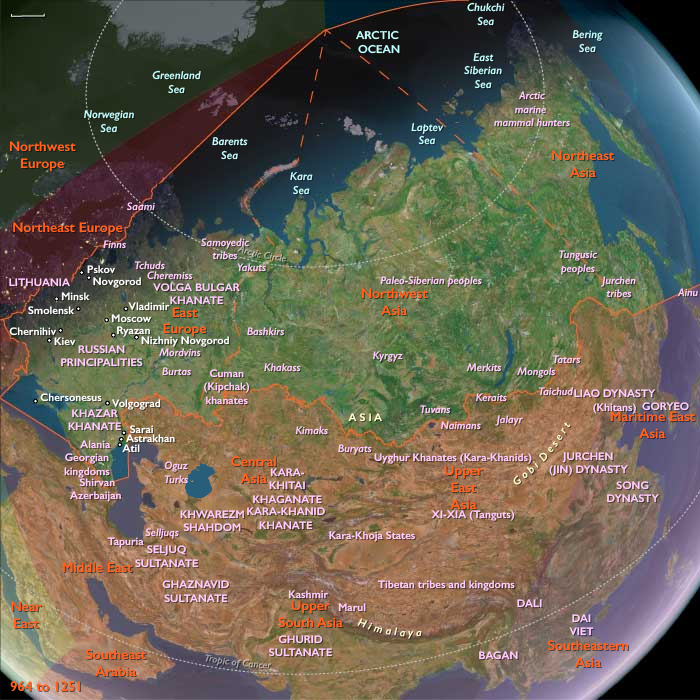
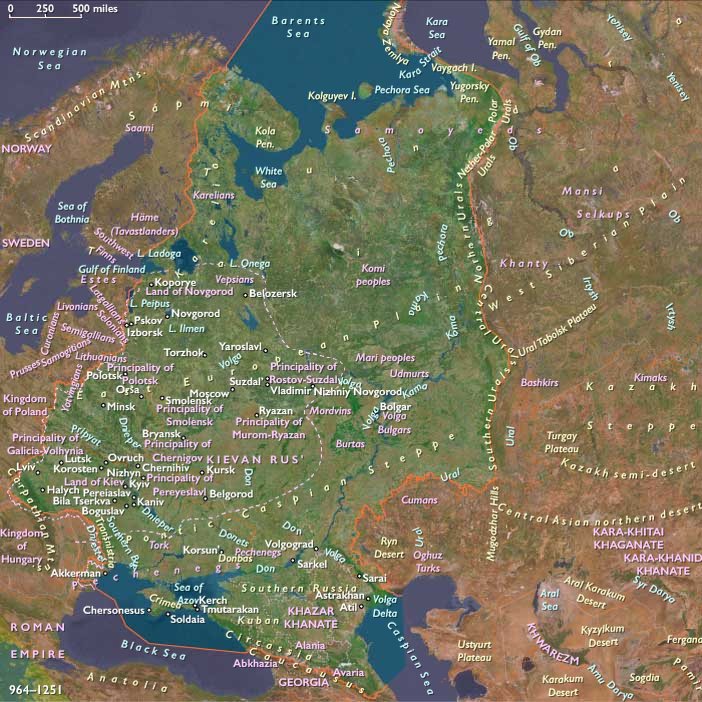
Prince Vladimir II Yaroslavich of Halych, who had been dethroned by his boyars, seeks refuge in the court of Béla III in 1188.
Béla leads his armies against Halych and occupies it, but afterwards he grants the principality to his second son, Andrew and has prince Vladimir arrested.
Locations
People
Groups
- Hungarian people
- Slavs, East
- Greeks, Medieval (Byzantines)
- Rus' people
- Hungary, Kingdom of
- Halych (Galicia), Principality of
Commodoties
Subjects
Regions
Subregions
Related Events
Filter results
Showing 10 events out of 47985 total
Bulgaria and Serbia become independent of Constantinople around 1188.
Nizami Ganjavi, an erudite recluse, draws on such earlier Persian poets as Firdawsi without imitating them.
A writer of both odes and romantic lyrics, Nezami's poems convey originality of thought as well as clarity of style.
Considered the greatest romantic epic poet in Persian literature, he is celebrated for his longer poems, including the philosophical “Treasury of Mysteries,” written in 1174-75, the romantic “Khusrau and Shirin,” written in 1180, and “Laila and Majnun,” written in 1188.
Croatia and parts of Dalmatia fall in 1188 to the Hungarians after seven years of war with Venice.
Hungary and Venice cease hostilities in 1188.
The Hungarians have been only partly successful, managing to retake Zadar and a few other Venetian-held cities along the coast.
The Birth and Struggles of Alfonso IX of León (1171–1188)
Alfonso IX of León was born in 1171 in Zamora, the only son of King Ferdinand II of León and Urraca of Portugal. His father, Ferdinand II, was the younger son of Alfonso VII of León and Castile, who had divided his vast realm between his sons—a decision that sowed long-standing conflicts between León and Castile. These rivalries persisted for decades, until the eventual reunification of the kingdoms under Alfonso IX’s son, Ferdinand III of Castile.
Upon Ferdinand II’s death in 1188, Alfonso IX faced significant obstacles in securing his throne. His cousin, Alfonso VIII of Castile, sought to assert dominance over the newly crowned monarch, demanding that the young king recognize Castile’s overlordship in exchange for being recognized as the rightful ruler of León. Pressured by Castile’s superior military and political power, Alfonso IX was forced to accept this arrangement in July 1188.
Economic Struggles and the Cortes of León (1188)
At the start of his reign, Alfonso IX faced severe economic difficulties, which led him to increase taxes on the lower classes. The resulting social unrest triggered protests and urban revolts, pushing the young king to seek a political solution.
In response, Alfonso IX convened the Cortes of León at the Basilica of San Isidoro in 1188, bringing together an assembly of nobles, clergy, and representatives from various cities. This Cortes was unprecedented in medieval Europe, as it provided a framework for greater oversight of royal expenditures and citizen representation in governance.
The First Parliament in Western Europe
The 1188 Cortes of León is widely regarded as the first parliamentary body in Western Europe to include full representation of the citizenry, preceding the first session of the English Parliament, which would not be convened until the 13th century. The principles established in this early Cortes influenced the development of representative institutions across the Iberian Peninsula and beyond, shaping the political evolution of medieval Spain.

The Death of Ferdinand II of León (1188)
In January 1188, while returning from a pilgrimage to Santiago de Compostela, King Ferdinand II of León died in Benavente. His journey to the shrine of Saint James, one of the most revered pilgrimage sites in medieval Christendom, was part of a long tradition of royal devotion to the apostle Santiago, the patron saint of Iberian Christian kingdoms.
Following his death, Ferdinand II was buried in the Cathedral of Santiago de Compostela, resting alongside other Leonese monarchs. His passing marked the end of a reign defined by territorial conflicts, shifting alliances, and ongoing struggles with both Portugal and Castile. His son and successor, Alfonso IX, inherited a kingdom still entangled in dynastic rivalries and political challenges.
The Cathedral of Tournai and the City’s Transition to Royal Authority (1187–1188 CE)
By 1187, the city of Tournai had successfully asserted its independence from its former feudal overlords, becoming directly subordinated to the French Crown as the Seigneurie de Tournaisis. This transition strengthened Capetian control in the region, making Tournai a key royal stronghold in Flanders.
At the same time, the city's ambitious architectural projects—including the ongoing construction of the Cathedral of Our Lady and the beginning of the belfry in 1188—reflected its growing autonomy and civic identity.
The Cathedral of Our Lady of Tournai
- Construction on Tournai’s cathedral began in the 12th century, built on the foundations of earlier religious structures.
- It occupies rising ground near the south bank of the Scheldt, a river that divides Tournai into two equal parts, reinforcing its central presence in the city.
- The nave, constructed primarily in the first third of the 12th century, features a heavy Romanesque style using local blue-gray stone, giving it a severe, fortress-like appearance.
- It incorporates a second-tier gallery between the ground-floor arcade and the triforium, prefiguring Early Gothic architecture.
The Transept and Towers
- The transept arms, built around the mid-12th century, end in apses, a design likely influenced by Rhenish (German) churches.
- This feature later influenced northeast French cathedrals, such as Noyon and Soissons.
- The massive square towers that flank the transept arms rise 83 meters (272 feet) high.
- Architectural details blend round-arched Romanesque and early pointed Gothic elements, showing stylistic transition during construction.
Construction of the Belfry (1188)
- In 1188, King Philip II Augustus granted Tournai its town charter, recognizing the city’s newly won independence.
- Among the privileges granted was the right to mount a communal bell, marking the beginning of the belfry’s construction.
- The belfry’s original form resembled a feudal keep, featuring:
- A square cross-section.
- A crenelated parapet.
- Use as a watchtower for spotting fires and enemy movements.
Significance of These Developments
- Tournai’s transition to direct Capetian rule (1187) strengthened French influence in northern Flanders, an area historically contested with the Counts of Flanders and the Holy Roman Empire.
- The Cathedral of Our Lady and the belfry’s construction reinforced Tournai’s status as a major religious and civic center in medieval France.
- The evolution of Tournai’s cathedral mirrored broader architectural shifts from Romanesque to Gothic, marking it as a pioneering structure in northern France.
Through these political and architectural transformations, Tournai emerged as a key royal and religious stronghold, bridging the artistic, cultural, and military dynamics of 12th-century France and Flanders.
Richard FitzNeal, named Treasurer of the Exchequer of England, begins writing a handbook for the division, his Dialogus de Scaccario.
It will describe the organization of personnel, the duties of each, how to audit sheriff's accounts at Easter and Michaelmas, how to value coinage, and how to draw up receipts.
Archbishop Joscius and the Call for the Third Crusade at Gisors (January 1188)
In January 1188, Archbishop Joscius of Tyre, traveling from Italy to France, arrived at Gisors, where he met with Henry II of England, Philip II of France, and Philip, Count of Flanders. By this time, news of the disastrous Christian defeat at the Battle of Hattin (1187) had already spread, and Richard, Count of Poitou (later Richard I, the Lionheart), had vowed to go on crusade.
Joscius’ Role at Gisors
-
Mediating Peace Between Henry II and Philip II
- At the time, Henry II and Philip II were engaged in ongoing conflicts over French territories.
- Joscius successfully negotiated a temporary peace, allowing both kings to focus on the Crusade rather than their rivalry.
-
Convincing Monarchs to Take the Cross
- Joscius urged Henry II, Philip II, and Philip of Flanders to take the cross, committing themselves to the Third Crusade.
- His appeal was successful, and the event marked the official launch of the Capetian-Plantagenet participation in the Crusade.
The Saladin Tithe and Its Possible Origins
- In response to the need for funding the Crusade, Henry II instituted the Saladin Tithe, a special tax levied in England to finance the expedition.
- The tax may have been inspired by the 1183 tax in Jerusalem, which had been imposed to strengthen the city's defenses against Saladin.
- It is likely that Joscius, having firsthand knowledge of the situation in the Holy Land, informed Henry about this precedent during the Gisors meeting.
Mistaken Attribution of the Archbishop at Gisors
- Some later chroniclers, including Matthew Paris, mistakenly claimed that the archbishop present at Gisors was William of Tyre.
- However, William had already retired from active diplomacy by this time, and it was Joscius of Tyre who played the key role in securing Western European participation in the Crusade.
Significance of the Meeting at Gisors
- The 1188 council at Gisors marked a crucial turning point in the preparations for the Third Crusade (1189–1192).
- Joscius’ diplomatic efforts united England and France under the Crusader cause, even if their cooperation remained tense and fragile.
- The Saladin Tithe became one of the earliest examples of a centralized tax system in England, showing how the Crusades influenced European financial administration.
Though the Crusade itself would be plagued by tensions between Richard and Philip, the diplomatic success at Gisors ensured that both England and France would play leading roles in the campaign to recover Jerusalem.
Gregory VIII had meanwhile sent a legation to the emperor, who is now nearly in his mid-sixties and approaching the end of an eventful career, which has included a protracted controversy with the papacy.
Nevertheless, Frederick has made peace with the church, had participated in the Second Crusade, and for some time has been genuinely desirous of taking the cross again.
Years: 1188 - 1188
Locations
People
Groups
- Hungarian people
- Slavs, East
- Greeks, Medieval (Byzantines)
- Rus' people
- Hungary, Kingdom of
- Halych (Galicia), Principality of