Prince Carol, who had served as an …
Years: 1869 - 1869
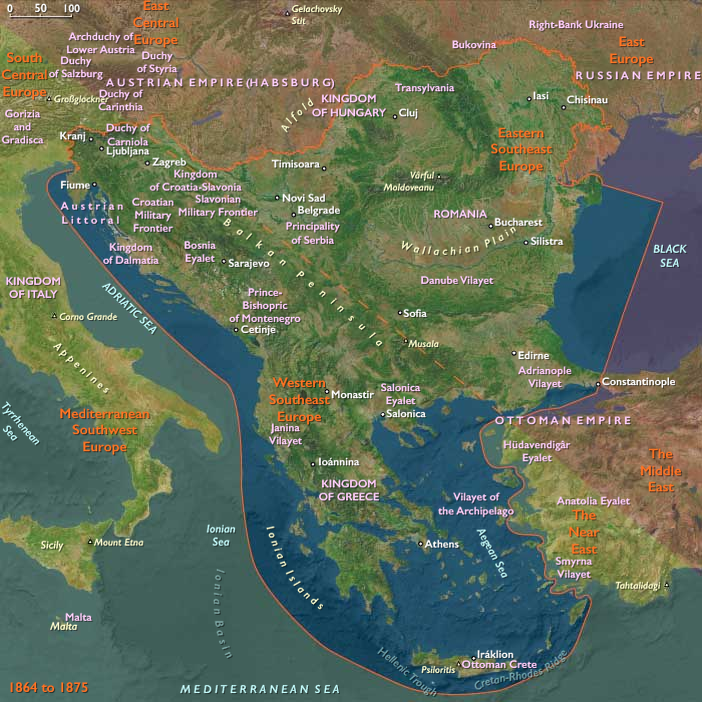
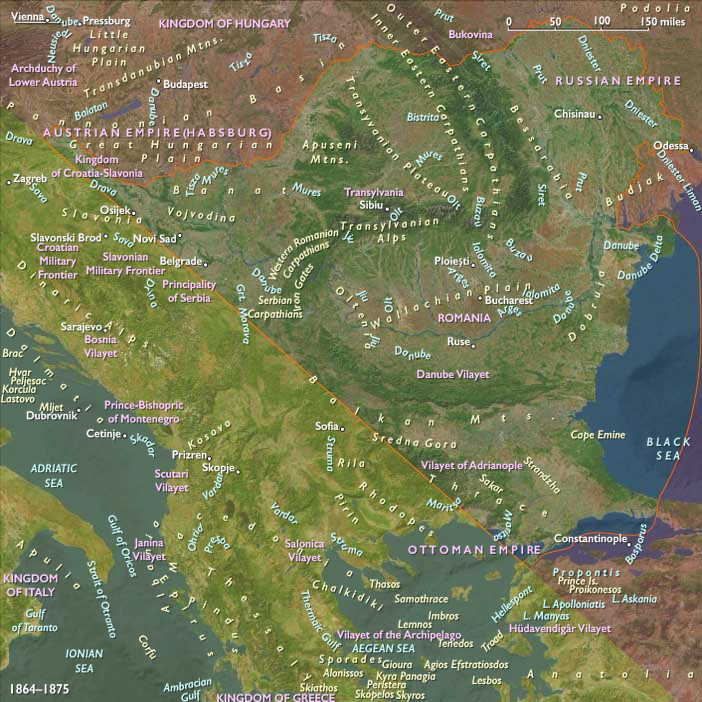
Prince Carol, who had served as an officer in the Prussian Army and experienced combat in Denmark in 1864, has continued the military development initiated by Cuza; the army built by Cuza and Carol will play a decisive role in achieving full independence and sovereignty for Romania.
In 1869, Karl marries the princess Elizabeth of Wied (who will later gain fame as the poetess Carmen Sylva).
The Bucharest–Giurgiu line, on which construction had begun in September 1965 by the English company John Trevor-Barkley, is opened to traffic on August 26, 1869.
Commissioned by the King of Romania, it is the first railway built on Romanian territory.
Locations
People
Groups
Topics
Subjects
Regions
Subregions
Related Events
Filter results
Showing 10 events out of 12937 total
Gold is discovered southeast of Darwin in the Pine Creek area, resulting in the establishment, in 1869, of Port Darwin, Northern Australia’s first permanent settlement.
Dmitri Mendeleev writes the definitive textbook of his time: Principles of Chemistry (two volumes, 1868–1870).
In his attempts to classify the elements according to their chemical properties after becoming a teacher, he had noticed patterns that lead him to postulate his periodic table of the elements.
Mendeleev is unaware of the earlier work on periodic tables going on in the 1860s.
On March 6, 1869, Mendeleev makes a formal presentation to the Russian Chemical Society, entitled The Dependence between the Properties of the Atomic Weights of the Elements, which describes elements according to both atomic weight and valence.
This presentation states that the elements, if arranged according to their atomic weight, exhibit an apparent periodicity of properties.
Elements that are similar regarding their chemical properties have atomic weights which are either of nearly the same value (e.g., Pt, Ir, Os) or which increase regularly (e.g., K, Rb, Cs).
The arrangement of the elements in groups of elements in the order of their atomic weights corresponds to their so-called valencies, as well as, to some extent, to their distinctive chemical properties; as is apparent among other series in that of Li, Be, B, C, N, O, and F.
The elements which are the most widely diffused have small atomic weights.
The magnitude of the atomic weight determines the character of the element, just as the magnitude of the molecule determines the character of a compound body.
We must expect the discovery of many yet unknown elements–for example, two elements, analogous to aluminum and silicon, whose atomic weights would be between 65 and 75.
The atomic weight of an element may sometimes be amended by a knowledge of those of its contiguous elements.
Thus the atomic weight of tellurium must lie between 123 and 126, and cannot be 128.
Here Mendeleev seems to be wrong, as the "atomic mass" of tellurium (127.6) remains higher than that of iodine (126.9) as displayed on modern periodic tables, but this is due to the way atomic masses are calculated, based on a weighted average of all of an element's common isotopes, not just the one-to-one proton/neutron-ratio version of the element to which Mendeleev was referring.
Certain characteristic properties of elements can be foretold from their atomic weights.
Mendeleev publishes his periodic table of all known elements and predicts several new elements to complete the table.
Only a few months after, Lothar Meyer publishes a virtually identical table.
Some consider Meyer and Mendeleev the co-creators of the periodic table.
There were fifty-six known elements in 1863, with a new element being discovered at a rate of approximately one per year.
Other scientists had previously identified the periodicity of elements.
John Newlands had described a Law of Octaves, noting their periodicity according to relative atomic weight in 1864, publishing it in 1865.
His proposal had identified the potential for new elements such as germanium.
The concept had been criticized and his innovation will not be not recognized by the Society of Chemists until 1887.
Another person to propose a periodic table had been Lothar Meyer, who had published a paper in 1864 describing twenty-eight elements classified by their valence, but with no prediction of new elements.

The heavily plotted novels of Lithuanian novelist Abraham Mapu, influenced stylistically by Victor Hugo and Eugène Sue, romanticize a sovereign Israel and indirectly pave the way for the revival of Jewish nationalism and the Zionist movement.
His second novel, Ashmat Shomron (Guilt of Samaria, 1865), is a biblical epic about the hostility between Jerusalem and Samaria in the time of King Ahaz.
His third, Ayit tzavua' (The Hypocrite; 1858-69), marks a departure.
Dealing with contemporary life in the ghetto and attacking its social evils, it portrays a new type, the maskil (possessor of Haskala), in a fight against orthodox obscurantism.
Another novel, Hoze hezyono (The Visionary; 1869), an exposé of Hasidism, is confiscated by religious authorities.
The Rotes Rathaus (Red City Hall), the town hall of Berlin, located in the Mitte district on Rathausstraße near Alexanderplatz and built between 1861 and 1869 in the style of the north Italian High Renaissance by Hermann Friedrich Waesemann, is modeled on the Old Town Hall of Toruń, today Poland, while the architecture of the tower is reminiscent of the cathedral tower of Notre-Dame de Laon in France.
It replaces several individual buildings dating from the Middle Ages.
It occupies an entire city block today, as the home to the governing mayor and the government (the Senate of Berlin) of the Federal state of Berlin.
Political parties emerge in Serbia after 1868, and aspects of Western culture begin to appear.
The Russian administration in Moldavia, held by Russia from 1812, had at first been liberal.
Autonomy had been granted in 1818 and had remained in force until 1828; a Moldavian boyar had been made governor and a Moldavian archbishop installed.
Nevertheless, many Moldavian peasants, fearing the introduction of serfdom, had fled across the Prut River.
The introduction of the zemstvo system in 1869 provides a measure of local autonomy, but ...
....a policy of Russification in both civil and ecclesiastical administration will be hereafter pursued, with little effect on the largely illiterate peasantry.
The British wish to maintain security on the route from Europe to India so that merchants can safely send goods between India and the gulf.
Britain also seeks to exclude the influence in the area of other powers, such as Turkey and France.
East-West trade through the Persian Gulf dries up in 1869 after the opening of the Suez Canal, which provides a direct route to the Mediterranean Sea.
The monsoon of 1868 had been late in coming and, moreover, when it did come, had been light and brief, lasting until only August 1868.
There is shortage of fodder in most areas of Rajputana, and some areas have water shortage as well.
Since the much needed grain can be brought in only on slow camel trains, the stricken areas are more or less inaccessible.
British authorities, having been criticized for the badly bungled relief effort during the Orissa famine of 1866, had begun to discuss famine policy soon afterwards.
The Government of British India organizes famine relief works in the British territory of Ajmer and in neighboring Agra Province of British India.
Many inhabitants of the famine-stricken regions of Rajputana (for example, two-thirds of the population of Marwar) emigrate with their livestock or herds.
Initially, however, they do not go to Ajmer, where relief works have been arranged; many wander in search of food until they die from starvation.
Late in 1868, epidemics of cholera had broken out among the vulnerable population, and there is no harvest in the spring of 1869.
In May 1869, many villagers, who had emigrated earlier, now return to their villages believing that the rains this year will be early.
However, the rains hold off until mid-July, and, in the interim, many thousands more die of starvation.
Even so, the autumn harvest promises to be abundant; however, swarms of locusts descend upon the fields and destroythe young crops.
In September and October 1869, there are heavy rains, which, although good for the spring harvest, cause an epidemic of malaria and kills many more.
In Ajmer, Rs.
49 lakhs are spent in the relief effort, Rs.
5 lakhs in revenue remission, and Rs.
21 lakhs in a new scheme for agricultural credit.
In Agra, another Rs.
30 lakhs are spent in relieving 29 million units (i.e.
one person for one day).
The princely states of Rajputana, however, provide very little relief: only Udaipur State spends Rs.
5 lakhs.
Consequently, the immigration from the princely states into British India in the later stages of the famine begins to overwhelm British efforts, and, in spite of Sir William Muir's newly defined responsibility for each district officer, the resulting mortality is great.
It is thought that over 1.5 million people have died all over Rajputana during the famine.
Sher Ali's return, and a general rising in his favor towards the end of 1868, had resulted in the defeat of Abdur Rahman and Azam Khan at Tinah Khan on January 3, 1869.
Both seek refuge in Persia, Abdur Rahman eventually placing himself under Russian protection at Samarkand.
Azam dies in Persia in October 1869.