Juan Prim's death has deprived Amadeo of …
Years: 1872 - 1872
April
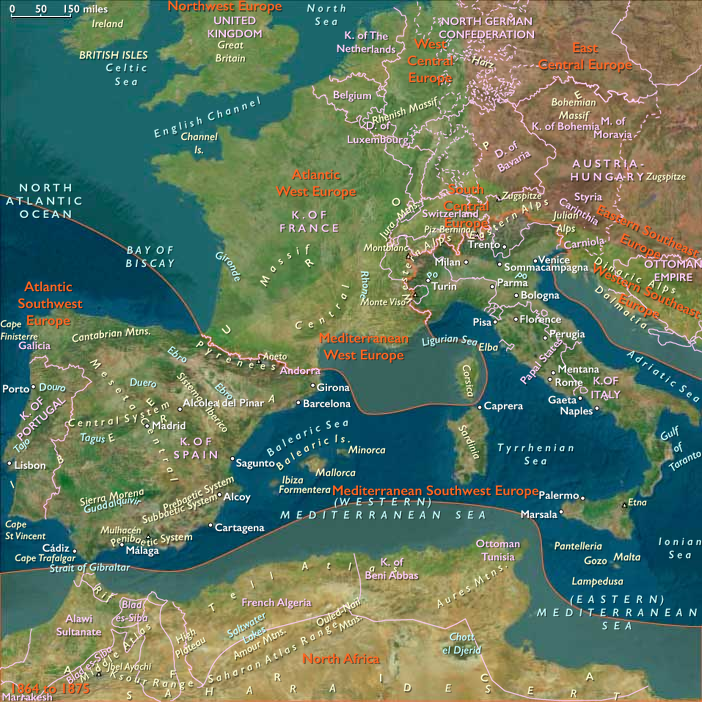
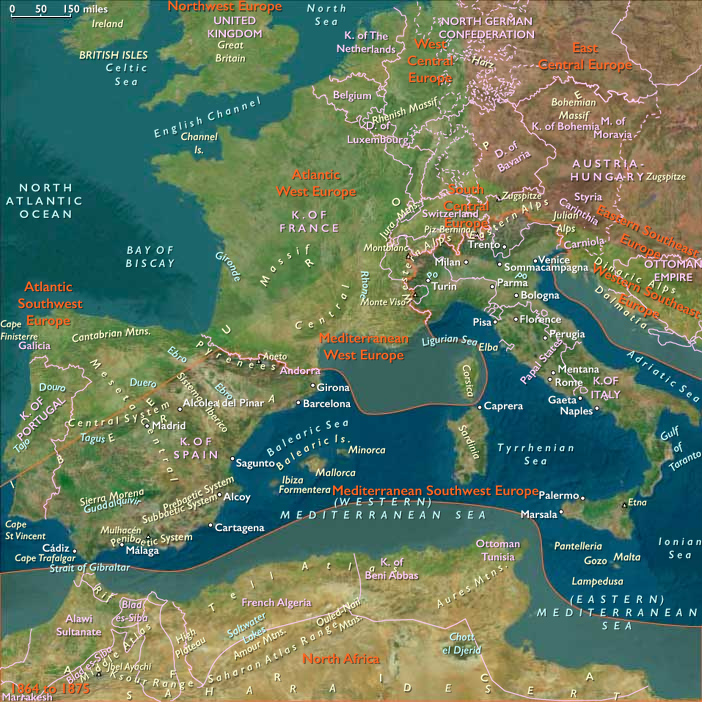
Juan Prim's death has deprived Amadeo of a staunch supporter.
Bereft of Prim's help and feebly served by a series of short-lived ministries, Amadeo faces continuous turmoil.
He attempts to rule as a constitutional monarch but, opposed both by Republicans and by Carlists, he can form no stable government from the “September coalition” of former conservative Liberal Unionists, the ex-Progressives, and the moderate Democrats—now called Radicals.
Once Amadeo calls the Radicals to power, the conservatives desert the dynasty.
Support for Alfonso, the grandson of Don Carlos, increases, along with republican agitation, and the Second Carlist War beaks out in 1872.
Locations
People
Groups
Topics
Commodoties
Subjects
Regions
Subregions
Related Events
Filter results
Showing 10 events out of 12640 total
The firm of Hutchison, Kohl and Company, including Hayward Hutchison, William Kohl, and Louis Sloss, had bought the Russian-American Company after the 1867 purchase of Alaska by the United States.
In 1868, Sloss, Lewis Gerstle, and A. Wassermann had bought this company, although Hutchison, Kohl & Company is in simultaneous existence and under the same ownership until 1872, when the new company pays off the purchase.
This new company, formed in 1868, is called the Alaska Commercial Company.
As he lay bedstricken, he had answered those that come to visit him: "The Good Lord cannot take me today, today is my birthday".
He is buried in the Royal Mausoleum of Hawaii known as Mauna ʻAla.
He is the last ruling monarch of the House of Kamehameha.
Kamehameha's sister and only named Heir Apparent to the throne, Crown Princess Victoria Kamāmalu, had died childless in 1866 and through the remainder of his reign, Kamehameha V had not named a successor.
According to his Constitution of 1864, Article 24: "The Crown is hereby permanently confirmed to His Majesty Kamehameha V, and to the Heirs of His Body Lawfully Begotten, and to their Lawful Descendants in a Direct Line..."
The legislature, choosing to use a later part of that same article to select a new king, declares an election for the office.
Located on the corner of Hotel Street and Richards Street in Honolulu, the hotel had been proposed in 1865 but not laid down until 1871.
Queen Victoria had send her second son Alfred, Duke of Saxe-Coburg and Gotha, on a state visit to Hawaii in 1869.
With these visitors have come envoys, politicians and merchants, creating the need for hotels.
Kamehameha had appealed to Kaiser Wilhelm I of Germany, who loans Henri Berger, a member of Germany's imperial army band, from his Potsdam station to organize the Royal Hawaiian Band, a gift of music from the king to his people.
The Maoris lose their independence and much of their land after government forces finally defeat the insurgent Maoris in 1872.
In separate expeditions, Ernest Giles and William Gosse are the first European explorers to this area.
While exploring the area in 1872, Giles sights Kata Tjuta from a location near Kings Canyon and calls it Mount Olga, while the following year Gosse observes Uluru and names it Ayers Rock, in honor of the Chief Secretary of South Australia, Sir Henry Ayers.
These barren desert lands of Central Australia disappoint the Europeans as unpromising for pastoral expansion, but will later come to be appreciated as emblematic of Australia.
Giles doesn't attempt a regular exploring expedition until 1872, when with two other men he leaves Chambers pillar, South Australia (now in the Northern Territory), around the middle of August and traverses much previously untrodden country to the northwest and west.
Finding their way barred by Lake Amadeus, a huge salt lake in the southwest corner of Australia's Northern Territory, about 50 km north of Unluru (Ayers Rock), and that their horses are getting very weak, a return is made to the Finke River and thence to Charlotte Waters and Adelaide, where Giles will arrive in January 1873.
He will look upon his expedition as a failure, but he had done well considering the size and equipment of his party.
Giles is supposedly the first European to sight the huge freestanding multicolored monolith rising above the flat plain of central Australia, but is beaten to the claim by a competing explorer, William Gosse. (The rock, sacred to the region’s Aborigines as Uluru, is given its European name in honor of former South Australian premier Sir Henry Ayers.)
Ernest Giles was born in Bristol, England, son of William Giles, a merchant, and Jane Elizabeth, née Powell, and had been educated at Christ's Hospital school, Newgate, London.
At the age of fifteen, he had emigrated to Australia, joining his parents, and had taken up residence in Adelaide, South Australia.
In 1852, Giles had gone to the Victorian goldfields, then became a clerk at the Post Office in Melbourne, and later at the County Court.
Soon tiring of town life, Giles had gone to the back country and obtained valuable experience as a bushman.
Their leader is Fernando La Madrid, a mestizo Sergeant.
They seize Fort San Felipe in Cavite and kill eleven Spanish officers.
The mutineers think that soldiers in Manila will join them in a concerted uprising, the signal being the firing of rockets from the city walls on that night.
Unfortunately, what they think to be the signal is actually a burst of fireworks in celebration of the feast of Our Lady of Loreto, the patron of Sampaloc.
News of the mutiny reaches Manila, and the Spanish authorities fear a massive Filipino uprising.
The next day, a regiment led by General Felipe Ginoves besieges the fort until the mutineers surrender.
Ginoves then orders his troops to fire at those who had surrendered, including La Madrid.
In the aftermath of the mutiny, all Filipino soldiers are disarmed and later sent into exile in Mindanao.
Those suspected of supporting the mutineers are arrested and executed.
The mutiny is used by the Spanish colonial government and Spanish friars to implicate three Filipino priests, Mariano Gómez, José Burgos and Jacinto Zamora, collectively known as Gomburza, and other Filipino leaders.
These executions, particularly those of the Gomburza, are to have a significant effect on people because of the shadowy nature of the trials.
Jose Rizal dedicates his work, El filibusterismo, to the executed priests.
On January 27, 1872 Governor-General Rafael Izquierdo approves the death sentences on forty-one of the mutineers.
On February 6, eleven more are sentenced to death, but these are commuted to life imprisonment.
Others are exiled to Guam.
The most important group will create a colony of Filipino expatriates in Europe, particularly in Madrid and Barcelona, where they will be able to create small associations and print publications that are to advance the claims of the Philippine Revolution.
The primary cause of the Cavite mutiny is believed to be an order from Governor-General Rafael de Izquierdo to subject the soldiers of the Engineering and Artillery Corps to personal taxes, from which they had previously been exempt.
The taxes require them to pay a monetary sum as well as to perform forced labor called, "polo y servicio."

Tengku Kudin brings in five hundred soldiers from Kedah along with mercenaries and European officers from the Straits Settlements during the course of the the Klang War.
Sultan Abdul Samad also provides the revenues of Kuala Langat to Tengku Kudin to help him fund the handling of the war.
Tengku Kudin in turn engages the help of Pahang in 1872, as well as mercenaries supplied by Sir harry Ord.
This marks the first British involvement in local Malayan politics.
Japan introduces universal military services and smallpox vaccination in 1872.
Industrialization had come to Denmark in the second half of the nineteenth century.
The nation's first railroads had been constructed in the 1850s, and improved communications and overseas trade have allowed industry to develop in spite of Denmark's lack of natural resources.
Trade unions develop starting in the 1870s.
There is a considerable migration of people from the countryside to the cities, and Danish agriculture becomes centered around the export of dairy and meat products.
The two concepts of internationalism and nationalism have become very much part of the history of the Danish labor movement, which gathers momentum when social issues become associated with internationalism.
Socialist theory and organizational contact with the First International, which links labor movements in various countries, has paved the way, and Louis Pio has merged as the driving force.
In 1871, following the bloody defeat of the Paris Commune, he had begun publishing socialist journalism.
Campaigning strongly for an independent organization of the workers under their own management, he has organized a Danish branch of the First International.
This becomes the foundation stone for the Social Democratic Party under the name of Den Internationale Arbejderforening for Danmark (The International Labor Association for Denmark).
As a combination of union and political party, it adroitly brings together national and international elements.
Pio sees internationalism as vital for the success of the workers' struggle: without internationalism, no progress.
He points out that the middle classes cooperate across national frontiers and use nationalistic rhetoric as a weapon against the workers and their liberation.
The Danish section starts organizing strikes and demonstrations for higher wages and social reforms: moderate demands, but sufficient to provoke the employers and the forces of law and order.
Things come to a head in the Battle of Fælleden on May 5, 1872.
The authorities arrest the three leaders, Louis Pio, Poul Geleff and Harald Brix, charge them with calling a public workers' meeting, in defiance of a government prohibition against such meetings, and convict them of high treason.
Widespread disturbances had followed their arrest.
Pio, sentenced to five years imprisonment, will be cultivated as a martyr by the socialist movement, and will continue to write articles which were smuggled from prison and published in Socialisten.
Released early, he will reestablish himself as the movement's leader in 1875.