
The Mallet brothers visit the Skidi Pawnee …
Years: 1739 - 1739
Pierre Antoine Mallet (b. 20 June 1700, d. after 1750) and his brother Paul Mallet (b. ?, d. 1753, Arkansas Post, Arkansas), were born in Montreal, Canada and moved to Detroit in 1706 and Kaskaskia, Illinois in 1734.
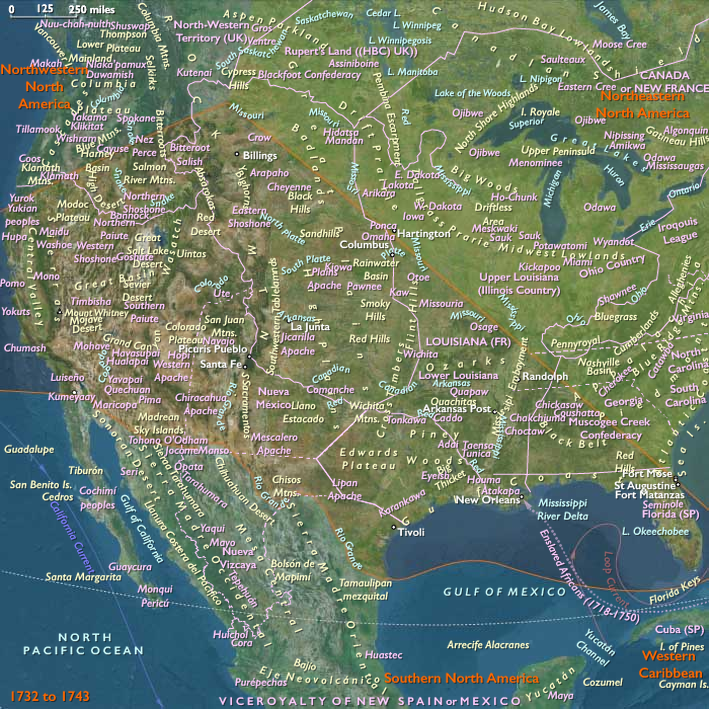
From Kaskaskia, in 1739, they attempt to travel to Santa Fe, New Mexico with six companions and nine horses loaded with trade goods.
They follow the Missouri River north to South Dakota to the villages of the Arikara.
It was believed at this time that the Missouri River flows all the way to the Spanish colonies in New Mexico.
Told by the natives that New Mexico is to the southwest, they backtrack to the Pawnee villages on the Loup River in Nebraska.
From here on May 29, 1739, they embark for Santa Fe.
Locations
People
Groups
- Pawnee (Amerind tribe)
- Arikara people (Amerind tribe)
- New France (French Colony)
- New Spain, Viceroyalty of
- France, (Bourbon) Kingdom of
- Santa Fe de Nuevo México (Spanish Colony)
- French Canadians
- Louisiana (New France)
Topics
Subjects
Regions

Subregions
Related Events
Filter results
Showing 10 events out of 27420 total
Many of Antoine Pesne's portraits of the Prussian royal family and their household hang today in Berlin Museums and in Charlottenburg Palace.
These include (among others) his portraits of the first two kings of Prussia, Frederich I and Frederick William I, and members of the latter's family.
In St. Agnus Church in Köthen, where J. S. Bach was music director (Kapellmeister), there is a huge portrait of the donor Gisela Agnes, Princess of Anhalt-Köthen, painted by Pesne in 1713.
The ceiling paintings in Charlottenburg, Rheinsberg, and Sanssouci Palaces are at least partially his work.
Pesne, born in Paris, had first studied art under his father and uncle, and had received a stipend for advanced training from 1704 to 1710 at the Académie Royale in Italy.
He was called to Berlin by King Frederick I of Prussia in 1710
As the director of the Berlin Academy of the Arts from 1722, Pesne has become famous through his portraiture.
Frederick William’s son, later to be known as Frederick the Great, had been restored to the Prussian Army as Colonel of the Regiment von der Goltz, stationed near Nauen and Neuruppin.
When Prussia provided a contingent of troops to aid Austria during the War of the Polish Succession, Frederick had studied under Prince Eugene of Savoy during the campaign against France on the Rhine.
Frederick William, weakened by gout brought about by the campaign, had granted Frederick Schloss Rheinsberg in Rheinsberg, north of Neuruppin.
In Rheinsberg, Frederick has assembled a small number of musicians, actors and other artists.
He spends his time reading, watching dramatic plays, making and listening to music, and regards this time as one of the happiest of his life.
Frederick has formed the "Bayard Order" to discuss warfare with his friends; Heinrich August de la Motte Fouqué is made the grand master of the gatherings.
Russia forges ties with Montenegro and ...
...Bosnia. (This settlement forms the basis of the northern border of modern Bosnia.)
First performed on May 21, 1739, at the Paris Opéra, the famous dancer Marie Sallé appears as Terpsichore in the third entrée.
Antoine Gautier de Montdorge, who wrote the libretto, is a friend of Rameau's patron Alexandre Le Riche de La Poupelinière.
His libretto had come in for heavy criticism and the second entrée had had to be revised with the aid of Simon-Joseph Pellegrin, who had written the words for Rameau's first opera, Hippolyte et Aricie.
In spite of the weak libretto, the work is an immediate success and becomes one of Rameau's most popular operas, enjoying eighty performances in its first year.
Zaïde, reine de Grenade (Zaïde, Queen of Grenada) is a ballet-héroïque written by Joseph-Nicolas-Pancrace Royer, to a text by the Abbé de La Marre.
Zaïde is first performed, under the direction of the composer, on September 3, 1739 for the wedding of King Louis XV's daughter, when it runs for forty-four performances.
Rameau’s Dardanus, an opera in five acts, with a French libretto by Charles-Antoine Leclerc de La Bruère, is first performed on November 19, 1739, at the Académie de musique in Paris.
It receives twenty-six performances, mainly because of the support from Rameau's followers in the dispute between the styles of Rameau and Lully.
Critics accuse Rameau's original opera of lacking a coherent plot.
The inclusion of the sea monster also violates the French operatic convention of having a clear purpose for encounters with supernatural beings.
François Boucher, born in Paris, the son of a lace designer Nicolas Boucher, is perhaps the most celebrated decorative artist of the eighteenth century, with most of his work reflecting the Rococo style.
Boucher at the age of seventeen had been apprenticed by his father to François Lemoyne, but after only three months had gone to work for the engraver Jean-François Cars.
Within three years, Boucher had already won the elite Grand Prix de Rome, although he did not take up the consequential opportunity to study in Italy until four years later.
On his return in 1731 from studying in Italy, he was admitted to the Académie de peinture et de sculpture as a historical painter, and in 1734 became a faculty member.
He had in 1733 married Marie-Jeanne Buzeau, with whom he will have three children.
Along with his painting, Boucher also designs theater costumes and sets, and the ardent intrigues of the comic operas of Favart (1710–1792) closely parallel his own style of painting.
Tapestry design is also a concern.
For the Beauvais tapestry workshops, he had first designed a series of Fêtes italiennes ("Italian festivals") in 1736, which proved to be very successful and will often be rewoven over the years, then, commissioned in 1737, a suite of the story of Cupid and Psyche.
Boucher's early work, reflecting inspiration gained from the artists Watteau and Rubens, Bcelebrates the idyllic and tranquil, portraying nature and landscape with great élan.
His art, however, typically forgoes traditional rural innocence to portray scenes with a definitive style of eroticism, and his mythological scenes are passionate and intimately amorous rather than traditionally epic.
Marquise de Pompadour (mistress of King Louis XV), whose name becomes synonymous with Rococo art, is a great fan of Boucher's, and has the painter under her protection: it is particularly in his portraits of her that this style is clearly exemplified.
Paintings such as The Breakfast of 1739, a family scene, also show Boucher as a master of the genre scene, as he regularly uses his own wife and family as models.
David Hume introduces Newtonian methodology into philosophical analysis in 1739 in A Treatise of Human Nature, his most important work, in which the Scottish empiricist philosopher and historian and attempts to show how human knowledge arises from sense experience.
Saul (HWV 53), an oratorio in three acts written by George Frideric Handel with a libretto by Charles Jennens, is first performed on January 16, 1739, at the King’s Theatre in London.
Taken from the 1st Book of Samuel, the story of Saul focuses on the first king of Israel’s relationship with his eventual successor, David; one which turns from admiration to envy and hatred, ultimately leading to the downfall of the eponymous monarch.
The work, which Handel began in 1738, includes the famous Dead March, a funeral anthem for Saul and his son Jonathan, and some of the composer's most dramatic choral pieces.
Many historians believe the libretto for Israel in Egypt (HWV 54), a biblical oratorio by Handel, was compiled by Handel's collaborator Charles Jennens; it is composed entirely of selected passages from the Hebrew Bible, mainly from Exodus and the Psalms.
Israel in Egypt premieres on April 4, 1739, at London's King's Theatre in the Haymarket.
Handel had started it soon after the opera season at King's Theatre was cancelled because of a lack of subscribers.
Probably the Organ Concerto in F major "The Cuckoo and the Nightingale", which Handel had finished before, was played between the acts among other things.
The oratorio is not well received by audiences, although commended in the Daily Post, and the second performance is shortened, the mainly choral work now augmented with Italian arias.
Henry Brooke had begun his career as a poet.
His now forgotten Universal Beauty was published in 1735, and Alexander Pope thought its sentiments and poetry fine.
He then turned dramatist by adapting extant plays, such as The Earl of Essex.
He writes from the Tory point of view and becomes one of the most important figures in Augustan drama, although not for his successes.
His Gustavus Vasa is not particularly savage or dark, and it takes relatively few liberties.
However, his previous The Earl of Essex had been perceived as highly political, and therefore Gustavus Vasa (1739) earns the distinction of being the first play banned by the Licensing Act of 1737.
The play concerns the liberation of Sweden from Denmark in 1521 by King Gustav I of Sweden (then regent).
Robert Walpole believes that the villain of the play resembles him.
Further, a facetious "attack" on it is the first public writing of Samuel Johnson, whose A Complete Vindication of the Licensers of the English Stage feigns support for Walpole while it drives the censor's argument to reductio ad absurdum.
George Whitefield, disagreeing with the Wesley brothers' views on the doctrine of the Atonement Arminianism while accepting the Church of England's doctrine of predestination, does what his friends hoped he would not do—hand over the entire ministry over to John Wesley.
Whitefield forms and is the president of the first Methodist conference, but he soon relinquishes the position to concentrate on evangelical work.
Three churches are established in England in his name: Bristol, and two churches in London: "Moorfields Tabernacle"; and "Tottenham Court Road Chapel".
The society meeting at the second Kingswood School at Kingswood, a town on the eastern edge of Bristol, wills eventually also be named Whitefield's Tabernacle.
Whitefield acts as chaplain to Selina, Countess of Huntingdon, and some of his followers join the Countess of Huntingdon's Connexion, whose chapels are built by Selina, where a form of Calvinistic Methodism similar to Whitefield's is taught.
Many of Selina's chapels will be built in the English and Welsh counties, and one will be erected in London—Spa Fields Chapel., born at the Bell Inn, Southgate Street, Gloucester, in England, is the fifth son and seventh child of Thomas Whitefield and Elizabeth Edwards, who kept an inn at Gloucester.
Whitefield had found at an early age that he had a passion and talent for acting in the theater, a passion that he will carry on through the very theatrical reenactments of Bible stories that he will tell during his sermons.
Educated at the Crypt School, Gloucester, and Pembroke College, Oxford, Whitefield did not have the means to pay for his tuition, because he comes from a poor background.
He therefore had entered Oxford as a servitor, the lowest rank of students at Oxford.
In return for free tuition, he was assigned as a servant to a number of higher ranked students.
His duties included waking them in the morning, polishing their shoes, carrying their books and even assisting with required written assignments.
He was a part of the 'Holy Club' at Oxford University with the Wesley brothers, John and Charles.
An illness, as well as Henry Scougal's The Life of God in the Soul of Man, had influenced him to cry out to the Lord for salvation.
Following a religious conversion, he had become very passionate for preaching his newfound faith.
The Bishop of Gloucester had ordained him before the canonical age.
Whitefield had preached his first sermon in St. Mary de Crypt Church in his home town of Gloucester a week after his ordination.
He had earlier become the leader of the Holy Club at Oxford when the Wesley brothers departed for Georgia.
He had adopted the practice of Howell Harris of preaching in the open-air at Hanham Mount, near Kingswood, Bristol.
Before becoming parish priest of Savannah, Georgia, in the American colonies, he had in 1738 invited John Wesley to preach in the open-air for the first time at Kingswood and then Blackheath, London.
After a short stay in Georgia, he had returned home the following year to receive priest's orders and resumed his open-air evangelistic activities.
He also works to raise funds to establish the Bethesda Orphanage, which is the oldest extant charity in North America.
The majority of the population of the South Carolina colony since 1708 has been enslaved, as importation has increased in recent decades with the expansion of cotton and rice cultivation; this is what will be called the Plantation Generation by the historian Ira Berlin.
Most of the slaves are native Africans and many in South Carolina are from the Kingdom of Kongo; many had been enslaved in the West Indies before being brought to South Carolina.
Several factors may have persuaded the slaves that a rebellion at this time might lead to freedom.
Accounts of slaves' gaining freedom by escaping to Spanish-controlled Florida give the Carolina slaves hope; the Spanish have issued a proclamation and have had agents spread the word about giving freedom and land to slaves who got to Florida.
Tensions between England and Spain over territory in North America make slaves hopeful in gaining freedom by reaching Spanish territory, particularly the free black community of Fort Mose, founded in 1738.
In addition, a malaria epidemic has killed many in Charleston, weakening the power of slaveholders.
Lastly, historians have suggested the slaves organized their revolt to take place on Sunday, when planters would be occupied in church and might be unarmed.
The Security Act of 1739 (which requires all white males to carry arms even to church on Sundays) had been passed in August, and penalties are supposed to begin after September 29.
Jemmy, the leader of the revolt, is a literate slave described in an eyewitness account as "Angolan"; because of patterns of trade, he is more likely from the Kingdom of Kongo in west Central Africa, which had long had relations with Portuguese traders.
His cohort of twenty slaves are also called "Angolan", and likely also Kongolese.
The slaves are described as Catholic, and some speak Portuguese, learned from the traders operating in the Kongo Empire at this time.
The patterns of trade and the fact that Kongo is a Catholic nation point to their origin there.
The kingdom of Kongo had voluntarily converted to Catholicism in 1491; by the eighteenth century, the religion is a fundamental part of its citizens' identity.
The nation has independent relations with Rome.
Portuguese is the language of trade as well as the one of the languages of educated people in Kongo.
Speaking Portuguese allows the slaves in South Carolina to be more aware of offers of freedom by Spanish agents.
They would also have been attracted to the Catholicism of Florida.
Because Kongo has been undergoing civil wars, more people have been captured and sold into slavery in recent years, among them trained soldiers.
It is likely that Jemmy and his rebel cohort were such military men, as they fight hard against the militia when they are caught, and are able to kill twenty of them.
Years: 1739 - 1739
Locations
People
Groups
- Pawnee (Amerind tribe)
- Arikara people (Amerind tribe)
- New France (French Colony)
- New Spain, Viceroyalty of
- France, (Bourbon) Kingdom of
- Santa Fe de Nuevo México (Spanish Colony)
- French Canadians
- Louisiana (New France)
