President Yahya Khan's plan provides that when …
Years: 1971 - 1971
President Yahya Khan's plan provides that when the new assembly meets it must produce a constitution within 100 days.
Any constitutional agreement clearly depends on the consent of three persons: Mujib of the East Wing, Bhutto of the West Wing, and Yahya Khan, as the ultimate authenticator representing the military government.
In his role as intermediary and head of state, Yahya Khan attempts to persuade Bhutto and Mujib to come to some kind of accommodation.
This effort proves unsuccessful as Mujib insists on his right as leader of the majority to form a government-a stand at variance with Bhutto, who claims there are "two majorities" in Pakistan.
Mujib counters by insisting on complete independence for East Pakistan, except for foreign policy, though the East wants to conclude its own aid, trade, and defense agreements.
Bhutto rejects these terms and refuses to bring his party to Dhaka to participate in the assembly.
Bhutto declares that the PPP will not attend the inaugural session of the assembly, thereby making the establishment of civilian government impossible.
On March 1, 1971, Yahya Khan, who earlier had referred to Mujib as the "future prime minister of Pakistan," dissolves his civilian cabinet and declares an indefinite postponement of the National Assembly.
Mujib responds by ordering a boycott and general strike throughout East Pakistan.
Strikes, demonstrations, and civil disobedience increase in tempo until there is open revolt.
Prodded by Mujib, Bengalis declare they will pay no taxes and will ignore martial law regulations on press and radio censorship.
The writ of the central government all but ceases to exist in East Pakistan.
Bowing to the inevitable, Yahya proceeds to Dhaka in mid-March to negotiate a compromise that will concede the substance of Mujib's demands while retaining tenuous ties that might still preserve the name of Pakistan.
Mujib, Bhutto, and Yahya Khan negotiate in Dhaka in late March in a final attempt to defuse the growing crisis.
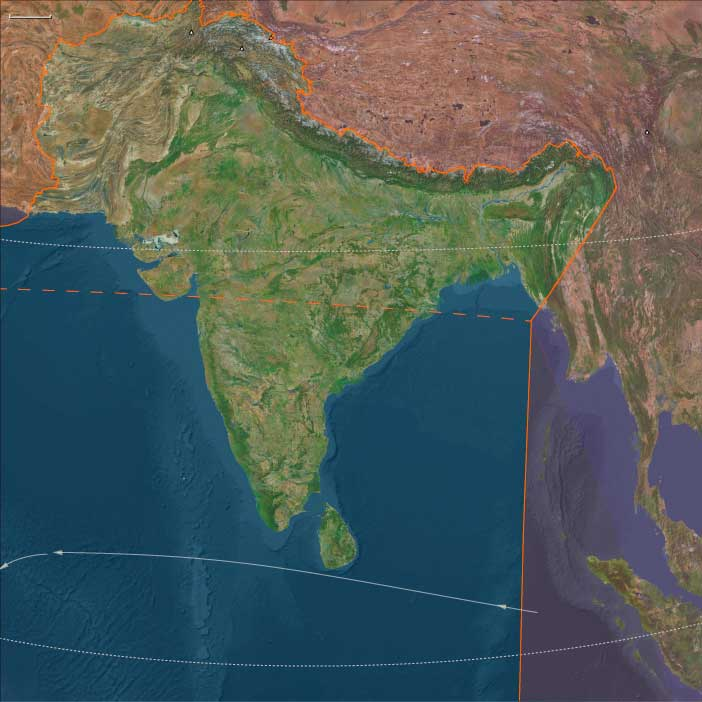
Simultaneously, General Tikka Khan, who commands the Pakistani forces in East Pakistan, prepares a contingency plan for a military takeover and calls for troop reinforcements to be flown in via Sri Lanka.
Throughout the month, Yahya Khan negotiates at length in Dhaka with Mujib while government troops pour in from West Pakistan.
In an atmosphere of distrust and suspicion, the talks break down, and on March 25 Yahya Khan and Bhutto fly back to West Pakistan.
Yahya Khan denounces Mujib and his colleagues as traitors and launches a drive to "reoccupy" the East with West Pakistan troops.
Tikka Khan's emergency plan goes into operation.
Roadblocks and barriers appear throughout Dhaka.
Universities are attacked, and the first of many deaths, including many students, occurs.
Mujib is taken into custody and flown to the West Wing to stand trial for treason.
Major Zia ur-Rahman, a political unknown, proclaims the independence of Bangladesh ("Bengal Land") from Chittagong, a city in the southeast of the new country.
On March 26, Yahya Khan outlaws the Awami League, bans political activity, and reimposes press censorship in both wings.
Because of these strictures, people in the West Wing remain uninformed about the crackdown in the east and tend to discount reports appearing in the international press as an Indian conspiracy.
Most of the Awami League leaders flee to Calcutta, where they form a Bangladeshi government in exile.
Zia ur-Rahman, who holds out for some days in Chittagong before the town's recapture by the Pakistan army, retreats to the border and begins, with others, to organize Bengali troops to form the Mukti Bahini (Liberation Force) to resist the Pakistan Army.
The East Pakistan Rifles, a paramilitary force, mutinies and joins the revolutionary forces.
The tempo of violence of the military crackdown during these first days soon accelerates into a full-blown and brutal civil war.
Relations between Pakistan and India, already tense, deteriorate sharply because of the crisis.
On March 31, the Indian parliament passes a resolution in support of the "people of Bengal." Student militants organize a different resistance.
Among these, Abdul Kader Siddiqi with his followers, known as Kader Bahini, acquires a reputation for ferocity.
Nevertheless, the Pakistan Army presses its heavy offensive and in early April controls most of East Pakistan.
More than 250,000 refugees cross into India in the first few days of the war.
As the influx continues over the next six months, some 10 million Bengalis, mainly Hindus, flee over the frontier into India.
No accurate estimate can be made of the numbers of people killed or wounded or the numbers of women raped, but the assessment of international human rights organizations is that the Pakistani crackdown is particularly alarming in its ferocity.
The Mukti Bahini, formed around regular and paramilitary forces, receives equipment, training, and other assistance from India.
Superpower rivalries further complicate the situation, impinge on Pakistan's war, and possibly impede its political resolution.
The Indian government watches the struggle with alarm.
The Awami League, which they support, is a moderate middle-class body like the Congress Party; but many guerrillas are leftist.
The United States and China, for different reasons, are committed to a united Pakistan; India and the Soviet Union want a Bangladesh dependent on India.
In the fall, military and guerrilla operations increase, and Pakistan and India report escalation of border shelling.
On the western border of East Pakistan, military preparations are also in evidence.
On November 21, the Mukti Bahini launches an offensive on Jessore, southwest of Dhaka.
Yahya Khan declares a state of emergency in all of Pakistan on November 23 and asks his people to prepare for war.
In response to Indian military movements along and across the Indian-East Pakistani border, the Pakistan Air Force attacks military targets in northern India on December 3, and on December 4 India begins an integrated ground, naval, and air invasion of East Pakistan.
The Indian army launches a five-pronged attack and begins converging on Dhaka.
Indian forces close in around the city and receive the surrender of Pakistani forces on December 16.
Indian prime minister Indira Gandhi proclaims a unilateral cease-fire on December 17.
Mujib is released from jail and eventually returns to a hero's welcome in Bangladesh.
Violent demonstrations against the military government soon break out at the news of Pakistan's defeat.
Accepting responsibility for the defeat and breakup of Pakistan, President Yahya Khan resigns on December 20, inviting the PPP to form a government.
Bhutto, the deputy prime minister and foreign minister, assumes power as president and chief martial law administrator of a disgraced military, a shattered government, and a bewildered and demoralized population.
Promising to make a new Pakistan out of the West Wing and to restore national confidence, Bhutto conveniently lays the entire blame for the war and Pakistan's defeat on Yahya Khan and his junta.
Years: 1971 - 1971
Locations
Subjects
Regions