…present Portsmouth in Hampshire.
Years: 250 - 250
…present Portsmouth in Hampshire.
Locations
Groups
Topics
Commodoties
Subjects
Regions
Subregions
Related Events
Filter results
Showing 10 events out of 60393 total
The Japanese clans’ construction of massive mounded tombs on the Yamato Plain inaugurates Japan’s so-called Kofun period, an era in the history of Japan from around 250 to 538.
The word kofun is Japanese for the type of burial mounds dating from this era.
Following the Yayoi period, the Kofun and the subsequent Asuka periods are sometimes referred to collectively as the Yamato period.
While conventionally assigned to the period from 250 CE, the actual start of Yamato rule is disputed.
The Kofun period is illustrated by an animistic culture which existed prior to the introduction of Buddhism.
Politically, the establishment of the Yamato court, and its expansion as allied states from Kyushu to the Kanto are key factors in defining the period.
Also, the Kofun period is the oldest era of recorded history in Japan.
However, as the chronology of the historical sources are very much distorted, studies of this age require deliberate criticism and the aid of archaeology.
The archaeological record, and ancient Chinese sources, indicate that the various tribes and chiefdoms of Japan did not begin to coalesce into states until 300, when large tombs began to appear while there were no contacts between western Japan and China.
Some describe the "mysterious century" as a time of internecine warfare as various chiefdoms competed for hegemony on Kyūshū and Honshuū.
The oldest Japanese kofun is said to be Hokenoyama Kofun located in Sakurai, Nara, which dates to the late third century.
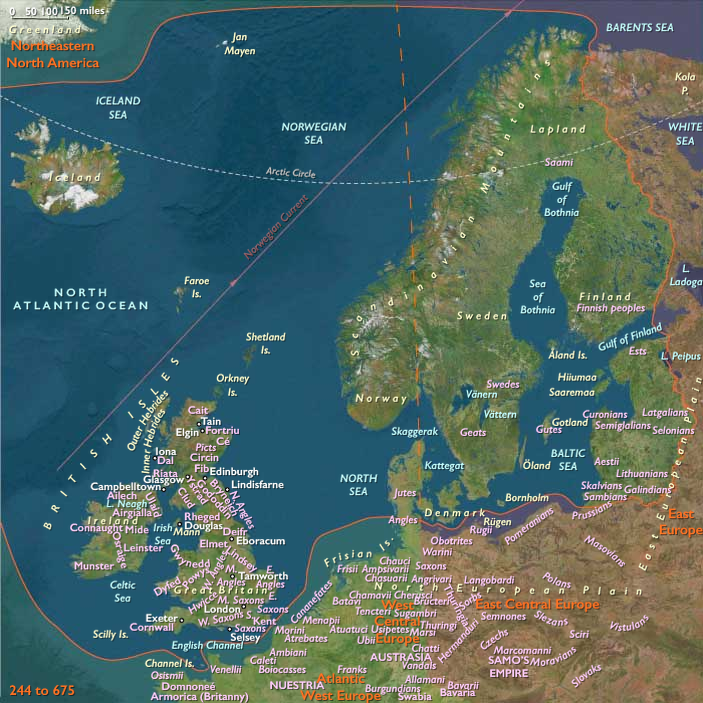
The Burgundians (Latin: Burgundiones), an East Germanic tribe, may have emigrated from mainland Scandinavia to the island of Bornholm, whose old form in Old Norse still was Burgundarholmr (the Island of the Burgundians), and from there to mainland Europe.
The Burgundians' tradition of Scandinavian origin finds support in place-name evidence and archaeological evidence (Stjerna) and many consider their tradition to be correct (e.g., Musset, p. 62).
Possibly because Scandinavia was beyond the horizon of the earliest Roman sources, including Tacitus (who only mentions one Scandinavian tribe, the Suiones), Roman sources do not mention where the Burgundians came from, and the first Roman references place them east of the Rhine (inter alia, Ammianus Marcellinus, XVIII, 2, 15).
Early Roman sources consider them simply another East Germanic tribe.
The population of Bornholm (the island of the Burgundians) in about 250 largely disappears from the island.
Most cemeteries cease to be used, and those that are still used have few burials (Stjerna, in Nerman 1925:176).
The Limes Germanicus (Latin for Germanic frontier) is a line of frontier (limes) fortifications that bound the Roman provinces of Germania Inferior, Germania Superior and Raetia, dividing the Roman Empire and the unsubdued Germanic tribes from the years 83 to about 260 CE.
At its height, the limes stretched from the North Sea outlet of the Rhine to near Regensburg on the Danube.
The Lower Germanic Limes extend from the North Sea at Katwijk in the Netherlands along the then main Lower Rhine branches (modern Oude Rijn, Leidse Rijn, Kromme Rijn, Nederrijn).
The Upper Germanic Limes start from the Rhine at Rheinbrohl (Neuwied (district)) across the Taunus mountains to the river Main (East of Hanau), then along the Main to Miltenberg, and from Osterburken (Neckar-Odenwald-Kreis) south to Lorch (Ostalbkreis) in a nearly perfect straight line of more than seventy kilometers.
The proper Rhaetian Limes extend east from Lorch to Eining (close to Kelheim) on the Danube.
The total length is five hundred and sixty-eight kilometers (three hundred and forty-one miles).
It includes at least sixty castles and nine hundred watchtowers.
The pressure of the barbarians had begun to be felt seriously in the later part of the second century, and after long struggles the whole or almost the whole district east of the Rhine and north of the Danube is lost, seemingly all within one short period, about 250.
The Nördlinger Ries has been a very attractive site for human settlement from Paleolithic times forward.
The valley of the Danube had abounded with game, and many caves in the slopes of the crater provided shelter for Neanderthals and their successors.
The Ries has always been densely populated.
From 450 to 15 BCE, Celtic peoples had built their settlements on the tops of the hills.
Remains of Celtic ring walls and sanctuaries can be found all over the region.
They had been replaced about CE 90 by the Romans, who had secured the region by building forts and the Limes (which was some kilometers north of the present district).
In about 250, the Alamanni, a coalition of Germanic tribes from beyond the Limes Germanicus, drive the Romans from the modern area of Donau-Ries.
Getian insurgents, Goths, and Sarmatians have harassed Dacia during the two centuries of Roman rule in the western Balkans, and major migrations of ‘barbarian’ tribes have begun by the middle of the third century CE.
During the third century, East-Germanic peoples, moving in a southeasterly direction, had migrated into Dacian territories previously under Sarmatian and Roman control, and the confluence of East-Germanic, Sarmatian, Dacian and Roman cultures has resulted in the emergence of a new Gothic identity.
Part of this identity is adherence to a pagan religion, the exact nature of which, however, remains uncertain.
In 238, an army described by the Romans as Gothic had crossed the Danube and plundered the Roman province of Moesia Inferior, taking numerous hostages, which were later returned to the Romans in exchange for monetary compensation.
Within two years—possibly on the basis of a contractual agreement which had ended the same raid—Goths were enlisted into the Roman Army for Gordian III's campaign against the Persians, which had ended in 243-244.
At the conclusion of this campaign, the Gothic soldiers had been released from military duty and all subventions stopped.
This had been met with widespread disapproval, and by 250, a large army consisting of Goths, Vandali, Taifalae, Bastarnae and Carpi had assembled under the Gothic king Cniva.
Together with a number of Roman deserters and some members from such other tribes as the Vandals, the Goths cross the Danube in 250 and overrun the Roman provinces of Moesia and Thrace.
Their war chief Cniva leads his army to sack Philippopolis, called by the Romans Trimontium, the capital of Thrace.

Axum has begun interfering in South Arabian affairs in the third century, controlling at times the western Tihama region among other areas.
Axum takes control of commerce on the Red Sea around 250.
One group of Franks, taking advantage of a weakened Roman Empire, penetrates as far as Tarragona in present-day Spain around 250; they are to plague this region for about a decade before Roman forces subdue them and expel them from Roman territory.
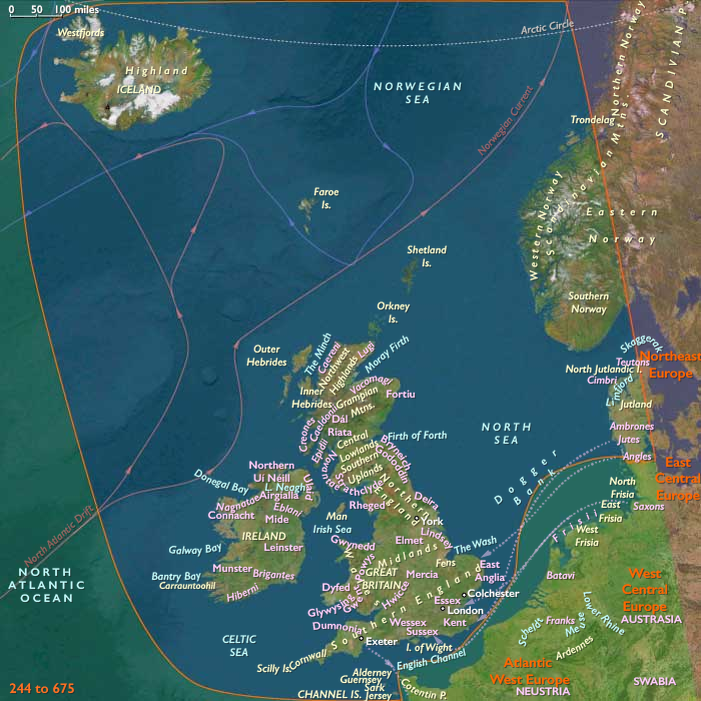
The Romans in Britain, harried by Saxon raiders, have by 250 established nine defensive coastal forts from Kent west to …
A “Count of the Saxon Shore” commands the central installation, at Rutupiae (present Richborough).