
Prehistoric South American sites include Lapa Vermelha …
Years: 14733BCE - 13006BCE
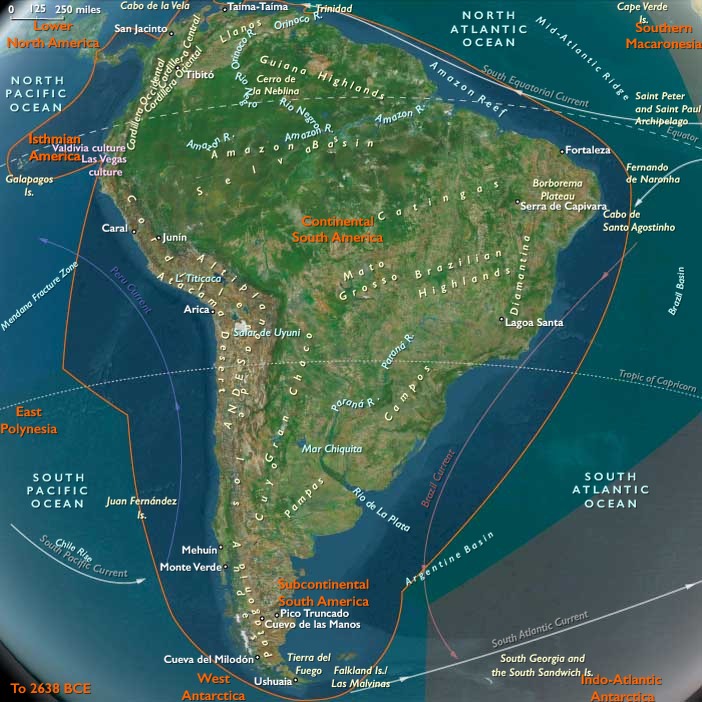
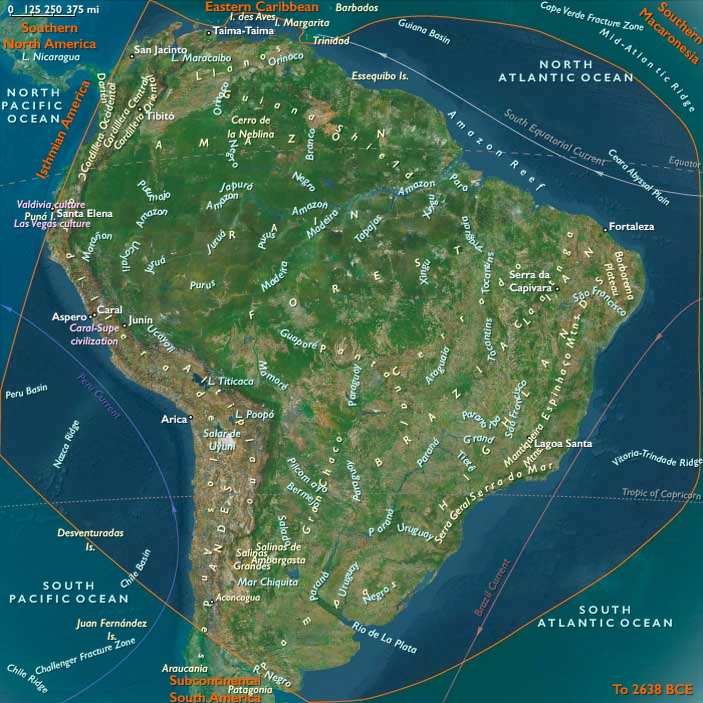
Prehistoric South American sites include Lapa Vermelha IV, also in Brazil, which yielded the thirteen thousand five hundred-year-old skull of a female nicknamed Luzia, who died in her early twenties.
It is the oldest human skeleton found in the Americas.
Although flint tools were found nearby, hers are the only human remains in Vermelha Cave.
Some archaeologists believe the young woman may have been part of the first wave of immigrants to South America.
Her facial features include a narrow, oval cranium, projecting face and pronounced chin, strikingly dissimilar to most native Americans and their indigenous Siberian forebears.
Anthropologists have variously described Luzia's features as resembling those of Negroids, Indigenous Australians, Melanesians and the Negritos of Southeast Asia.
Walter Neves, an anthropologist at the University of São Paulo, suggests that Luzia's features most strongly resemble those of Australian Aboriginal peoples.
Richard Neave of Manchester University, who undertook a facial reconstruction of Luzia, described it as Negroid.
However, cranio-facial variability could be a component of genetic drift in Native Americans.
A comparison in 2005 of the Lagoa Santa specimens, with modern Botocudos of the same region, also showed strong affinities.
Interestingly, two ancient human skulls from Brazil's indigenous Botocudo people, known for the large wooden disks they wore in their lips and ears, belonged to people who were genetically Polynesian, with no detectable Native American ancestry.
The genetic evidence indicates either that Rapa Nui people traveled to South America or that Native Americans journeyed to Easter Island.
The findings suggest these Polynesians reached South America and made their way to Brazil, either landing on the western coast of the continent and crossing the interior or voyaging around Tierra del Fuego and up the east coast.
Locations
Topics
Subjects
Regions
Subregions
Years: 14733BCE - 13006BCE
Locations
Topics
Subjects
Regions
Subregions