
Praxiteles, the (presumed) son of the sculptor …
Years: 340BCE - 340BCE
Praxiteles, the (presumed) son of the sculptor Cephisodotus, and a renowned Athenan sculptor in his own right, executes the magnificent Hermes and the Infant Dionysus around 340 for the Heraion at Olympia.
Discovered in 1877 in the ruins of the Temple of Hera at Olympia, it is displayed at the Archaeological Museum of Olympia.
It is traditionally attributed to Praxiteles and dated to the fourth century BCE, based on a remark by the second century Greek traveler Pausanias, and has made a major contribution to the definition of Praxitelean style.
Its attribution is, however, the object of fierce controversy among art historians.
The sculpture is unlikely to have been one of Praxiteles' famous works, as no ancient replicas of it have been identified.
The documentary evidence associating the work with Praxiteles is based on a passing mention by the second-century CE traveler Pausanias. (The Hermes’ sinuous curves and the fine finish of the marble conform to what is known of Praxiteles’ style.
Most scholars consider the famous sculpture to be an original work; others, however, characterize the Hermes as either an excellent Roman copy or a Hellenistic original by some follower of Praxiteles).
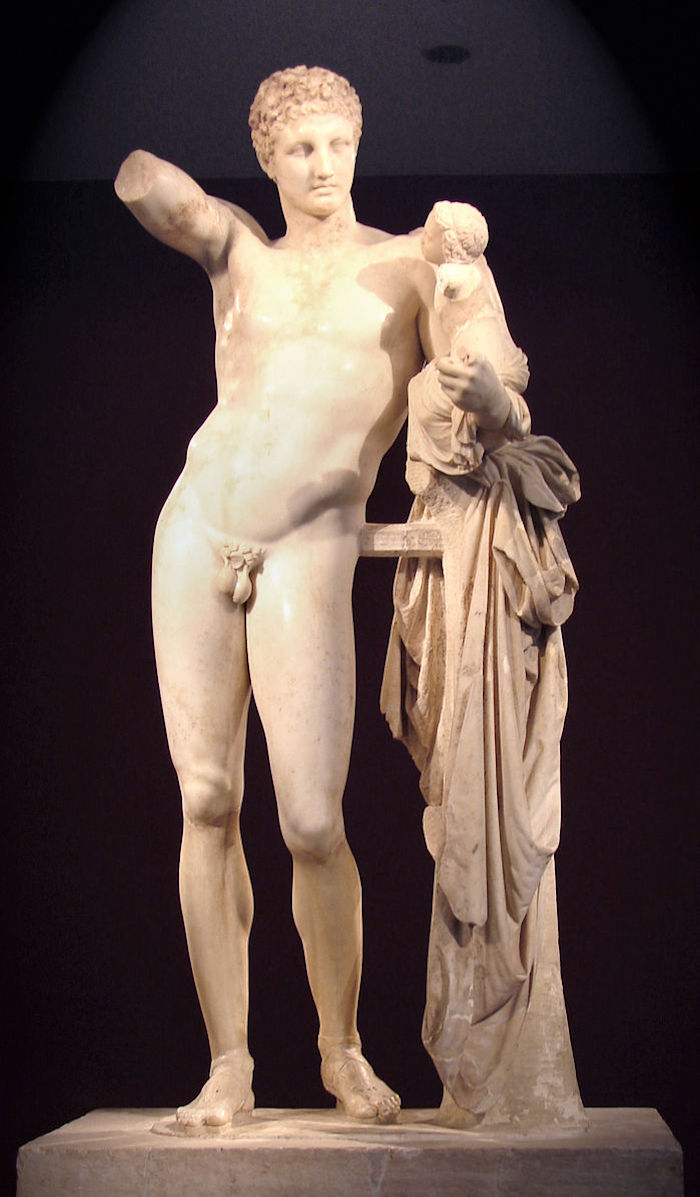
Hermes bearing the good person by Praxiteles. Parian marble, H. 2.15 m (7 ft. ½ in.). Archaeological museum of ancient Olympia, Greece. (Photo takne 20 October 2013 by Tetraktys)
Locations
People
Groups
- Polytheism (“paganism”)
- Greece, classical
- Athens, City-State of
- Athenian Empire or Confederacy, Second
Topics
Subjects
Regions
Subregions
Related Events
Showing 10 events out of 64595 total
Years: 340BCE - 340BCE
Hermes bearing the good person by Praxiteles. Parian marble, H. 2.15 m (7 ft. ½ in.). Archaeological museum of ancient Olympia, Greece. (Photo takne 20 October 2013 by Tetraktys)
Locations
People
Groups
- Polytheism (“paganism”)
- Greece, classical
- Athens, City-State of
- Athenian Empire or Confederacy, Second
Topics
Subjects
Regions
Subregions