
Prasutagas, king of the British Iceni tribe …
Years: 60 - 60
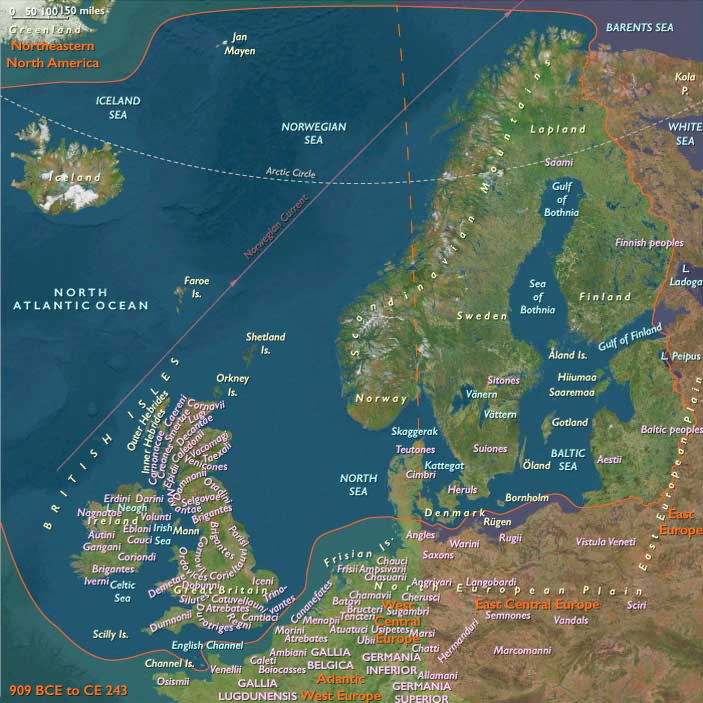
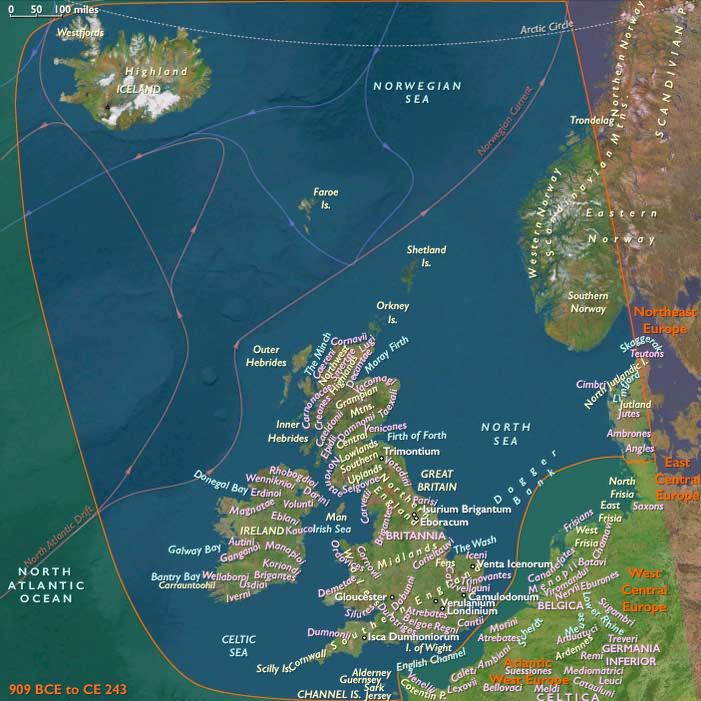
Prasutagas, king of the British Iceni tribe centered in present Norfolk, may have been one of the eleven kings who surrendered to Claudius following the Roman conquest in 43, or he may have been installed as king in 47 following the defeat of a rebellion of the Iceni.
In any case, as an ally of Rome, his tribe has been allowed to remain nominally independent, and to ensure this Prasutagus names the Roman emperor as co-heir to his kingdom, along with his two daughters.
Tacitus says he lived a long and prosperous life of conspicuous wealth.
It is normal Roman practice to allow allied kingdoms their independence only for the lifetime of their client king, who would agree to leave his kingdom to Rome in his will—the provinces of Bithynia and Galatia, for example, were incorporated into the Empire in just this way.
Roman law also allows inheritance only through the male line, so when Prasutagus dies in CE 60, his attempts to preserve his line are ignored and his kingdom is annexed as if it had been conquered; lands and property are confiscated and nobles treated like slaves.
Cassius Dio says that Roman financiers, including Seneca the Younger, chose this time to call in their loans.
Tacitus does not mention this, but does single out the procurator, Catus Decianus, for criticism for his "avarice".
Prasutagus, it seems, had lived well on borrowed Roman money, and on his death his subjects had become liable for the debt.
According to Tacitus, Boudica was flogged and their daughters raped.
All this leads to the revolt of the Iceni, under the leadership of Boudica.
Tacitus and the Greek historian Dio Cassius agree that Boudica was of royal descent.
Dio says that she was "possessed of greater intelligence than often belongs to women", that she was "tall and terrifying in appearance ... a great mass of red hair fell over her shoulders"; that she had a harsh voice and a piercing glare, and habitually wore a large golden necklace (perhaps a torc), a many-colored tunic, and a thick cloak fastened by a brooch.
Tacitus commented on the "red hair and large limbs of the inhabitants of Caledonia [Scotland]" (The Life of Agricola, Ch. 11), which he linked with some red haired German/Belgic Gaulish tribes.
While the current governor, Gaius Suetonius Paulinus, is leading a campaign against the island of Mona (modern Anglesey) in the north of Wales, which is a refuge for British rebels and a stronghold of the druids, the Iceni conspire in CE 60 or 61 with their neighbors the Trinovantes, among others, to revolt.
Boudica is chosen as their leader.
According to Tacitus, they draw inspiration from the example of Arminius, the prince of the Cherusci who had driven the Romans out of Germany in CE 9, and their own ancestors who had driven Julius Caesar from Britain.
Dio says that at the outset, Boudica employed a form of divination, releasing a hare from the folds of her dress and interpreting the direction in which it ran, and invoked Andraste, a British goddess of victory.
Locations
People
Groups
- Red-haired people
- Iceni (Celtic tribe)
- Trinovantes (Celtic tribe)
- Roman Empire (Rome): Julio-Claudian dynasty
- Pirates of the Korea Strait
Topics
- Classical antiquity
- Pre-Roman Iron Age of Northern Europe
- Roman Age Optimum
- Pax Romana
- Roman Conquest of Britain
- Boudica's uprising
Commodoties
Subjects
- Commerce
- Environment
- Labor and Service
- Fashion
- Decorative arts
- Conflict
- Faith
- Government
- Custom and Law
- Technology
- Prophecy
Regions
Subregions
Years: 60 - 60
Locations
People
Groups
- Red-haired people
- Iceni (Celtic tribe)
- Trinovantes (Celtic tribe)
- Roman Empire (Rome): Julio-Claudian dynasty
- Pirates of the Korea Strait
Topics
- Classical antiquity
- Pre-Roman Iron Age of Northern Europe
- Roman Age Optimum
- Pax Romana
- Roman Conquest of Britain
- Boudica's uprising
Commodoties
Subjects
- Commerce
- Environment
- Labor and Service
- Fashion
- Decorative arts
- Conflict
- Faith
- Government
- Custom and Law
- Technology
- Prophecy
Regions
Subregions