
Initial resistance to Nobunaga in the Kyoto …
Years: 1564 - 1575
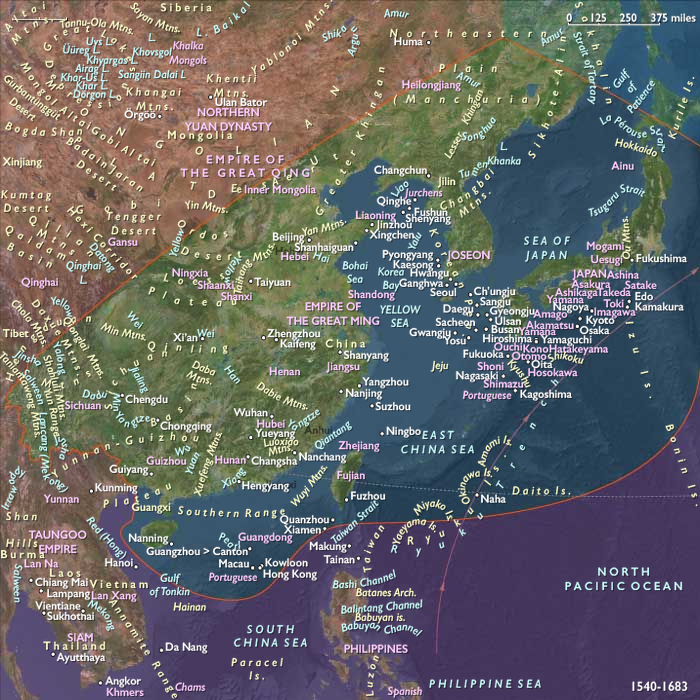
Initial resistance to Nobunaga in the Kyoto region comes from the Buddhist monks, rival daimyo, and hostile merchants.
Surrounded by his enemies, Nobunaga strikes first at the secular power of the militant Tendai Buddhists, destroying their monastic center at Mount Hiei near Kyoto and killing thousands of monks in 1571.
By 1573 he has defeated the local daimyo, banished the last Ashikaga shogun, and ushered in what historians call the Azuchi-Momoyama period (1573-1600), named after the castles of Nobunaga and Hideyoshi.
Having taken these major steps toward reunification, Nobunaga now builds a seven-story castle surrounded by stone walls at Azuchi on the shore of Lake Biwa.
The castle is able to withstand firearms and becomes a symbol of the age of reunification.
Nobunaga's power increases as he enfeoffs the conquered daimyo, broke down the barriers to free commerce, and drew the humbled religious communities and merchants into his military structure.
He secures control of about one-third of the provinces through the use of large-scale warfare and he institutionalizes administrative practices, such as systematic village organization, tax collection, and standardized measurements.
At the same time, other daimyo, both those Nobunaga had conquered and those beyond his control, build their own heavily fortified castles and modernize their garrisons.
In 1577 Nobunaga dispatches his chief general, Hideyoshi, to conquer twelve western Honshu provinces.
The war is a protracted affair, and in 1582, when Nobunaga leads an army to assist Hideyoshi, he is assassinated.
Locations
People
Groups
Topics
Commodoties
Subjects
Regions
Subregions
Years: 1564 - 1575
Locations
People
Groups
Topics
Commodoties
Subjects
Regions
Subregions