
Portuguese traders also bring opium to China …
Years: 1819 - 1819
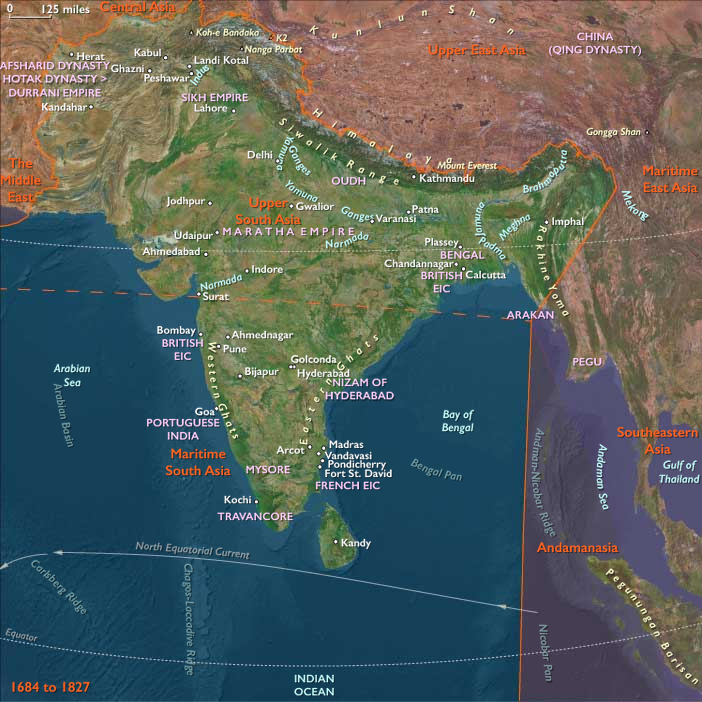
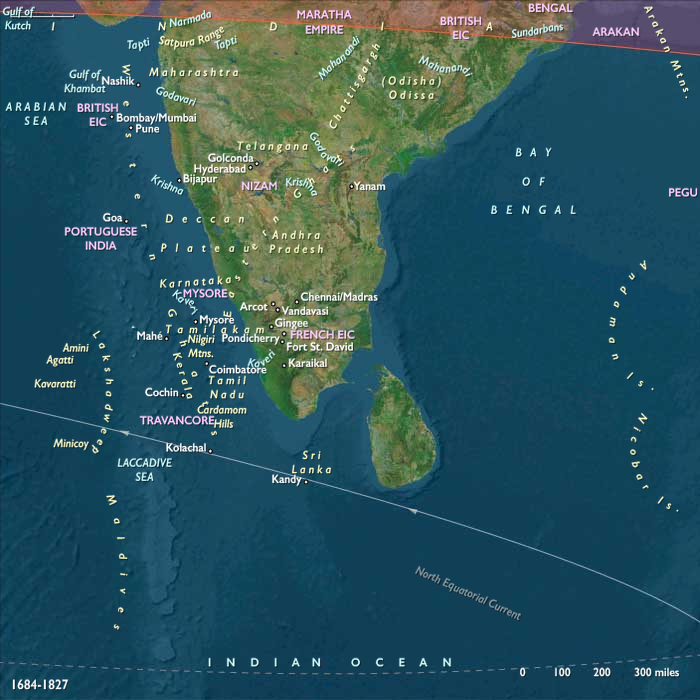
Portuguese traders also bring opium to China from the independent Malwa states of western India.
The British, however, are able by 1820 to restrict this trade by charging "pass duty" on the opium when it is forced to pass through Bombay to reach an entrepôt.
Locations
Groups
- India, Portuguese State of
- Portugal, Bragança Kingdom of
- Chinese Empire, Qing (Manchu) Dynasty
- East India Company, British (United Company of Merchants of England Trading to the East Indies)
- India, East India Company rule in
Commodoties
Subjects
Regions
Subregions
Related Events
Filter results
Showing 10 events out of 20501 total
Hongi Hika had led one of two Ngāpuhi taua in 1818 against East Cape and Bay of Plenty iwi Ngāti Porou and Ngaiterangi.
The taua return in 1819 carrying nearly two thousand captured slaves.
In most German territories, Jews are excluded from posts in public administration and the army and forbidden to hold teaching positions in schools and universities.
Jewish representatives had formally demanded emancipation at the Congress of Vienna (1815), and German academics and politicians alike had responded with vicious opposition.
The Jews had been portrayed to the public as "upstarts" who were attempting to take control of the economy, particularly the financial sector.
Anti-Jewish publications became common in the German press.
Influenced by the Haskalah, as well as the French Revolution with its Declaration of the Rights of Man and of the Citizen and other advancements in civil rights, many Jews and equal rights activists have begun to demand citizenship and equal treatment.
As Jewish Emancipation progresses, German Jews are becoming competitors for Christian guilds in the economy.
Amos Elon will write in his 2002 book The Pity of It All: A History of the Jews in Germany, 1743–1933:
In some places, attempts were made to return Jews to their old medieval status. The free city of Frankfurt reinstated parts of the medieval statute that restricted the rights of Jews. As of 1816 only twelve Jewish couples were allowed to marry each year. The 400,000 gulden the community had paid the city government in 1811 in return for its emancipation were declared forfeited. In the Rhineland, which had reverted to Prussian control, Jews lost the citizenship rights they had been granted under the French and were no longer allowed to practice certain professions. The few who had been appointed to public office before the war were summarily dismissed.
The most likely explanation is that it is based on the traditional herding cry of German shepherds.
National Freemasonry, the most important of several Polish secret societies devoted to ousting the Russians from Poland, is founded in 1819.
Arthur Schopenhauer, a German philosopher who emphasizes the force of the human will, was born in the city of Danzig (Gdańsk), the son of Heinrich Floris Schopenhauer and Johanna Schopenhauer, both descendants of wealthy German Patrician families.
When the Kingdom of Prussia acquired the Polish-Lithuanian Commonwealth city of Danzig in 1793, Schopenhauer's family had moved to Hamburg.
Schopenhauer's father may have committed suicide in 1805.
Shortly thereafter, Schopenhauer's mother Johanna moved to Weimar, at this time the center of German literature, to pursue her writing career.
After one year, Schopenhauer left the family business in Hamburg to join her.
In 1809, he became a student at the University of Göttingen, where he studied metaphysics and psychology under the author of Aenesidemus, Gottlob Ernst Schulze, who had advised him to concentrate on Plato and Immanuel Kant.
In Berlin, from 1811 to 1812, he had attended lectures by the prominent post-Kantian philosopher Johann Gottlieb Fichte and the theologian Friedrich Schleiermacher.
In 1814, Schopenhauer had begun his seminal work The World as Will and Representation (Die Welt als Wille und Vorstellung).
Completing it in 1818, he publishes it the following year.
In Dresden in 1819, Schopenhauer fathers, with a servant, an illegitimate daughter who is born and dies the same year.
Prussian law makes education compulsory in 1819.
Under the now fully developed three-tired education system, the children of Prussian society are divided into three groups: (1) those who will grow up to make policy, representing one half percent percent of the populace, are taught to think; (2) those who will become doctors, engineers, lawyers and other professionals, representing five and a half percent of the populace, are taught to partially think; (3) the ninety-four percent representing the children of the masses are to learn obedience and how to follow orders.
This latter school of the masses, the volkschulen, divides whole ideas into previously nonexistent subject divisions, thereby discouraging cross-assimilation.
Under this system, the masses will learn: (a) to think what someone else tells them to think about a subject: (b) when to think about it; (c) how long to think about it; (d) when to stop thinking about it; and (e) when to think of something else.
The British are primarily interested in controlling the Qawasim, whose main centers are Ra's al Khaymah, Ajman, and ash-Shariqah, which are all small ports along the southeastern gulf coast.
The British navy does not succeed in controlling the piracy situation in the Persian Gulf until 1819, when the British send a fleet from India that destroys the pirates' main base at Ra's al Khaymah, a Qawasim port at the southern end of the gulf.
From Ra's al Khaymah, the British fleet destroys Qawasim ships along both sides of the gulf.
The British are principally concerned to secure the area so that it will not pose a threat to shipping to and from their possessions in India.
Having no desire to take over the desolate areas along the gulf, and knowing that the sultan in Oman cannot be relied upon to control the pirates, the British decide to leave in power those tribal leaders who have not been conspicuously involved with piracy.
They conclude a series of treaties in which those leaders promise to suppress all piracy.
Consequently, the Arab side of the gulf comes to be known as the “trucial coast”.
This area had previously been under the nominal control of the sultan in Oman, although the trucial coast tribes were not part of the Ibadi imamate.
The area is also referred to as “trucial Oman” to distinguish it from the part of Oman under the sultan that is not bound by treaty obligation.
The kingdom of Lahore is at its most powerful and expansive during the rule of Maharaja Ranjit Singh, who extends Sikh control beyond Peshawar, adding Kashmir to his dominions in 1819.
The American operations will be largely ineffective, as after forty-two years only about one hundred suspected slave ships will have been captured.
Years: 1819 - 1819
Locations
Groups
- India, Portuguese State of
- Portugal, Bragança Kingdom of
- Chinese Empire, Qing (Manchu) Dynasty
- East India Company, British (United Company of Merchants of England Trading to the East Indies)
- India, East India Company rule in
