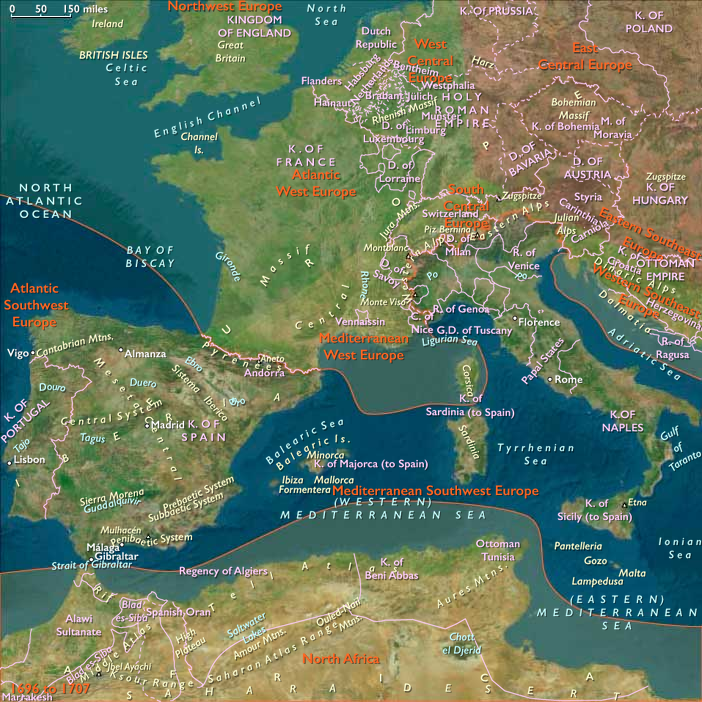
Francis II Rákóczi, deciding to invest his energies in a war of national liberation, he has accepted the request by kuruc forces to head a new uprising in Munkács begun by them.
Another group of about three thousand armed men headed by Tamás Esze had joined him on June 15, 1703, near the Polish city of Lawoczne.
Count Miklós Bercsényi had also arrived, with French funds and six hundred Polish mercenaries.
Most of the Hungarian nobility does not support Rákóczi’s uprising, because they consider it to be no more than a jacquerie, a peasant rebellion.
Rákóczi’s famous call to the nobility of Szabolcs county seems to be in vain.
He does manage to persuade the Hajdús (emancipated peasant warriors) to join his forces, so his forces by late September 1703 control most of Kingdom of Hungary to the east and north of the Danube.
He continues soon after by conquering Transdanubia.
The son of an old noble family and one of the richest landlords in the Kingdom of Hungary, Francis II Rákóczi, was born in 1676 to Francis I Rákóczi, elected ruling prince of Transylvania, and Ilona Zrínyi.
His father had died when Rákóczi was a mere baby, and his mother had married Imre Thököly in 1682.
After Thököly was defeated, Zrínyi had held the castle of Munkács (today Mukacheve in Ukraine) for three years, but was eventually forced to surrender.
Rákóczi has held the title of count (comes perpetuus) of the Comitatus Sarossiensis (in Hungarian Sáros) from 1694.
After the Treaty of Karlowitz, when his stepfather and mother had been sent into exile, Rákóczi had stayed in Vienna under Habsburg supervision.
Remnants of Thököly’s peasant army had started a new uprising in the Hegyalja region of northeastern present-day Hungary, which was part of the property of the Rákóczi family.
After capturing the castles of Tokaj, Sárospatak and Sátoraljaújhely, they had asked Rákóczi to become their leader, but, not being eager to head what had appeared to be a minor peasant rebellion, he had quickly returned to Vienna, where he tried his best to clear his name.
Rákóczi had then befriended Bercsényi, whose property at Ungvár (today Uzhhorod), in Ukraine), lies next to his own.
Bercsényi is a highly educated man, the third richest man in the kingdom (after Rákóczi and Simon Forgách), and is related to most of the Hungarian aristocracy.
As the House of Habsburg is on the verge of dying out, France is looking for allies in its fight against Austrian hegemony.
Consequently, they have established contact with Francis Rákóczi and promised support if he will take up the cause of Hungarian independence.
An Austrian spy had seized this correspondence and brought it to the attention of the Emperor.
As a direct result of this, Rákóczi had been arrested on April 18, 1700, and imprisoned in the fortress of Wiener Neustadt (south of Vienna).
It had become obvious during the preliminary hearings that, just as in the case of his grandfather Péter Zrínyi, the only possible sentence for Francis was death.
With the aid of his pregnant wife Amelia and the prison commander, Rákóczi had managed to escape and flee to Poland.
Here he had met with Bercsényi again, and together they resumed contact with the French court.
Three years later, the War of the Spanish Succession has used a large part of the Austrian forces in the Kingdom of Hungary to temporarily leave the country.