
Portrait of a Young Man is a …
Years: 1425 - 1425
Portrait of a Young Man is a painting attributed to Masaccio, although this attribution is disputed.
The subject of this painting is wearing a chaperon, a form of hood or, later, highly versatile hat worn in all parts of Western Europe in the Middle Ages.
Initially a utilitarian garment, it first grew a long partly decorative tail behind, and then developed into a complex, versatile and expensive headgear after what was originally the vertical opening for the face began to be used as a horizontal opening for the head.
Masolino's “Fall of Adam and Eve” and Masaccio's “Expulsion from Paradise,” positioned to face each other across the entrance to the chapel, dramatically demonstrate Masaccio's greater concern with the representation of emotional intensity as well as volume and depth.
In “The Expulsion,” Masaccio employs the dramatic effects of light and shadow—called chiaroscuro—to model the naked forms of the grief-stricken couple, whom he shows striding hastily from the Gate of Paradise in an animated, highly emotive rendition of the classic scene.
In another scene, a more static composition called “Tribute Money,” the Apostles gather in a circle around Christ as a tax collector confronts them.
Again Masaccio uses light and shadow to mold each figure into a concrete entity, artfully adjusting the light playing over distant hills to convey the impression of a panoramic landscape behind the figures.
Masolino interrupts his participation in this endeavor in September 1425 by a two-year visit to Hungary beginning in September 1425.
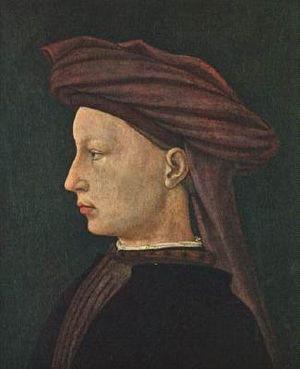
Masaccio: Portrait of a Young Man (circa 1425), Wood, National Gallery of Art, Washington, D.C.
Locations
People
Groups
Topics
Subjects
Regions
Subregions
Related Events
Showing 10 events out of 42131 total
Years: 1425 - 1425
Masaccio: Portrait of a Young Man (circa 1425), Wood, National Gallery of Art, Washington, D.C.
Locations
People
Groups
Topics
Subjects
Regions
Subregions