
Pope Pelagius II is a native of …
Years: 590 - 590
Pope Pelagius II is a native of Rome, but probably of Ostrogothic descent, as his father's name was Winigild.
Pelagius had ordered the construction of the Basilica di San Lorenzo fuori le Mura, a church shrine over the place where Saint Lawrence was martyred.
During his pontificate, the bishop of Milan, who had broken communion with Rome in the Schism of the Three Chapters, had returned to full communion around 581; other bishops in Northern Italy remain in schism.
During his reign also, the Visigoths of Spain have converted, but he also faces conflict with the See of Constantinople over the adoption of the title of "Ecumenical Patriarch," which Pelagius believes to undermine the authority of the papacy.
Locations
People
Groups
- Lombards (West Germanic tribe)
- East, or Oriens, Praetorian prefecture of
- Christianity, Chalcedonian
- Roman Empire, Eastern: Justinian dynasty
- Rome, Duchy of
- Lombards (Italy), Kingdom of the
Subjects
Regions
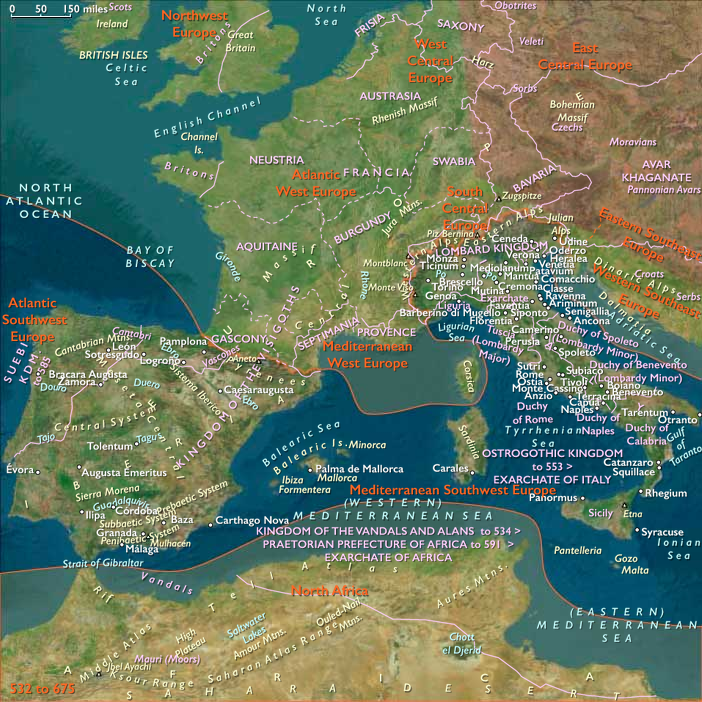
Subregions
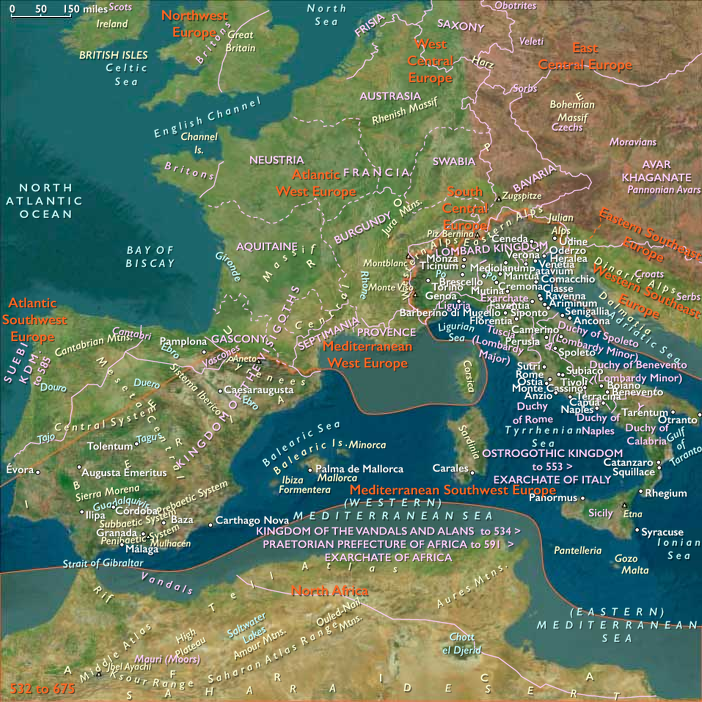
Related Events
Filter results
Showing 10 events out of 57245 total
Theodosius, eldest son of Maurice, is proclaimed as co-emperor on March 26, 590, becoming his father's heir to the imperial throne.
The Sangam literature mentions the early Pandya dynasty, which is believed to have gone into obscurity during the Kalabhra interregnum.
The dynasty is revived by Kadungon, who becomes king of the Pandyan Kingdom in about 590.
He is considered as the first important Pandya ruler.
Most of the scant knowledge of Kadungon comes from the Velvikudi (or Velvikkud) inscription of the Pandya king Parantaka Nedunchadaiyan (also Nedunjadaiyan or Nedunchezhiyan).
According to this inscription, Kadungon defeated several petty chieftains and destroyed "the bright cities of unbending foes".
It describes him as the one who liberated the Pandya country from the Kalabhras and emerged as a "resplendent sun from the dark clouds of the Kalabhras".
His defeat of Kalabhras (who are probably Jains or Buddhists) is hailed as the triumph of Brahminism.
Kadungon's title is "Pandyadhiraja", and his capital is Madurai.
He is succeeded by his son Maravarman Avanisulamani.
The Council of Narbonne in 590 forbids Jews from chanting Psalms while burying their dead.
Anyone violating this law is subject to a fine of six ounces of gold.
In addition, all Jews married to Christian woman must baptize their children.
Gregory, who Pelagius had in 579 made permanent papal ambassador at the court of Emperor Tiberius in Constantinople, had returned to his monastery from a five-year stint in Constantinople, and had been elected abbot.
As bishop, he has organized and increases the revenues from the Roman ecclesiastical estates, which he uses largely to ameliorate the social misery of the day.
Pelagius has appealed for help against the Lombards from Emperor Maurice, the Roman Senate having made him a gift of thousands of pounds of gold for this purpose, but Constantinople has been of little help.
Pelagius had been forced to buy a truce and turn to the Franks, who had invaded Italy but departed after being bribed by the Lombards.
Pope Pelagius II falls victim to the plague that devastates Rome at the end of 590.
Gregory is chosen pope, the first monk to attain this high office.
He elects to be known as the "servant of the servants of God" (”servus servorum Dei)”.
Pelagius had labored to promote the celibacy of the clergy, and had issued such stringent regulations on this matter that his successor thinks them too strict, and modifies them to some extent.
Maurice establishes the Exarchate of Carthage in Africa.
He combines the civil authority of a praetorian prefecture and the military authority, based at Carthage.
Guntram’s Failed Campaign Against Waroch II of Brittany (589–590 CE)
In 589 or 590 CE, King Guntram of Burgundy launches an expedition against Waroch II, ruler of Brittany's Veneti (Vanetais), to enforce Frankish authority. The campaign is marked by internal Frankish rivalries, Saxon intervention on behalf of the Bretons, and Waroch’s continued resistance—ultimately resulting in yet another inconclusive Frankish attempt to subdue Brittany.
1. Guntram’s Military Expedition: Internal Rivalries Weaken the Frankish Forces
- Guntram entrusts the campaign to two generals, Beppolem and Ebrachain, who are known to be personal enemies.
- This internal division weakens Frankish coordination, as Ebrachain does not fully support Beppolem in battle.
- Their mutual enmity complicates the campaign, as they are more focused on outmaneuvering each other than on defeating Waroch.
2. Fredegund’s Intervention: Saxons of Bayeux Support Waroch
- Fredegund, Queen Regent of Neustria, also an enemy of Ebrachain, sends Saxon auxiliaries from Bayeux to assist Waroch.
- This Neustrian-Breton alliance further weakens Guntram’s Burgundian campaign, showing how Frankish internal rivalries aid Brittany’s independence.
3. The Three-Day Battle and the Death of Beppolem
- Beppolem fights alone against the Bretons for three days, receiving no support from Ebrachain.
- After Beppolem’s death in battle, Waroch attempts to flee to the Channel Islands, likely seeking refuge.
4. Ebrachain’s Victory and Waroch’s Forced Submission
- Ebrachain, despite his rivalry with Beppolem, continues the campaign and destroys Waroch’s ships, cutting off his escape.
- Waroch is forced to submit, renew his oath of loyalty to the Franks, and surrender a nephew as a hostage.
5. Continued Breton Defiance: A Hollow Victory for the Franks
- Despite the peace agreement, Brittany continues to resist Frankish domination.
- Waroch and his successors maintain their independent course, refusing to fully integrate into the Frankish kingdom.
- The Franks’ repeated failures to subjugate Brittany reveal:
- The effectiveness of Breton guerrilla tactics.
- The impact of internal Frankish conflicts on military campaigns.
- The inability of the Merovingians to fully impose control over the region.
Conclusion: Another Failed Frankish Attempt to Conquer Brittany
The 589–590 CE campaign against Waroch II ultimately achieves little for Guntram. While the Bretons momentarily submit, their independence remains intact, and Frankish influence remains nominal at best. The internal conflicts between Frankish nobles and Fredegund’s intervention further weaken the Frankish effort, allowing Brittany to continue resisting Frankish domination well into the medieval period.
The Trial and Exile of Egidius, Bishop of Reims (c. 590 CE)
In circa 590 CE, Egidius, Bishop of Reims, is tried before a council of bishops in Metz for his alleged involvement in a conspiracy against King Childebert II of Austrasia. Found guilty, he is sentenced to exile in Strasbourg, marking another episode in the ongoing struggles between the Frankish monarchy and the Church.
1. The Conspiracy Against Childebert II
- Egidius, a prominent bishop in Austrasia, is accused of plotting against King Childebert II.
- The nature of the conspiracy is unclear, but it likely involves:
- Collaboration with Childebert’s rivals (potentially Guntram of Burgundy or Neustrian factions).
- Opposition to royal control over the Church, as bishops increasingly acted as political figures.
- The accusations lead to his trial before an episcopal council, a method often used to discipline rebellious clerics while maintaining Church jurisdiction over its own leaders.
2. The Trial at Metz and the Verdict
- The trial is held at Metz, the capital of Austrasia, ensuring Childebert’s direct oversight of the proceedings.
- The council of bishops, serving as judges, find Egidius guilty of conspiracy.
- Instead of execution or harsher punishment, he is exiled to Strasbourg, a city still within Austrasian control but far from his previous power base.
3. The Political and Religious Significance of Egidius’ Exile
- A Warning to the Church – The trial demonstrates that bishops, despite their influence, are not untouchable and must remain loyal to the Merovingian kings.
- Royal Control Over the Clergy – Childebert II strengthens monarchical authority over the Church, ensuring bishops cannot act independently in political affairs.
- Growing Tensions Between Kings and Bishops – Egidius’ case highlights the continuing struggle between Frankish rulers and the powerful episcopate, which sought to maintain autonomy.
4. Conclusion: A Reflection of Power Struggles in Merovingian Gaul
The trial and exile of Egidius of Reims in 590 CE reflect the complex relationship between the Frankish monarchy and the Church. While bishops wielded immense power, they were not immune to royal authority. Childebert II’s decisive action reinforces the king’s control over his kingdom, ensuring that the Church remained subordinate to royal power, a conflict that would continue to shape medieval Frankish politics.
Celestial Phenomena in Northern Gaul (590 CE): Fiery Globes and Unusual Brightness
According to Gregory of Tours, a vast region of northern Gaul is illuminated as brightly as noonday in 590 CE, a rare and unexplained celestial event. In addition, he records multiple instances of fiery globes crossing the night sky, lighting up the earth. These accounts suggest that bolides (large meteors or fireballs) were frequent during this period, possibly signaling increased meteoric activity or atmospheric disturbances.
1. Gregory of Tours’ Observations
- Gregory reports that in 590 CE, a wide swath of northern Gaul was suddenly illuminated with a brightness equal to that of noon.
- On multiple occasions throughout the year, people observed fiery globes moving across the night sky, momentarily turning darkness into daylight.
2. Possible Explanations for These Phenomena
A. Meteoric Activity and Bolides
- Gregory’s descriptions closely match meteor outbursts or bolide events, where large fireballs enter the Earth’s atmosphere and explode, creating intense flashes of light.
- The high frequency of reported sightings suggests a possible meteor shower peak, similar to the modern Leonids or Perseids, but of greater intensity.
B. Cometary Fragments or Airbursts
- Some historical celestial events are linked to cometary debris, which can produce brilliant fireballs when entering the atmosphere.
- The 590 CE event could have been caused by a cometary fragment disintegrating over northern Gaul, producing an exceptionally bright atmospheric explosion.
C. Volcanic or Atmospheric Optical Effects
- A high-altitude volcanic eruption, possibly from Iceland or the Mediterranean, could have injected aerosols into the stratosphere, creating unusual optical phenomena.
- These atmospheric disturbances might have intensified the brightness of meteors, making them appear more spectacular.
3. Impact on Medieval Society and Interpretations
- Medieval observers, including Gregory of Tours, often interpreted such celestial phenomena as omens of war, famine, or divine warnings.
- The sixth century was already a period of instability, marked by plagues, climate anomalies, and famine, which may have heightened apocalyptic fears.
- These events may have reinforced religious sentiment, strengthening the belief in divine intervention in earthly affairs.
4. Conclusion: A Remarkable Year for Celestial Events
The frequent bolide sightings and unexplained brightness over northern Gaul in 590 CE suggest a period of increased meteoric activity or other rare atmospheric events. Gregory of Tours’ account remains one of the earliest documented records of widespread meteor fireballs, providing valuable historical insight into celestial phenomena in the early medieval period.
Gregory, archdeacon of Rome, works to convert English slaves sold in the Roman market, calling them Angels if they will become Christians.
Pope Pelagius II, after an eleven-year reign, falls victim on February 7 to the plague that is devastating Rome.
He is succeeded by Gregory I, age fifty, as the sixty-fourth pope.
Gregory begins a vigorous program of rebuilding aqueducts and restoring Rome.
He feeds the citizens with doles of grain, as under Roman imperial rule.
Years: 590 - 590
Locations
People
Groups
- Lombards (West Germanic tribe)
- East, or Oriens, Praetorian prefecture of
- Christianity, Chalcedonian
- Roman Empire, Eastern: Justinian dynasty
- Rome, Duchy of
- Lombards (Italy), Kingdom of the
