
Pope Benedict XIII has endeavored to put …
Years: 1724 - 1724
February
Pope Benedict XIII has endeavored to put a stop to the decadent lifestyles of the Italian priesthood and of the cardinalate.
He has also abolished the lottery in Rome.
A man fond above all of asceticism and religious celebrations, according to Cardinal Lambertini (later Pope Benedict XIV) he "did not have any idea about how to rule".
(Rendina, Claudio (1993). I papi. Storia e segreti. p. 590. Rome: Newton Compton.)
The government is effectively held in his lieu by Cardinal Niccolò Coscia, who had been Benedict's secretary when he was archbishop of Benevento, and who has committed a long series of financial abuses at his own advantage, causing the ruin of the Papal treasure.
According to Montesquieu, "All the money of Rome go to Benevento... as the Beneventani direct [Benedict's] weakness". (Rendina, p. 592) In foreign politics, he has struggled with John V of Portugal and the Jansenists.
He has repealed the world-wide smoking ban set by Pope Urban VIII.
Benedict XIII, whose orders are descended from Scipione Rebiba, has personally consecrated at least 139 bishops for various important European sees, including German, French, English and New World bishops.
These bishops in turn will consecrate bishops almost exclusively for their respective countries, causing other episcopal lineages to die.
As a result, more than ninety percent of present-day bishops trace their episcopal lineage through him to Cardinal Rebiba.
He had in 1727 inaugurated the famous Spanish Steps and founded the University of Camerino.
Benedict dies on February 21, 1730 and is buried in a tomb in Santa Maria sopra Minerva completed by Pietro Bracci and others.
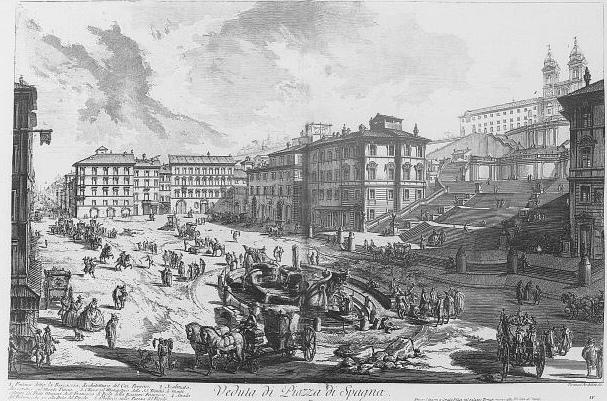
The piazza di Spagna in an 18th-century etching by Giuseppe Vasi, seen from south. The street on the left is Via del Babuino, leading to Piazza del Popolo.Piranesi, Giambattista "Illustrations de Antichita Romanae", 1748.
Locations
People
Groups
- Papal States (Republic of St. Peter)
- Christians, Roman Catholic
- Naples, Kingdom of
- Jesuits, or Order of the Society of Jesus
- Habsburg Monarchy, or Empire
- Portugal, Bragança Kingdom of
- Chinese Empire, Qing (Manchu) Dynasty
- Britain, Kingdom of Great
Commodoties
Subjects
Regions
Subregions
Related Events
Showing 1 events out of 1 total
Years: 1724 - 1724
February
The piazza di Spagna in an 18th-century etching by Giuseppe Vasi, seen from south. The street on the left is Via del Babuino, leading to Piazza del Popolo.Piranesi, Giambattista "Illustrations de Antichita Romanae", 1748.
Locations
People
Groups
- Papal States (Republic of St. Peter)
- Christians, Roman Catholic
- Naples, Kingdom of
- Jesuits, or Order of the Society of Jesus
- Habsburg Monarchy, or Empire
- Portugal, Bragança Kingdom of
- Chinese Empire, Qing (Manchu) Dynasty
- Britain, Kingdom of Great
Commodoties
Subjects
Regions
Subregions