
Pope Benedict III, who had intervened in …
Years: 858 - 858
Pope Benedict III, who had intervened in the conflict between the sons of Lothair I (the future Lothair II, Louis II and Charles the Bald) on the latter's death, has been active in other cases and adopted a firm position towards Constantinople.
During his reign, Æthelwulf of Wessex and his youngest son, the future Alfred the Great, have visited Rome.
At Benedict’s death on April 7, 858, Emperor Louis II, who is in the neighborhood of Rome, enters the city to exert his influence upon the election.
On April 24, a deacon named Nicholas, born to a distinguished family as the son of the Defensor Theodore, is elected pope, consecrated, and enthroned in St. Peter's in the presence of the emperor.
Three days later, he holds a farewell banquet for the emperor, and afterward, accompanied by the Roman nobility, visits him in his camp before the city, on which occasion the emperor comes to meet the pope and leads his horse for some distance.
Locations
People
- Alfred the Great
- Charles the Bald
- Lothair II, King of Lotharingia
- Louis II of Italy
- Pope Nicholas I
- Æthelwulf of Wessex
Groups
- Franks
- Anglo-Saxons
- Christianity, Chalcedonian
- Wessex, English Kingdom of
- Papal States (Republic of St. Peter)
- Frankish, or Carolingian (Roman) Empire
- Roman Empire, Eastern: Phrygian or Armorian dynasty
Commodoties
Subjects
Regions
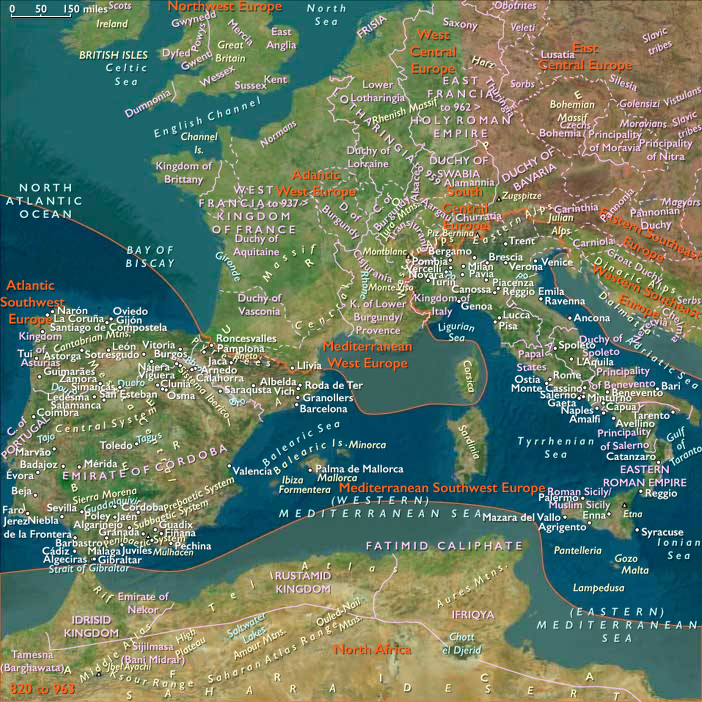
Subregions
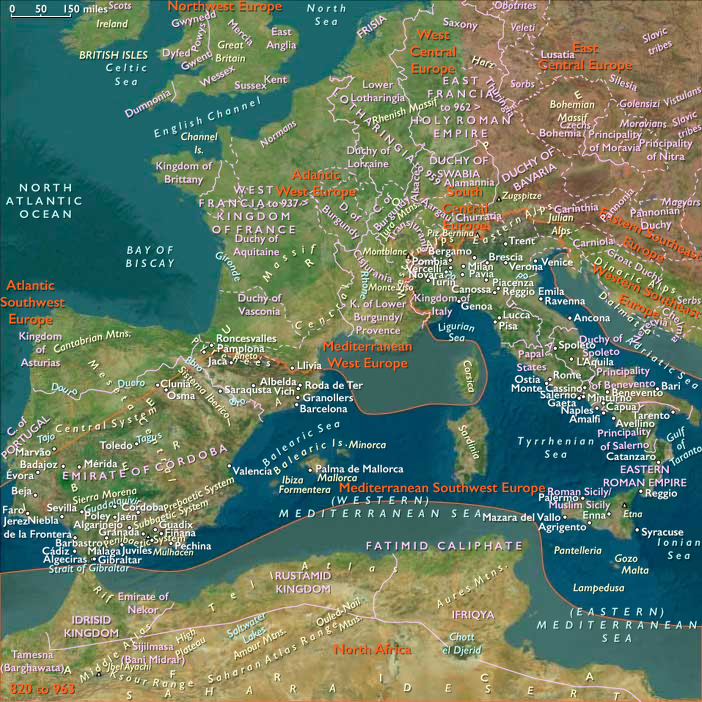
Related Events
Filter results
Showing 10 events out of 14 total
Lower Lorraine, following the death of Duke Richar, son of Duke Godfrey, had been directly ruled by the Emperor until 977, when Otto II enfeoffs Charles, the exiled younger brother of King Lothair of France.
The Origins of Brussels: From Marshland Hamlet to Medieval Stronghold
The name Brussels is commonly believed to derive from the Old Dutch term Broeksel, meaning "home in the marsh"(broek meaning marsh, sel meaning dwelling). This etymology reflects the city's origins in the low-lying, waterlogged terrain of the Senne River valley.
Early Beginnings: The Chapel of Saint Gaugericus (c. 580)
The earliest recorded settlement in the Brussels area dates back to c. 580, when Saint Gaugericus, a Frankish bishop, constructed a chapel on an island in the Senne River. This island, strategically located along trade routes, would later serve as the nucleus of the city.
By 695, the settlement was known as Brosella, as recorded by Saint Vindicianus, the Bishop of Cambrai. At this point, it remained a modest hamlet, overshadowed by larger urban centers in Lower Lotharingia.
The Official Founding: Duke Charles of Lower Lotharingia (979)
Brussels' emergence as a fortified town is traditionally traced to 979, when Duke Charles of Lower Lotharingia made a decisive act of religious and political significance:
- He transferred the relics of Saint Gudula from Moorsel to the Chapel of Saint Gaugericus, elevating the settlement’s status as a religious center.
- Around the same time, Charles constructed the first permanent fortification on the Senne island, marking the beginnings of Brussels as a defensible urban center.
The Foundation for Growth
The establishment of a fortified nucleus in Brussels ensured its strategic importance in the evolving political landscape of Lotharingia. Over the coming centuries, its position along trade routes, combined with its religious and military significance, would lay the groundwork for Brussels’ rise as one of the most influential cities in the Low Countries.
Hugh Capet’s Rise to the French Throne and the End of the Carolingians (987)
In 987, the death of Louis V, the last Carolingian king of West Francia, ushered in a dynastic shift that would shape France for centuries. The French magnates, wary of continuing Carolingian rule, elected Hugh Capet, Count of Paris and Duke of the Franks, as king, formally marking the end of the Carolingian dynasty and the beginning of Capetian rule.
The Decline of Carolingian Power and the Rise of Hugh Capet
Hugh Capet had been a powerful noble for years, but his influence was limited by the fragmentation of the Capetian family’s holdings:
- He had already lost control of Anjou and Blois, key sections of the Capetian domain, to increasingly independent subordinate counts.
- Throughout the reign of Lothair (954–986), Capet had persistently intrigued against the Carolingian king, weakening royal authority.
When Lothair died in 986, his son, Louis V, inherited an already diminished and politically unstable realm. His sudden death in 987, without an heir, left the Carolingian succession in crisis.
Capet’s Election and the Carolingian Threat
Rather than recognizing the legitimate Carolingian claimant, Charles, Duke of Lower Lorraine (Lothair’s brother), the French nobles instead elected Hugh Capet as king in July 987. The decision reflected:
- The nobility’s distrust of Charles, who had sworn allegiance to the Holy Roman Emperor, making him an unacceptable candidate.
- The shift in power toward the great territorial lords, who saw Capet as a weaker, more manageable ruler than the independent-minded Carolingians.
Charles, however, did not concede defeat and contested Capet’s rule. His claim to the throne remained a serious challenge in the early years of Capetian rule.
The Capetian Nucleus: Île-de-France and the Struggle for Control
As king, Hugh Capet ruled over a shrunken French state, with his direct authority largely confined to Île-de-France, the small duchy centered on Paris, also called Francia.
- Unlike the Carolingians, who had ruled vast territories (even if indirectly), Hugh Capet’s power was limited by the autonomy of the great dukes and counts.
- His early reign was preoccupied with consolidating control over his immediate domain, laying the groundwork for what would eventually become the Kingdom of France.
Legacy: The Foundations of Capetian Rule
Despite its modest beginnings, Capetian rule would prove enduring, as the dynasty eventually extended its power beyond Île-de-France. The Capetian line maintained an unbroken succession for centuries, ensuring France’s gradual unification into a powerful medieval kingdom.
Hugh Capet’s election in 987 thus marked a decisive turning point in French history, as Carolingian legitimacy gave way to feudal kingship, with Paris as the political heart of the emerging French state.
William IV of Aquitaine: The Iron Arm and His Struggle for Independence (963–990)
William IV of Aquitaine, known as Fierebras ("Iron Arm"), ruled as Duke of Aquitaine and Count of Poitou from 963. A warlike and independent-minded noble, he spent much of his reign embroiled in conflicts against the Counts of Anjou and later against Hugh Capet, the first Capetian King of France. His resistance to Capetian authority and his support for the Carolingian claimant to the throne positioned him as one of the most formidable opponents of the newly established French monarchy.
Family and Early Life
William IV was the son of William III of Aquitaine and Gerloc (Adela of Normandy), daughter of Rollo, the Viking founder of Normandy. His sister, Adelaide, became the wife of Hugh Capet, forging an uneasy familial connection between the Capetians and the House of Poitiers.
William’s early rule was shaped by conflict and territorial ambition:
- He inherited Aquitaine after his father’s abdication to the Abbey of Saint-Cyprien in Poitiers, a monastic retirement that William himself would later emulate.
- His reign was characterized by frequent wars, particularly against the Counts of Anjou, in an effort to secure control over disputed borderlands.
- He fought Geoffrey Greymantle, Count of Anjou, who had seized Loudun, a key strategic stronghold in Poitou.
A Stormy Marriage and Monastic Retirement
In 968, William married Emma (or Emmeline) of Blois, daughter of Theobald I of Blois and Luitgarde of Vermandois. However, their union was deeply troubled:
- William’s infidelity and obsession with hunting led to repeated tensions.
- Emma banished his mistresses and they separated twice for extended periods.
- Eventually, following the example of his father, William retired to a monastery, leaving Emma to govern Aquitaine on behalf of their son, William V.
War with Hugh Capet (988)
Following the death of Louis V, the last Carolingian king, in 987, William IV refused to recognize Hugh Capet as the legitimate ruler of France.
- Hugh Capet, who had once been granted Aquitaine by King Lothair, renewed his claim on the duchy after taking the throne.
- In 988, he launched a royal invasion of Aquitaine, seeking to impose Capetian authority over the powerful and independent duchy.
- William IV decisively defeated Capet’s forces on the plains of the Loire Valley, ensuring Aquitaine’s continued autonomy from the French crown.
Protector of the Carolingian Heir
A committed opponent of Capetian rule, William IV extended his support to Louis, the young son of Charles, Duke of Lower Lorraine, the last Carolingian claimant to the throne.
- He welcomed Louis to Poitiers, treating him as royalty, and recognized him as the rightful king of France.
- His defiance of Hugh Capet reinforced Aquitaine’s status as a quasi-independent principality, resisting integration into the nascent Capetian state.
Legacy and the Future of Aquitaine
William IV’s resistance to Capetian rule set the stage for Aquitaine’s continued semi-autonomous status throughout the early Capetian era. His retirement from rule, leaving Duchess Emma to govern in the name of their son, ensured that the House of Poitiers retained power and influence.
While his wars and personal scandals defined his rule, his defiance of Hugh Capet and support for the Carolingian heir demonstrated that Aquitaine was not yet ready to submit to the authority of the French monarchy, a reality that would persist for centuries.
The Struggle for Reims: Arnulf, Charles of Lorraine, and the Carolingian Resistance (989–991)
The death of Archbishop Adalberon of Reims on January 23, 989, created an important vacancy in one of the most politically influential sees in West Francia. His chosen successor, Gerbert of Aurillac, was a natural candidate, given his loyalty to Hugh Capet and his opposition to the Carolingian cause. However, the election that followed took an unexpected turn, leading to a brief Carolingian resurgence under Charles of Lorraine.
Hugh Capet’s Strategic Mistake: The Appointment of Arnulf
Rather than securing the election of Gerbert, Hugh Capet, in March 989, instead accepted the appointment of Arnulf, the illegitimate son of Lothair of France and nephew of Charles of Lorraine, the last legitimate Carolingian heir.
- The choice was likely a compromise intended to pacify lingering Carolingian sympathizers while maintaining royal authority over Reims.
- However, Arnulf soon proved disloyal, betraying Hugh in favor of his Carolingian uncle.
The Carolingian Coup: Charles of Lorraine Takes Reims and Laon (September 989)
By September 989, Arnulf facilitated an attempt to place Charles of Lorraine on the throne.
- Charles launched a military campaign, seizing both Reims and Laon, two of the most important cities of the realm.
- With control over Reims, where West Frankish kings were traditionally crowned, Charles briefly posed a serious challenge to Capetian rule.
A Short-Lived Threat
Although Charles of Lorraine succeeded in capturing key cities, his attempt to claim the French throne ultimately failed.
- Hugh Capet and his son Robert II responded decisively, moving to counter the Carolingian resurgence.
- By 991, Charles and Arnulf would be captured through treachery, marking the final collapse of Carolingian legitimacy in West Francia.
Legacy: The Securing of Capetian Rule
The events of 989–991 demonstrated the fragility of Capetian authority in its early years. Hugh Capet’s decision to allow a Carolingian prince to assume power in Reims had nearly led to a restoration of the Carolingian line. However, the failure of Charles of Lorraine to garner widespread support and his subsequent fall in 991 ensured that the Capetian dynasty remained unchallenged, solidifying their hold on the French throne.
Conan I and the Reunification of Brittany (990)
In the spring of 990, Conan I, Count of Rennes, assumed the title of Duke of Brittany, following his successful attack on Nantes and the subsequent death of Count Alan. His rise to power marked the end of a period of fragmentation in Brittany, as he sought to unify the duchy under his rule.
The End of Fractured Rule
Brittany had endured a prolonged period of instability following the death of Drogo of Brittany, whose regency had governed the duchy. After his passing, Brittany fractured under the divided rule of his brothers:
- Hoël and Guerech controlled different regions, resulting in a brief vacancy in the ducal title.
- This political disunity weakened the duchy and left it vulnerable to external pressures.
Conan I emerged as the dominant Breton leader, but before he could secure the title of Duke, he had to ally himself with Odo I, Count of Blois, a powerful regional figure who helped consolidate his claim.
Marriage Alliance with Anjou
Long before assuming the title of Duke, Conan had reinforced his position through a dynastic marriage:
- In 973, he wed Ermengarde-Gerberga of Anjou, daughter of Geoffrey I, Count of Anjou, and Adele of Vermandois.
- This alliance with the House of Anjou bolstered Conan’s standing among the great feudal lords of northwestern France.
Religious Patronage and Land Grants
As Duke, Conan I extended land grants to religious institutions, strengthening ties with the powerful monastic orders. In a charter dated July 28, 990, he granted Villamée, Lillele, and Passille to Mont Saint-Michel—territories that would later become part of the seigneury of Fougères.
A More Unified Brittany
With his consolidation of power in 990, Conan I helped end the fractured rule that had plagued Brittany, asserting ducal authority over Rennes and Nantes. Though tensions among Breton nobles persisted, his reign marked the beginning of a more centralized rule in the duchy, setting the stage for future Bretons to assert their independence within the feudal order of medieval France.
Charles of Lorraine Captures Reims; Hugh Capet Seeks Arnulf’s Deposition (989–991)
Following his invasion of Reims in 989, Charles of Lorraine successfully captured the city and took Archbishop Arnulf—his own nephew—prisoner. This bold move marked a serious challenge to Hugh Capet’s authority, as Reims was the traditional coronation site of West Frankish kings and a center of royal legitimacy.
Hugh Capet’s Response: The Deposition of Arnulf
Despite being a Carolingian prince, Arnulf had initially been accepted as Archbishop of Reims by Hugh Capet. However, his betrayal and support for Charles led Hugh to consider him a traitor. In retaliation, Hugh:
- Refused to recognize Arnulf as archbishop, declaring him a turncoat for aiding the Carolingian claimant.
- Sought Papal intervention, demanding that Pope John XV depose Arnulf from his position.
The Struggle for Control of Reims
With Charles of Lorraine controlling Reims, the city briefly became a Carolingian stronghold, reinforcing his claim to the West Frankish throne. However, his failure to secure widespread support meant that his resurgence remained short-lived.
Hugh Capet’s diplomatic and political maneuvering against Arnulf and Charles would soon culminate in Charles' downfall and the final end of Carolingian ambitions in France.
Odo I of Blois: A Staunch Carolingian Loyalist in the Capetian Struggle (977–996)
Odo I, Count of Blois, was a powerful noble and a staunch supporter of the Carolingian cause, standing in opposition to Hugh Capet and the newly established Capetian dynasty. His alliances and military campaigns placed him at the center of the struggles for control over France and Brittany in the late 10th century.
Inheritance and Early Conflicts
- Odo inherited his father’s vast holdings in Blois, Chartres, Châteaudun, Tours, and Saumur after Theobald I's death around 977.
- Following his father’s war with Archbishop Odalric of Reims over the Castle of Coucy, Odo received the castle and held it as a fief of the archbishopric.
Expansion into Brittany and Rivalry with Conan I
- During the 970s, Odo extended his influence into Brittany, subjugating the County of Rennes.
- However, in 990, Conan I, newly established as Duke of Brittany, asserted his family’s ancestral rights in the region, challenging Odo’s dominance.
Alliance with Charles of Lorraine (988)
- Odo remained loyal to the Carolingians, aligning himself with Charles of Lorraine, the last legitimate Carolingian heir.
- In 988, he aided Charles in seizing Laon, a key stronghold in the battle against Hugh Capet.
Turning Against the Carolingians and Conflict with Hugh Capet (991–996)
By 991, however, Odo abandoned the Carolingian cause, likely recognizing the waning prospects of Charles of Lorraine.
- At Dreux, he withdrew his support for the Lorrainers, signaling a shift in his ambitions.
- Instead, he besieged Melun, a stronghold belonging to Bouchard the Venerable, a loyal vassal of Hugh Capet.
Hugh, responding to this direct challenge to his authority, assembled a powerful coalition:
- Richard I of Normandy, an early Capetian supporter.
- Fulk Nerra, Count of Anjou, a rival of Odo and a key ally of the Capetians.
Under pressure from this formidable alliance, Odo was forced to lift the siege, dealing a setback to his ambitions.
Legacy and Impact
Despite his initial support for the Carolingians, Odo ultimately acted in his own interests, shifting allegiances as needed. His involvement in Brittany, the wars of succession, and conflicts with the Capetians ensured that the House of Blois remained a major player in France’s feudal landscape. However, his failure to decisively challenge Hugh Capet reinforced the Capetians' consolidation of power, marking the beginning of a new era in French monarchy.
he Deposition of Arnulf and the Contested Appointment of Gerbert of Aurillac (991–996)
By 991, Hugh Capet had secured his dynasty’s future by making his son, Robert II, joint sovereign, ensuring a smooth Capetian succession. However, he still faced a lingering Carolingian threat, particularly from Charles of Lorraine and his nephew, Arnulf of Reims, both of whom had sought to restore Carolingian rule.
The Synod of Reims and the Deposition of Arnulf (June 991)
After capturing both Charles of Lorraine and Archbishop Arnulf, Hugh Capet sought to eliminate the Carolingian presence from ecclesiastical and political power.
- In June 991, he convened a synod at Reims, composed of loyal French bishops, to formalize his control over the archbishopric.
- The synod obediently deposed Arnulf, citing his betrayal in supporting Charles of Lorraine against the Capetians.
- To replace him, the bishops elected Gerbert of Aurillac, one of the most brilliant scholars of the age and a staunch supporter of the Capetian cause.
Rome’s Rejection and the Summoning of an Imperial Synod
Despite Hugh’s efforts, Gerbert’s appointment faced strong opposition:
- Pope John XV refused to recognize the legitimacy of the Reims synod, declaring that a French royal council lacked authority to depose an archbishop without papal approval.
- The pope called for a second synod, held outside of Capetian territory, in the imperial city of Aachen, to reconsider Arnulf’s case.
- When the French bishops refused to attend, Pope John XV summoned them to Rome, demanding an independent ruling on Arnulf’s deposition.
French Defiance and the Struggle Over Church Authority
The Capetian-aligned bishops declined to travel to Rome, citing unsettled conditions on the route and political instability in the city. Their refusal underscored the growing tensions between the papacy and the emerging Capetian monarchy, as Hugh Capet sought to assert greater royal control over the French Church, a pattern that would continue throughout the medieval period.
Legacy: The Rise of Gerbert and Capetian-Papal Tensions
- Though Gerbert of Aurillac remained in Reims for a time, his position was not universally accepted, forcing him to later align with the Ottonians in the Holy Roman Empire.
- Arnulf, though deposed, still had support from Rome, reflecting the ongoing struggle between the pope and secular rulers over ecclesiastical appointments.
- This conflict over Reims foreshadowed later investiture struggles, as monarchs sought to secure loyal clergy while the papacy insisted on supremacy in Church matters.
Though Hugh Capet succeeded in neutralizing the Carolingian threat, his defiance of papal authority set an early precedent for Capetian involvement in ecclesiastical affairs, a dynamic that would shape French monarchy-church relations for centuries.
Years: 858 - 858
Locations
People
- Alfred the Great
- Charles the Bald
- Lothair II, King of Lotharingia
- Louis II of Italy
- Pope Nicholas I
- Æthelwulf of Wessex
Groups
- Franks
- Anglo-Saxons
- Christianity, Chalcedonian
- Wessex, English Kingdom of
- Papal States (Republic of St. Peter)
- Frankish, or Carolingian (Roman) Empire
- Roman Empire, Eastern: Phrygian or Armorian dynasty
