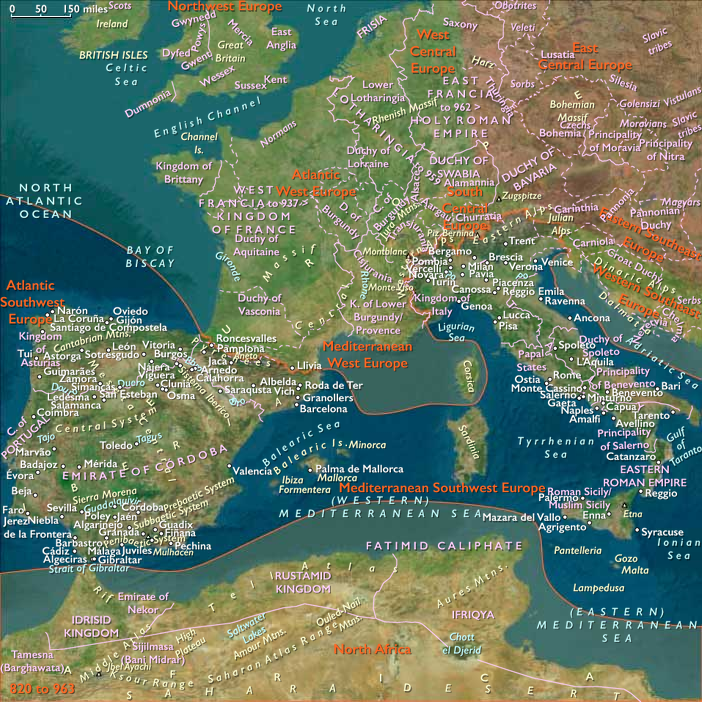
Pope Anastasius III is a Roman by …
Years: 913 - 913
Pope Anastasius III is a Roman by birth.
A Roman nobleman, Lucian, is sometimes recognized as his father, although other sources assert that he was the illegitimate son of his predecessor Pope Sergius III.
Almost nothing is recorded of Pope Anastasius III, his pontificate falling in the period when Rome and the Papacy are in the power of Theophylact, Count of Tusculum, and his wife Theodora, who had approved Anastasius III's candidacy.
Under his reign the Normans of Rollo have been evangelized.
Locations
People
Groups
Topics
Subjects
Regions
Subregions
Related Events
Filter results
Showing 10 events out of 53406 total
The Yan State at present-day Beijing, established by Liu Shouguang in 911, only lasts for two years before destroyed by Li Cunxu, the son of Li Keyong and the prominent leader of what will become the Later Tang Dynasty.
As the only ruler of Yan, Liu wis noted for his cruelty, so this Yan is also called Jie Yan, which compares the regime to a former one under the cruel king Jie in Xia Dynasty.
Alexander finds himself attacked by the forces of Al-Muqtadir of the Abbasid Caliphate in the East, and provokes a war with Simeon I of Bulgaria by refusing to send the traditional tribute on his accession.
According to John Kinnamos, the tzykanion, a kind of polo adopted by the Empire from Sassanid Persia, was played by two teams on horseback, equipped with long sticks topped by nets, with which they tried to push an apple-sized leather ball into the opposite team's goal: mounted lacrosse.
The Great Palace of Constantinople features a tzykanisterion, first built by Emperor Theodosius II (r. 408–450) on the southeastern part of the palace precinct.
It was demolished by Basil I in order to erect the Nea Ekklesia church in its place, and rebuilt in larger size further east, connected to the Nea with two galleries.
Aside from Constantinople and Trebizond, other cities of the Empire also feature tzykanisteria, most notably Sparta, Ephesus, and Athens, an indication of a thriving urban aristocracy.
These are also used as places of public tortures and executions, as it is historically recorded for the tzykanisteria of Constantinople and Ephesus.
The sport is very popular among the Empire’s nobility: Emperor Basil I (r. 867–886) excelled at it; Emperor Alexander dies of exhaustion after a game of tzykanion on June 6, 913, allegedly fulfilling his brother's prophesy that he would reign for thirteen months.
The sources are uniformly hostile towards Alexander, who is depicted as lazy, lecherous, and malignant, including the rumor that he planned to castrate the young Constantine VII in order to exclude him from the succession.
At least that charge did not come to pass, but Alexander leaves his successor a hostile regent (Nicholas Mystikos) and the beginning of a long war against Bulgaria.
The sources also accuse the Emperor of idolatry, including making pagan sacrifices to the golden statue of a boar in the Hippodrome in hope of curing his impotence.
The Doukas family, first prominent in the ninth century, suffers a setback when Constantine Doukas, son of General Andronikos Doukas, loses his life attempting to become emperor in 913.
Bulgarian khan Simeon launches another campaign against the Greeks, in which he advances to Constantinople in 913, but withdraws without fighting after securing tributes from the empire.
The war between the Sajids and the Bagratids continues, during which the country is devastated and the Armenians suffer from religious oppression at the hands of the Muslims.
Yusuf manages to trap Smbat in one of his fortresses in about 913.
Although the siege is unable to force the surrender of the fortress, Smbat decides to voluntarily surrender himself to Yusuf in an effort to end the war.
Yusuf initially lets him go, but then seizes him and puts him in prison for a year.
Hasan al-Utrush was born in Medina around 844; his father was a descendant of Husayn ibn Ali, the grandson of Muhammad and third Shi'a Imam, via his eldest son Zayn al-Abidin, while his mother was an unnamed enslaved Khurasani.
When Hasan ibn Zayd, a descendant of Husayn's brother Hasan, established his rule over Tabaristan in the 860s, Hasan had joined him there.
However, he eventually fell out with Hasan ibn Zayd's brother and successor, Muhammad ibn Zayd, who distrusted him.
Hasan left Tabaristan and tried to set up a realm of his own in the provinces further east.
To this end, he had allied himself with the ruler of Khurasan, Muhammad ibn Abdallah al-Khujistani, who was an enemy of Muhammad ibn Zayd.
Soon, however, al-Khujistani too had come to distrust him and had him imprisoned and scourged, as a result of which he lost his hearing and received the sobriquet al-Utrush ("the Deaf"), by which he is known.
When he was released from imprisonment, Hasan had returned to Tabaristan and the service of Muhammad ibn Zayd.
Hasan had been present and fought alongside the latter in the disastrous battle in 900 at Gurgan against the Samanid army of Muhammad ibn Harun al-Sarakhsi.
Muhammad ibn Zayd had been defeated and died of his wounds, leaving Tabaristan open to Samanid occupation.
Hasan had managed to escape the defeat and at first sought refuge in Rayy, where he received the invitation of the Justanid king of Daylam, who had also supported and served the Zaydid brothers.
Together, Hasan and the Justanids had tried in 902 and 903 to recover control of Tabaristan, but without success.
Worried by the fickleness of the Justanids, Hasan had resolved to build a power base of his own, and engaged in a mission to the as yet unconverted Gilites and the Daylamites to the north of the Alburz mountains, where he preached in person and founded mosques.
His efforts were swiftly crowned by success: the mountain Daylamites and the Gilites east of the Safid Rud river recognized him as their imam with the name of al-Nāṣir li'l-Ḥaqq ("Defender of the True Faith") and were converted to his own branch of Zaydi Islam, which is named after him as the Nasiriyya and differs in some practices from the "mainstream" Qasimiyya branch adopted in Tabaristan following the teachings of Qasim ibn Ibrahim.
This development had threatened the position of the Justanid king, Justan ibn Vahsudan, but in the ensuing showdown between the two, Hasan was able to affirm his position and compel the Justanid to swear allegiance to him.
The Samanid ruler Ahmad ibn Isma'il, seeing Hasan's rise to power, sends an army under Muhammad ibn Sa'luk to Tabaristan to oppose a new Zaydid takeover of the province.
Although the Samanid force is far superior in numbers and equipment, Hasan manages to inflict a crushing defeat upon it in December 913 at Burdidah on the river Burrud west of Chalus.
A detachment that manages to find refuge in the fortress of Chalus is induced to surrender and then massacred by his son-in-law, Abu Muhammad al-Hasan ibn al-Qasim.
After this success, the provincial capital Amul opens its gates to the Zaydid forces, and Hasan takes up residence in the palace.

Bhoja II (910–912) had been overthrown by Mahipala I (912–914).
Several feudatories of the empire take advantage of the temporary weakness of the Gurjar Pratiharas to declare their independence, notably the Paramaras of Malwa, the Chandelas of Bundelkhand, and the Kalachuris of Mahakoshal.
Mansur's oppressive taxation policies had sparked a revolt in Sistan within a year of his appointment.
The garrison at Zaranj was destroyed, and Mansur was captured.
Amr ibn Ya'qub, a Saffarid, was installed, first as a puppet for the leader of the rebellion, then as amir in his own right.
A Samanid army, however, under the control of Husain ibn 'Ali Marvarrudhi restores Samanid control to the region.
'Amr is sent to Samarkand; the other rebel leaders are killed.
Ahmed ibn-Kohrob, the rebellious governor of Sicily, having thrust out the Fatimids from the island, launches a successful assaults against the North African cities of Sfax and …
…Tripoli.
San Miguel de Escalada: A Mozarabic Masterpiece of Repoblación Architecture
San Miguel de Escalada is a monastery in the province of León, Spain, located ten kilometers from the Way of St. James, the renowned pilgrimage route to Santiago de Compostela.
Construction of the monastery begins during the reign of King Alfonso II of Asturias and is completed in 913 CE under his son, King García I of León.
San Miguel de Escalada stands as a remarkable example of Mozarabic architecture, also known as Repoblación art and architecture, a style developed by Christian communities influenced by Islamic artistic traditions during the Reconquista.