
Pope Adrian IV swiftly takes steps to …
Years: 1155 - 1155
Pope Adrian IV swiftly takes steps to regain control of Rome, and endeavors to bring down Arnold of Brescia, the leader of the anti-papal faction in the city.
Disorder within the city leads to the murder of a cardinal, causing the Pope, shortly before Palm Sunday 1155, to take the previously unheard-of step of putting Rome under interdict.
He allies with Emperor Frederick Barbarossa, who takes Rome by force in 1155 after a Holy Week interdict and forces Arnold again into exile.
Arnold is seized by Imperial forces and tried by the Roman Curia as a rebel.
Importantly, he is never accused of heresy.
Faced with the stake, he refuses to recant any of his positions.
Convicted of rebellion, Arnold is hanged in June and his body burnt.
Because he remains a hero to large sections of the Roman people and the minor clergy, his ashes are cast into the Tiber, to prevent his burial place becoming venerated as the shrine of a martyr.
Frederick, crowned Holy Roman Emperor in Rome by Pope Adrian IV, leaves Italy in the autumn of 1155 to prepare for a new and more formidable campaign.
Adrian IV during his reign issues a papal bull, Laudabiliter, granting dominion over Ireland to the English monarch, Henry II.
The bull makes Ireland a feudal possession of the King of England under the nominal overlordship of the papacy.
The title the English King is to hold over Ireland is "Lord of Ireland".
The theory of western Christendom is that certain states are recognized and others are not; Laudabiliter formally brings Ireland as a political entity into the European polity.
Locations
People
Groups
- Papal States (Republic of St. Peter)
- Ireland, medieval
- German, or Ottonian (Roman) Empire
- Italy, Kingdom of (Holy Roman Empire)
- Christians, Roman Catholic
- Rome, Commune of
- England, (Plantagenet, Angevin) Kingdom of
Topics
Commodoties
Subjects
Regions
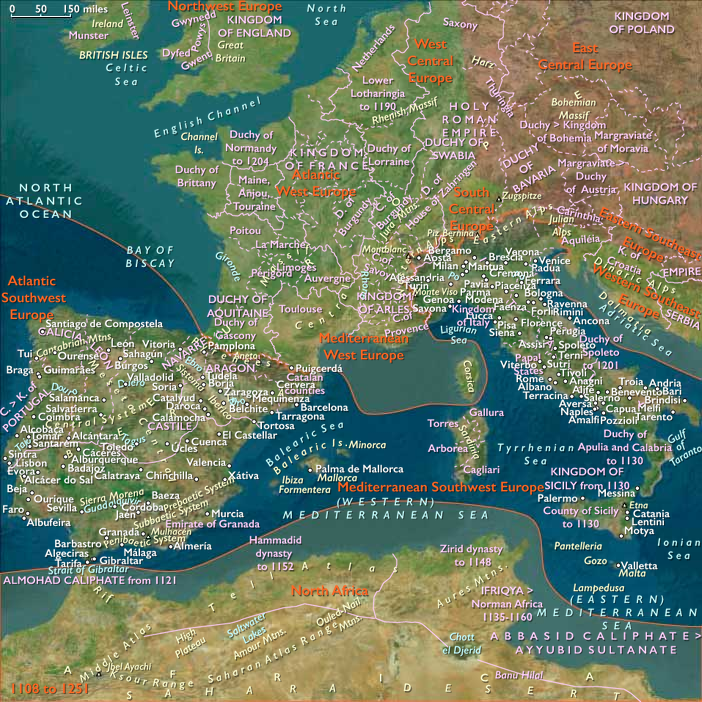
Subregions
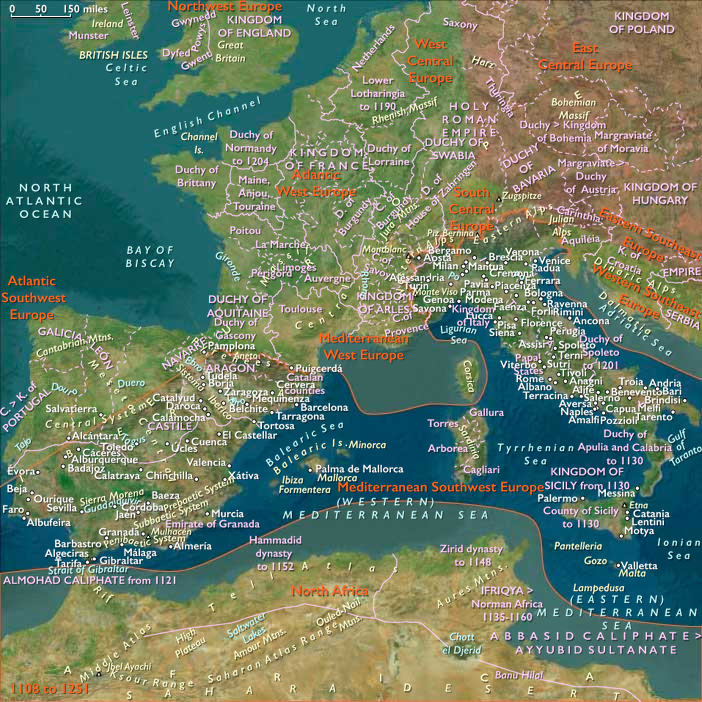
Years: 1155 - 1155
Locations
People
Groups
- Papal States (Republic of St. Peter)
- Ireland, medieval
- German, or Ottonian (Roman) Empire
- Italy, Kingdom of (Holy Roman Empire)
- Christians, Roman Catholic
- Rome, Commune of
- England, (Plantagenet, Angevin) Kingdom of
Topics
Commodoties
Subjects
Regions
Subregions