Pope Adrian, compelled to make a separate …
Years: 1157 - 1157
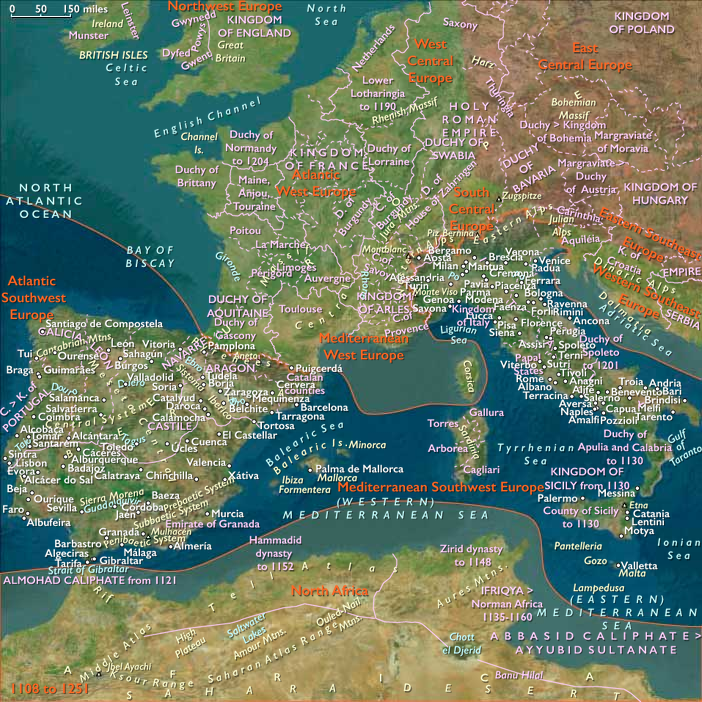
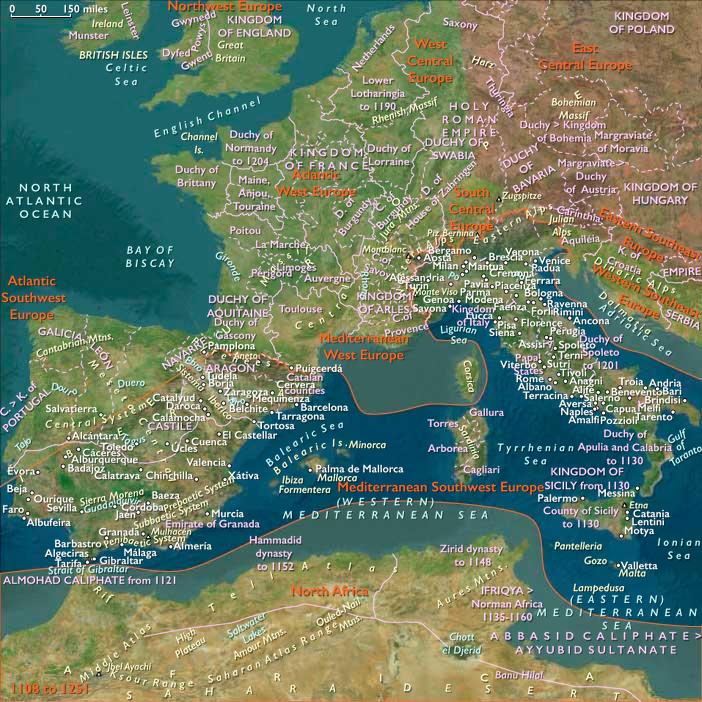
Pope Adrian, compelled to make a separate peace with Sicily in 1157 following William’s defeat of the imperial Greek forces at Brindisi, invests the Norman monarch as ruler of Sicily, Apulia, Capua, Naples, Amalfi, Salerno, and the Marsi.
Locations
People
Groups
- Greeks, Medieval (Byzantines)
- Papal States (Republic of St. Peter)
- Christians, Roman Catholic
- Roman Empire, Eastern: Komnenos dynasty, restored
- Italo-Normans
- Apulia and Calabria, Duchies of
- Sicily, Kingdom of
Topics
Subjects
Regions
Subregions
Related Events
Filter results
Showing 10 events out of 48576 total
Albert, called Albert the Bear, the only son of Otto, Count of Ballenstedt, and Eilika, daughter of Magnus Billung, Duke of Saxony, had inherited the valuable estates in northern Saxony of his father in 1123, and on his mother's death, in 1142, had succeeded to one-half of the lands of the house of Billung.
Albert was a loyal vassal of his relation, Lothar I, Duke of Saxony, from whom, about 1123, he had received the Margraviate of Lusatia, to the east; after Lothar became King of the Germans, Albert had accompanied him on a disastrous expedition to Bohemia in 1126, when he suffered a short imprisonment.
Albert's entanglements in Saxony stemmed from his desire to expand his inherited estates there.
After the death of his brother-in-law, Henry II, margrave of a small area on the Elbe called the Saxon Northern March, in 1128, Albert, disappointed at not receiving this fief himself, had attacked Udo, the heir, and was consequently deprived of Lusatia by Lothar.
In spite of this, he had gone to Italy in 1132 in the train of the king, and his services there were rewarded in 1134 by the investiture of the Northern March, which was again without a ruler.
Once he was firmly established in the Northern March, Albert's covetous eye lay also on the thinly populated lands to the north and east.
For three years, he had campaigned against the Slavic Wends, who as pagans are considered fair game, and whose subjugation to Christianity had been the aim of the Wendish Crusade of 1147 in which Albert took part; diplomatic measures were more successful, and by an arrangement made with the last of the Wendish princes of Brandenburg, Pribislav of the Hevelli, Albert had secured this district when the prince died in 1150.
Taking the title "Margrave of Brandenburg", he has pressed the "crusade" against the Wends, extended the area of his mark, encouraged German migration, established bishoprics under his protection, and so becomes the founder of the Margraviate of Brandenburg in 1157, which his heirs — the House of Ascania — will hold until the line dies out in 1320.
Wladyslaw II, the former High Duke of Poland, had administered the Kaiserpfalz at Altenburg and its dependencies in the Imperial Pleissnerland during the Second Crusade.
Without waiting for German aid, Wladyslaw and his wife Agnes had gone to the Roman Curia and asked Pope Eugene III for help in restoring Wladyslaw to the Polish throne but this attempt had been unsuccessful.
In 1152, King Conrad III of Germany had died and been succeeded by his nephew Frederick Barbarossa.
With this, the hopes of Wladyslaw II, called the Exile, of returning to Poland had been reborn.
Following the inducements of Wladyslaw and Frederick's aunt Agnes of Babenberg, the Holy Roman Emperor launches a new expedition to Greater Poland in 1157.
The campaign is a success, but unexpectedly Frederick Barbarossa does not restore Wladyslaw to the Polish throne, after Boleslaw IV, apprehended at Krzyszkowo, has to declare himself a vassal to the Emperor andis compelled to pay tribute to him.
In compensation, the Emperor forces Boleslaw IV to promise the restitution of Silesia to Wladylsaw's sons Boleslaw the Tall and Mieszko IV Tanglefoot.
At this time, it appears, Wladyslaw knew that his battle for supremacy in Poland was finally lost.
He remains in exile at Altenburg, where he will die two years later.
It will not be until 1163 that Boleslaw IV finally grants the Silesian province to Wladyslaw's sons.
Sancho III and Ferdinand II, the sons of King Alfonso VII of Castile, divide his kingdom between them upon his death.
Ferdinand receives León and Galicia, while his brother Sancho receives Castile and Toledo.
Frederick regards the Jews of his realm as both a duty to protect and a financial resource.
Upon his election as Emperor in 1157, he renews in perpetuity the privileges granted the Jews by his predecessor Henry IV.
Possessed of an exalted concept of his dignity as Roman emperor, Frederick introduces the word Holy in his title, intended to reflect a mystical association between himself and the destiny of Christianity.
Owain of Gwynedd, prince of north Wales, and Rhys ap Gruffydd, leader of south Wales, reconquer lands earlier taken from them by the Anglo-Normans.
King Henry II (who had ascended to the throne in 1154) decides to invade Gwynedd to halt the recent expansion of Owain into the lands of Powys, and to expand his empire into northern Wales.
With the support of the Prince of Powys Madog ap Maredudd and Owain's brother Cadwaladr ap Gruffydd (who Owain had recently stripped of his lands in Ceredigion), Henry leads a large army (claimed to be as many as thirty thousand men) into northern Wales and sends a fleet (led by Henry FitzRoy) to capture Anglesey to cut off Owain's supplies.
Owain responds by raising a Welsh army of around three thousand men.
Owain's army makes camp at Basingwerk to block the route to Rhuddlan.
Henry splits from his main army with a smaller force that will march through the nearby Ewloe woods (near Flintshire) to outflank Owain's army.
Sensing this, Owain is said to have sent a large army led by his sons Dafydd ab Owain Gwynedd and Cynan ab Owain Gwynedd into the woods to guard Owain's main force from Henry's outflanking army.
Owain splits his army and decides to personally lead an extra two hundred men into the Ewloe woods to reinforce his sons' armies.
When Henry's outflanking force advances into the wood, they are ambushed by Owain's forces and cut down.
The remainder of Henry's force retreat, with Henry narrowly avoiding being killed himself (having been rescued by Roger, Earl of Hertford).
Henry manages to escape back to his main army alive.
Not wishing to engage the Angevin army directly, Owain repositions himself first at St. Asaph, then further west, clearing the road for Henry II to enter into Rhuddlan "ingloriously".
Once in Rhuddlan, Henry II receives word that his naval expedition hadfailed.
Instead of meeting Henry II at Deganwy or Rhuddlan as the king had commanded, the English fleet had gone to plunder Môn and the Norman troops on board had been defeated by the local Welsh soldiers (Henry FitzRoy himself had also been killed).
Despite Owain's success in the Ewloe woods and his men on Anglesey's success, Henry has still succeeded in securing Rhuddlan, so Owain feels obliged to make peace with him.
Owain surrenders the lands of Rhuddlan and Tegeingl to Chester.
He also returns to Cadwaladr his lands in Ceredigion, which re-cements the alliance between the two brothers.
Owain also agrees to render homage and fealty to Henry.

Henry II in 1157 annexes the Scottish earldom of Northumberland inherited by William, the grandson of Scottish king David I.
Caliph Al-Muqtafi has been able to defend the 'Abbasid capital from various attacks, but he is ill-advised enough to support the rebellion of a son of the Seljuq Sultan of Hamadan, who in response marches against Baghdad and forces the Caliph to take refuge in the eastern quarter, initiating the Seljuq siege of Baghdad.
From January 12 to March 16, 1157, Al-Muqtafi successfully defends Baghdad against the coalition forces of Sultan Muhammad of Hamadan, and Atabeg Qutb-adin of Mosul.
Nur ad-Din Zengi had in 1154 achieved his goal of seizing Damascus and welding Syria into a Zengid empire.
Instead of confronting a group of Muslim emirates and being able to play them off against one another, the Crusader states (Kingdom of Jerusalem, County of Tripoli and Principality of Antioch) now face a unified threat to their existence.
Each year, the Damascenes pasture large flocks in the area of Banias on the Franks' territory, whose permission they had secured.
Baldwin unwisely attacks them in February 1157, seizing the animals to pay his kingdom's debts.
This act of aggression violates a truce.
Nur ad-Din, infuriated, immediately begins launching raids on the Franks in the vicinity and lays siege to the fortified town of Banias at the foot of Mount Hermon.
King Baldwin III of Jerusalem assembles a Frankish army in June and marches to the relief of Banias and its Knights Hospitaller defenders.
While Baldwin and his knights camp near Lake Huleh in the upper Jordan River valley, they are surprised and defeated by forces under Nur ad-Din.
Baldwin and his surviving soldiers take refuge in the nearby castle at Safad.
Losses are considerable.
Ibn al-Qalanisi, in his chronicle, the Dhail or Mudhayyal Ta'rikh Dimashq (Continuation of the Chronicle of Damascus) writes of many Crusader prisoners and severed heads being presented in a victorious celebration in Damascus.
Few consequences attend the Christian defeat beyond the heavy casualties suffered in the combat.
Banias will remain a Latin territory until 1164.
Nur ad-Din falls ill soon after his victory, and in his absence, Baldwin mounts a campaign in northern Syria.
The Franks fails in a siege of Shaizar but in the winter of 115 recover the castle of Harim for the Principality of Antioch.
Sweyn III, son of Eric Emune, had been declared king of Zealand and Scania after Eric III of Denmark abdicated in 1146, while Canute, son of king Magnus, had become king of Jutland.
Canute had made several attempts to conquer Zealand (1147 and 1150), but was driven off and fled to Germany, where he had managed to raise an army.
A battle had been fought in 1152 at Gedebæk, close to Viborg.
Canute had lost and appealed to the German king (later emperor), Frederick I Barbarossa, who commanded both kings to meet him at Merseburg.
Here, Frederick had confirmed Sweyn's rights of kingship, and Sweyn had sworn fealty to him.
The nobles of Denmark were growing concerned about the growing German influence.
Valdemar, having at first joined Sweyn, who had made him duke of Schleswig, changed sides and was betrothed to Canute's half-sister Sophie.
Both Canute and Sweyn had been hailed as kings in 1154 at the Landsting in Viborg.
The three contenders had agreed to share power, so that Valdemar would rule Jutland, Canute would rule the islands of Zealand and Funen, and Sweyn would rule Scania.
A reconciling feast is agreed upon, and it is held in Roskilde on August 9, 1157, where, according to Saxo Grammaticus, Sweyn ordered his men to kill the two other kings.
Canute is slain, but Valdemar, though wounded, managed to turn over some great candlesticks and escape in the following fire and confusion.
He flees in the darkness and manages to return to Jutland.
People flock to Valdemar's banner when Sweyn's treachery is revealed, and he gathers a great host.
Sweyn lands at Grenå (at the mouth of the Djurså stream), but his fleet is destroyed by a combination of force and guile.
Sweyn marches upon Randers and Valdemar retreats to the other side of the Gudenå river and tears down the bridge.
At the end of September Valdemar feels that he is sufficiently powerful to face Sweyn's army, and on October 23, the two armies meet at Grathe Heath in a battle that is short but vicious.
Sweyn fails to locate Valdemar's main force, and is suddenly attacked with such force that he flees his army.
He blunders into the swampy areas at one end of the Hauge Lake, and loses his weapons and armor.
Shortly afterwards, he is captured and killed with an ax, according to tradition, by angry peasants.
After his death, Sweyn is nicknamed Grathe, after the place where he lost both his crown and his life.
Valdemar, having outlived all his rival pretenders, becomes the sole King of Denmark, and sets to the work of reorganizing and rebuilding the war-torn country.
Years: 1157 - 1157
Locations
People
Groups
- Greeks, Medieval (Byzantines)
- Papal States (Republic of St. Peter)
- Christians, Roman Catholic
- Roman Empire, Eastern: Komnenos dynasty, restored
- Italo-Normans
- Apulia and Calabria, Duchies of
- Sicily, Kingdom of