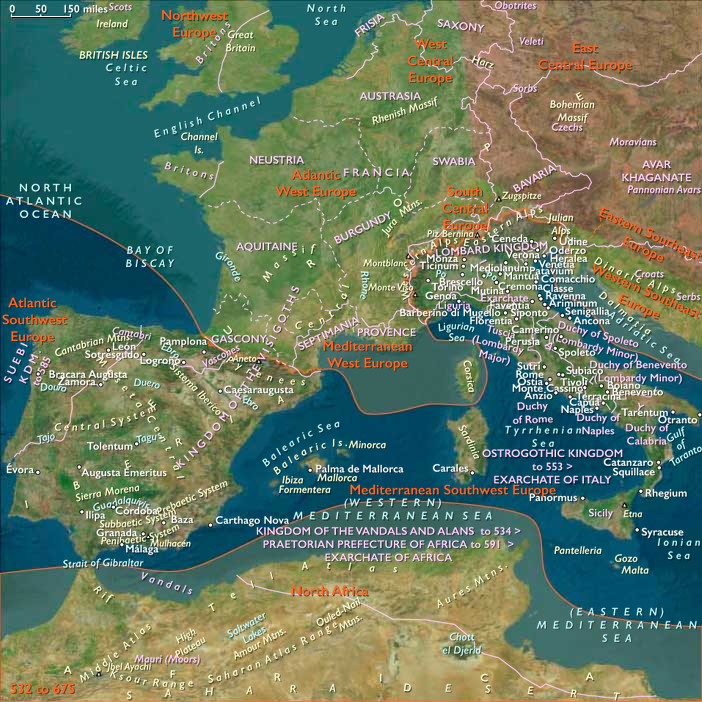
Pope Adeodatus II succeeds Pope Vitalian as …
Years: 673 - 673
Pope Adeodatus II succeeds Pope Vitalian as the seventy-seventh pope.
Locations
People
Groups
- Christianity, Chalcedonian
- Rome, Duchy of
- Ravenna, Exarchate of
- Roman Empire, Eastern: Heraclian dynasty
Topics
Subjects
Regions
Subregions
Related Events
Filter results
Showing 10 events out of 56223 total
Otomo commits suicide following the defeat of his forces in the war of imperial succession, called Jinjshin-no-ran in Japan, and Oama becomes Emperor Temmu Tenno.
He establishes his capital at Asuka in Yamato province (present-day Nara prefecture), a safe distance from the seats of Nakatomi and Soga power.
Hilderic, Governor of Nimes, revolts against Wamba, and many Jews join him.
One Duke Paul is sent from Toledo to put down the rebellion, but converts instead to Judaism.
The rebellion fails, however, and …
…the Jews of Narbonne are expelled.
The origins of the city of Ely lie in the foundation of an abbey in 673 one mile (one point six kilometers) to the north of the village of Cratendune on the Isle of Ely, under the protection of St Etheldreda, daughter of the late King Anna.
Muawiyah had sent an army under his son Yazid against the Roman Empire as early as 668.
Yazid, reachingas far as Chalcedon, hasd taken the important imperial center Amorion.
Although the city had been quickly recovered, the Arabs had next attacked Carthage and Sicily in 669.
In 670, the Arabs had captured Cyzicus and established a base from which to launch further attacks into the heart of the Empire.
Their fleet captured Smyrna and other coastal cities in 672.
Finally, in 672, the Arabs sent a large fleet to attack Constantinople by sea.
While the emperor, Constantine IV, was diverted by this action, the Slavs had unsuccessfully attacked Thessalonika.
The victories had ended in 674, however, when the first naval siege of Constantinople itself proved to be a catastrophe due to the defender’s effective use of Greek fire, invented around 670 in Constantinople by Kallinikos (Callinicus), an architect from Heliopolis in the Roman Iudaea Province.
Twentieth-century British chemist and historian James Partington will posit that "Greek fire was really invented by the chemists in Constantinople who had inherited the discoveries of the Alexandrian chemical school".
Many accounts note that the fires it caused could not be put out by pouring water on the flames—on the contrary, the water served to intensify or spread them, suggesting that 'Greek fire' may have been a 'thermite-like' reaction, possibly involving a quicklime or similar compound.
Others have posited a flammable liquid that floated on water, possibly a form of naphtha or another low-density liquid hydrocarbon, as petroleum was known to Eastern chemists long before its use became widespread in the 1800s.

'Uqbah is recalled in 674.
When the conquest of the Maghrib west of Tunisia is initiated by his successor, Abu al-Muh'jir Dyn'r, the Arabs must fight semi-settled Berber communities that have developed some tradition of centralized political authority.
Abu al-Muh'jir Dyn'r in the course of his campaign prevails upon the Berber “king” Kusaila to become Muslim.
Kusaila, from his base in Tlemcen, dominates a confederation of the Awr'ba tribes living between the western Aurés Mountains and the area of present-day Fés.
The Succession of Dagobert II and Theuderic III After the Death of Childeric II (675 CE)
After the assassination of King Childeric II in 675 CE, two Merovingian kings emerge as his successors:
- Dagobert II, the long-exiled son of Sigebert III, is restored to the throne of Austrasia.
- Theuderic III, another Merovingian prince, is installed as King of Neustria and Burgundy.
This division of power continues the pattern of Frankish territorial fragmentation, as Neustria and Austrasia once again operate as separate kingdoms under different rulers.
1. The Assassination of Childeric II and the Power Struggle
- Childeric II was murdered in 675 CE, leaving a vacuum of power in the Frankish kingdom.
- His death led to factional disputes among the Neustrian and Austrasian nobility, as different factions backed different claimants.
- The Mayors of the Palace, who had increasingly become the true power behind the Merovingian kings, played a decisive role in the selection of successors.
2. Dagobert II Returns from Exile to Rule Austrasia
- Dagobert II, the son of Sigebert III, had been exiled to Ireland as a child by the former Mayor of the Palace, Grimoald the Elder, in an attempt to usurp the Austrasian throne.
- After Childeric II’s death, Dagobert is restored to power in Austrasia, likely with the backing of the Austrasian nobility and the Church.
- His return signals an attempt to reassert Merovingian legitimacy in Austrasia.
3. Theuderic III Installed in Neustria and Burgundy
- In Neustria and Burgundy, the nobility appoints Theuderic III, another Merovingian prince, as king.
- Like many of his predecessors, Theuderic III serves largely as a figurehead, while real power is exercised by the Neustrian Mayors of the Palace.
- His rule marks the continued decline of Merovingian authority, as the aristocracy consolidates power.
4. The Continued Division of the Frankish Kingdom
- With Dagobert II ruling Austrasia and Theuderic III controlling Neustria and Burgundy, the Frankish realm is once again split into competing kingdoms.
- This division fuels ongoing conflicts between Austrasia and Neustria, as both sides seek to expand their influence.
Conclusion: The Merovingian Dynasty in Decline
The events following Childeric II’s death in 675 CE highlight:
- The continued fragmentation of the Frankish kingdom.
- The struggle between the Merovingians and the nobility, with the Mayors of the Palace becoming the real power in the realm.
- The brief restoration of Dagobert II, though his rule will later end in assassination in 679 CE, further weakening Merovingian legitimacy.
As the Merovingian kings grow increasingly weak, their fate will soon be sealed by the rise of the Carolingians, who will ultimately replace them as rulers of Francia.
A revolt within the Avar Empire, precipitated by the creation in the second half of the seventh century of the Bulgarian state in the southeastern Balkans, results in the expulsion of about nine thousand dissidents.
Years: 673 - 673
Locations
People
Groups
- Christianity, Chalcedonian
- Rome, Duchy of
- Ravenna, Exarchate of
- Roman Empire, Eastern: Heraclian dynasty