
Filters:
Relations between British colonists and natives, which …
Years: 1766 - 1766
August
Relations between British colonists and natives, which had been severely strained during the French and Indian War, had reached a new low during Pontiac's Rebellion.
People on both sides of the conflict had come to the conclusion that colonists and natives are inherently different and cannot live with each other.
The British government had also come to the conclusion that colonists and natives must be kept apart.
On October 7, 1763, the Crown had issued the Royal Proclamation of 1763, an effort to reorganize British North America after the Treaty of Paris.
The Proclamation, already in the works when Pontiac's War erupted, had been hurriedly issued after news of the uprising reached London.
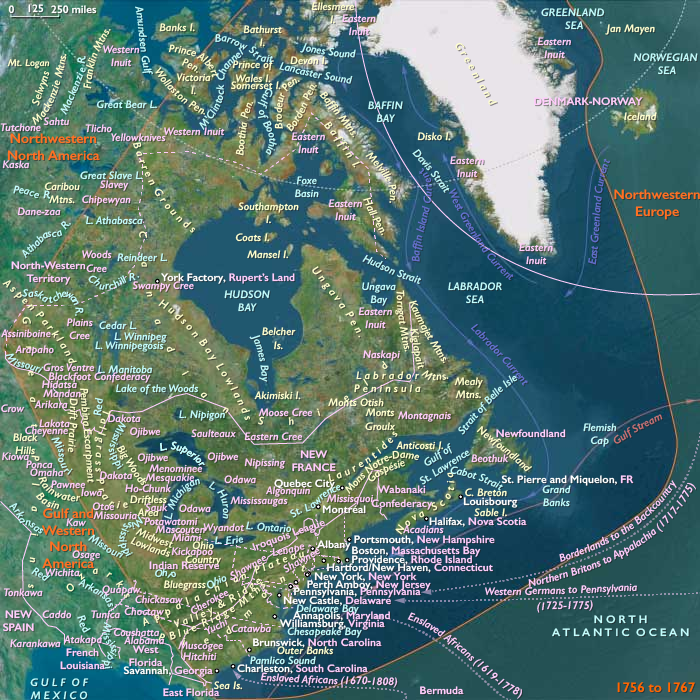
Officials had drawn a boundary line between the British colonies along the seaboard, and native lands west of the Allegheny Ridge (i.e., the Eastern Divide), creating a vast 'Indian Reserve' that stretched from the Alleghenies to the Mississippi River and from Florida to Quebec.
It thus confirmed the antebellum demarcation that had been set by the Treaty of Easton in 1758.
By forbidding colonists from trespassing on native lands, the British government hopes to avoid more conflicts like Pontiac's Rebellion.
People on both sides of the conflict had come to the conclusion that colonists and natives are inherently different and cannot live with each other.
The British government had also come to the conclusion that colonists and natives must be kept apart.
On October 7, 1763, the Crown had issued the Royal Proclamation of 1763, an effort to reorganize British North America after the Treaty of Paris.
The Proclamation, already in the works when Pontiac's War erupted, had been hurriedly issued after news of the uprising reached London.
Officials had drawn a boundary line between the British colonies along the seaboard, and native lands west of the Allegheny Ridge (i.e., the Eastern Divide), creating a vast 'Indian Reserve' that stretched from the Alleghenies to the Mississippi River and from Florida to Quebec.
It thus confirmed the antebellum demarcation that had been set by the Treaty of Easton in 1758.
By forbidding colonists from trespassing on native lands, the British government hopes to avoid more conflicts like Pontiac's Rebellion.
Locations
People
- Alexander McGillivray
- Benjamin Lincoln
- Blue Jacket
- George Croghan
- George III of Great Britain
- Guyasuta
- Henry Louis Bouquet
- John Bradstreet
- Joseph Brant
- Neolin
- Pontiac (Ottawa leader)
- Thomas Gage
- William Johnson, 1st Baronet
Groups
- Iroquois (Haudenosaunee, also known as the League of Peace and Power, Five Nations, or Six Nations)
- Wyandot, or Wendat, or Huron people (Amerind tribe)
- Miami (Amerind tribe)
- Lenape or Lenni-Lenape (later named Delaware Indians by Europeans)
- Ojibwa, or Ojibwe, aka or Chippewa (Amerind tribe)
- Odawa, or Ottawa, people (Amerind tribe)
- Seneca (Amerind tribe)
- Susquehannock (Amerind tribe)
- Mascouten (Amerind tribe)
- Kickapoo people (Amerind tribe)
- Potawatomi (Amerind tribe)
- Wea (Amerind tribe)
- Piankeshaw (Amerind tribe)
- Shawnees, or Shawanos (Amerind tribe)
- Ohio Country
- Thirteen Colonies, The
- Illinois Country
- Britain, Kingdom of Great
- Mingo (Seneca-Cayuga Tribe of Oklahoma)
Topics
- Colonization of the Americas, British
- Seven Years' War
- Pontiac's War (Pontiac's Rebellion of Conspiracy)
- American Revolution
Subjects
Regions
Subregions
Years: 1766 - 1766
August
Locations
People
- Alexander McGillivray
- Benjamin Lincoln
- Blue Jacket
- George Croghan
- George III of Great Britain
- Guyasuta
- Henry Louis Bouquet
- John Bradstreet
- Joseph Brant
- Neolin
- Pontiac (Ottawa leader)
- Thomas Gage
- William Johnson, 1st Baronet
Groups
- Iroquois (Haudenosaunee, also known as the League of Peace and Power, Five Nations, or Six Nations)
- Wyandot, or Wendat, or Huron people (Amerind tribe)
- Miami (Amerind tribe)
- Lenape or Lenni-Lenape (later named Delaware Indians by Europeans)
- Ojibwa, or Ojibwe, aka or Chippewa (Amerind tribe)
- Odawa, or Ottawa, people (Amerind tribe)
- Seneca (Amerind tribe)
- Susquehannock (Amerind tribe)
- Mascouten (Amerind tribe)
- Kickapoo people (Amerind tribe)
- Potawatomi (Amerind tribe)
- Wea (Amerind tribe)
- Piankeshaw (Amerind tribe)
- Shawnees, or Shawanos (Amerind tribe)
- Ohio Country
- Thirteen Colonies, The
- Illinois Country
- Britain, Kingdom of Great
- Mingo (Seneca-Cayuga Tribe of Oklahoma)
Topics
- Colonization of the Americas, British
- Seven Years' War
- Pontiac's War (Pontiac's Rebellion of Conspiracy)
- American Revolution
Subjects
Regions
Subregions