Pompey removes Azotus (Ashdod) from Jewish rule …
Years: 62BCE - 62BCE
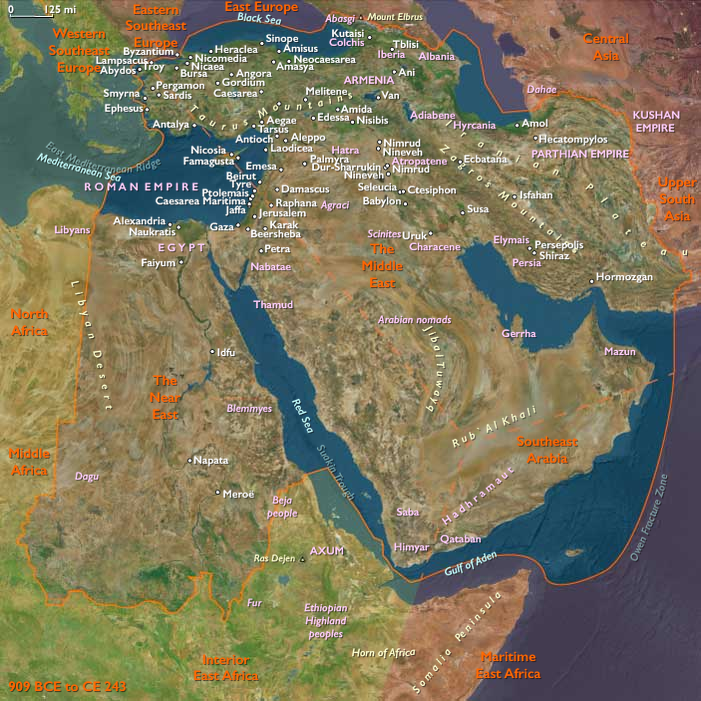
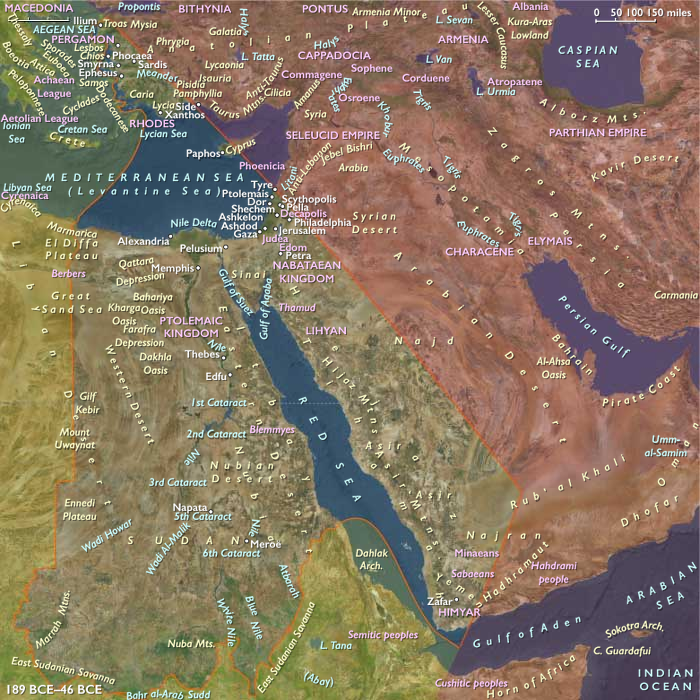
Pompey removes Azotus (Ashdod) from Jewish rule and annexes it to the province of Syria.
Locations
People
Groups
Topics
Commodoties
Subjects
Regions
Subregions
Related Events
Filter results
Showing 10 events out of 62596 total
Pompey, now free to plan the consolidation of the eastern provinces and frontier kingdoms, receives Tigranes graciously and for six thousand talents …
…he restores the king to the Armenian throne in exchange for Syria and other southern conquests, thereby establishing Tigranes as a friend and ally of Rome—and as his own protégé.
Tigranes continues to rule over Armenia as a Roman client-king, though he has lost all his conquests except Sophene and Corduene.
Rejecting a request by Parthian king Phraates III to recognize the Euphrates as the limit of Roman control, …
…Pompey extends the Roman chain of protectorates to include Colchis, on the Black Sea, and the states south of the Caucasus.
The organization of the East remains Pompey's greatest achievement.
His sound appreciation of the geographical and political factors involved has enabled him to impose an overall settlement that is to form the basis of the defensive frontier system and is to last, with few important changes, for more than five hundred years.
The Roman military has not been very successful in their campaigns against the Nabataeans.
In 62 BCE, Marcus Aemilius Scaurus accepts a bribe of three hundred talents to lift the siege of Petra, partly because of the difficult terrain and the fact Scaurus has run out of food provisions.
Hyrcanus, who is a friend of Aretas, is dispatched by Scaurus to the King to buy peace.
In so obtaining peace, King Aretas retains his whole possessions, including Damascus, and becomes a Roman vassal.
The country remains independent but pays imperial taxes.
(Roman policy seems to have been to maintain Nabataea as a buffer state against the desert tribes.
).
Ariovistus, chieftain of the Germanic Suebi tribe, had resumed the tribe’s migration from eastern Germany to the Marne and Rhine region in 71 BCE.
Despite the fact that this migration encroaches on Sequani land, the Gaulish Sequani seek Ariovistus’ allegiance against the Aedui, a numerous Celtic people occupying the drainage system of the upper Loire.
They are nearly between their neighbors to the northeast, the Sequani, who occupy the Doubs river valley, and the Arverni in the Massif Central.
When, in about 62 BCE, a Gaulish Roman client state, the Arverni, conspires with the Sequani and the Germanic Suebi nation east of the Rhine to attack the Aedui, a strong Roman ally, Rome turns a blind eye.
The Romans appear to be unconcerned about a conflict between non-client, client and allied states.
the Suebic leader Ariovistus and the events he was part of are known from Caesar's Commentarii de Bello Gallico.
Caesar, as a participant in the events, is a primary source, although as his Commentaries are in part political propaganda they may be suspected of being self-serving.
Later historians, notably Dio Cassius, are suspicious of his motives.
Caesar does not say what the cause of the conflict was, but the Sequani control access to the Rhine river along the valley of the Doubs.
To that end, they have gradually built up an oppidum or fortified town at Vesontio.
Tradesmen headed up the Rhone and its tributary the Saône (the ancient Arar) cannot pass the Doubs at Vesontio without coming to terms with the Sequani, nor can anyone pass from the Rhine to the Rhone except on similar terms.
The east of the entire great channel is bordered by the Jura mountains and the west by the Massif Central.
Vesontio is seventy-five miles (one hundred and twenty-one kilometers) from that stretch of the Rhine between Mulhouse and Basel.
The Arar forms part of the border between the Aedui and the Sequani.
Strabo, who lived a generation after Caesar in the late republic and early empire, does make a statement concerning the cause of the conflict between the Sequani and Aedui, and it was in fact commercial, at least in Strabo's view.
Each tribe claimed the Arar and the transportation tolls from traffic along it, "but now", says Strabo, "everything is to the Romans."
The Sequani also habitually supported the Germans in their previous frequent expeditions across the river, which shows that Ariovistus’ subsequent devastation of Sequani lands represented a new policy.
Lucullus, who had been prevented from celebrating his triumph at Rome until 63 (and had finally done so thanks in small part to the political maneuvering of both Cato and Cicero), now retires to enjoy a life of great extravagance, using the vast treasure he has amassed during his wars in the East to live a life of luxury.
He has splendid gardens outside the city of Rome, as well as villas around Tusculum and Neapolis.
The one near Neapolis includes fish ponds and man-made extensions into the sea, and is only one of many elite senators' villas around the Bay of Naples.
Pompey is said by Pliny to have referred often to Lucullus as "Xerxes in a toga".
(The adjective Lucullan, meaning “luxurious,” derives from his name.)
Among Lucullus' other contributions to fine dining, he is also responsible for bringing the sweet cherry and the apricot to Rome, developing major facilities for aquaculture, and being the only person in Rome with the ability to provide thrushes for gastronomic purposes in every season, having his own fattening coops.
Marcus Licinius Crassus—like Pompey, a former lieutenant of Sulla—had served as censor in 65.
During the 60s, while Pompey had been scoring military victories abroad, Crassus had been building a political following at Rome.
He uses his great wealth—derived largely from the sale of property confiscated by Sulla—to extend credit to indebted senators.
The increasingly conservative Cato, becoming tribune in 62, increases distribution of subsidized grain to blunt popular criticism, but otherwise resists all change.
Julius Caesar is elected a praetor for this year.
Toward the end of the year of his praetorship, a scandal is caused by Publius Clodius Pulcher, who enters Caesar's house disguised as a woman at the celebration there of the rites, for women only, of Bona Dea (a Roman deity of fruitfulness, both in the Earth and in women).
He is charged with sacrilege; Caesar, although he had refused to testify against Clodius, divorces Pompeia on suspicion of infidelity with Clodius.
Clodius meanwhile becomes a bitter enemy of Cicero, who gives evidence against him.
Caesar obtains the governorship of Farther Spain for 61-60, but he is still in considerable debt and needs to satisfy his creditors before he can leave.
He turns to Crassus, one of Rome's richest men.
In return for political support in his opposition to the interests of Pompey, Crassus pays a quarter of Caesar's debts and acts as guarantor for others.
Even so, to avoid becoming a private citizen and thus be open to prosecution for his debts, Caesar leaves for his province before his praetorship has ended.
While Catiline is preparing the army, the conspirators continue with their plans.
The conspirators observe that a delegation from the Allobroges is in Rome seeking relief from the oppression of their governor.
Lentulus Sura therefore instructs Publius Umbrenus, a businessman with dealings in Gaul, to offer to free them of their miseries and to throw off the heavy yoke of their governor.
He brings Publius Gabinius Capito, a leading conspirator of the equestrian rank, to meet them and the conspiracy is revealed to the Allobroges.
The envoys quickly take advantage of this opportunity and inform Cicero, who then instructs the envoys to get tangible proof of the conspiracy.
Five of the leading conspirators write letters to the Allobroges so that the envoys can show their people that there is hope in a real conspiracy.
However, a trap has been laid.
These letters are intercepted in transit to Gaul at the Mulvian Bridge.
Cicero then has the incriminating letters read before the Senate the following day, and shortly thereafter these five conspirators are condemned to death without a trial despite an eloquent protest by Julius Caesar.
Fearing that other conspirators might try to free Lentulus and the rest, Cicero has them strangled in the Tullianum, the notorious Roman prison, immediately.
He even escorts Lentulus to the Tullianum personally.After the executions, he announces to a crowd gathering in the Forum what had occurred.
Thus, an end is made to the conspiracy in Rome.
Cicero receives the honorific "Pater Patriae" for his efforts to suppress the conspiracy, but is to live hereafter in fear of trial or exile for having put Roman citizens to death without trial.

The failure of the conspiracy in Rome is a massive blow to Catiline.
Many men desert his army upon hearing of the death of Lentulus and the others, reducing the size from about ten thousand to a mere three thousand.
Catiline and his ill-equipped army, in vain attempts to avoid a battle, begin to march towards Gaul, then back towards Rome several times.
Inevitably, Catiline is forced to fight in January 62 BCE when Quintus Caecilius Metellus Celer with three legions in the north blocks his escape.
He chooses to engage Antonius Hybrida’s army near Pistoria (now Pistoia), hoping that he will lose the battle and dishearten the other Republican armies.
Catiline also hopes that perhaps he will have an easier time battling Antonius, whom he assumes will fight less determinedly, as he was once allied with Catiline.
Catiline may have still believed that Antonius Hybrida was conspiring with him, which may have been true as Antonius Hybrida will claim to have been ill on the day of the battle.
Catiline himself bravely fights as a soldier on the front lines of the battle and, once he sees that there is no hope of victory, throws himself into the thick of the fray.
When the corpses are counted, all Catiline’s soldiers are found with frontal wounds, and his corpse is found far in front of his own lines.
After Catiline’s death, many of the poor still regard him with respect and do not view him as the traitor and villain that Cicero claims he is.
The aristocratic element of Rome certainly views him in a much darker light, but many Romans still view his character with a degree of respect.
Well after Catiline's death and the end of the threat of the conspiracy, even Cicero will reluctantly admit that Catiline was an enigmatic man who possessed both the greatest of virtues and the most terrible of vices.
The Sequani reward Ariovistus with land in 61 BCE following his victory in the Battle of Magetobriga.
Ariovistus settles the land with one hundred and twenty thousand of his people.
When twenty-four thousand Harudes join his cause, Ariovistus demand that the Sequani give him more land to accommodate the Harudes people.
This demand 'concerns' Rome because if the Sequani concede, Ariovistus will be in a position to take all of the Sequani land and attack the rest of Gaul.
By this time, the Helvetii are well on their way in the planning and provisioning for a mass migration under the leadership of the wealthy aristocrat Orgetorix, who has persuaded the Helvetians to attempt to migrate from Helvetian territory to southwestern Gaul (modern-day France).
The reasons for their migration are mentioned by Caesar in separate passages as either harassment by the Germanic tribes, or not being able to in turn raid for plunder themselves due to their situation in hilly and mountainous territory.
Via council and parley, Orgetorix makes clandestine negotiations with the ambitious Sequani and the Roman-dominated Aedui.
The Sequani are beginning to resent and regret the abundance of unruly Germanic war bands and their huge encampments of dependents.
The Aedui are loath to obey the Roman spur any longer than they must and are keen to revisit their former days at council.
The parley for the trek is successful and Orgetorix is granted passage, and with the trek ratified by council, an army is called up and provisioned.
During this process, Orgetorix had also succeeded in making a personal alliance with the Sequanii chieftain Casticus and the Aedui chieftain Dumnorix through marital arrangements and host exchange of family members.
Orgetorix's Gallic rivals allege that these political successes and displays of diplomacy are intended to benefit Orgetorix alone and their claims are made more convincing by Roman intrigues and impositions.
Caesar, in Spain, has conquered two local tribes and is hailed as imperator by his troops, reforms the law regarding debts, and completes his governorship in high esteem.
Caesar’s military expedition beyond the northwest frontier of his province has enabled him to win loot for himself as well as for his soldiers, with a balance left over for the treasury.
As imperator, Caesar is entitled to a triumph.
However, he also wants to stand for consul, the most senior magistracy in the republic.
If he were to celebrate a triumph, he would have to remain a soldier and stay outside the city until the ceremony, but to stand for election he would need to lay down his command and enter Rome as a private citizen.
He cannot do both in the time available.
He asks the senate for permission to stand in absentia, but Cato blocks the proposal.
Faced with the choice between a triumph and the consulship, Caesar chooses the consulship.