
Pompey is supposedly infatuated with his bride. …
Years: 58BCE - 58BCE
Pompey is supposedly infatuated with his bride.
The personal charms of Julia are remarkable: she is a woman of beauty and virtue; and although policy had prompted her union, and she is twenty-three years younger than her husband, she possesses in Pompey a devoted husband, to whom she is, in return, devotedly attached.
A rumor suggests that the aging conqueror is losing interest in politics in favor of domestic life with his young wife.
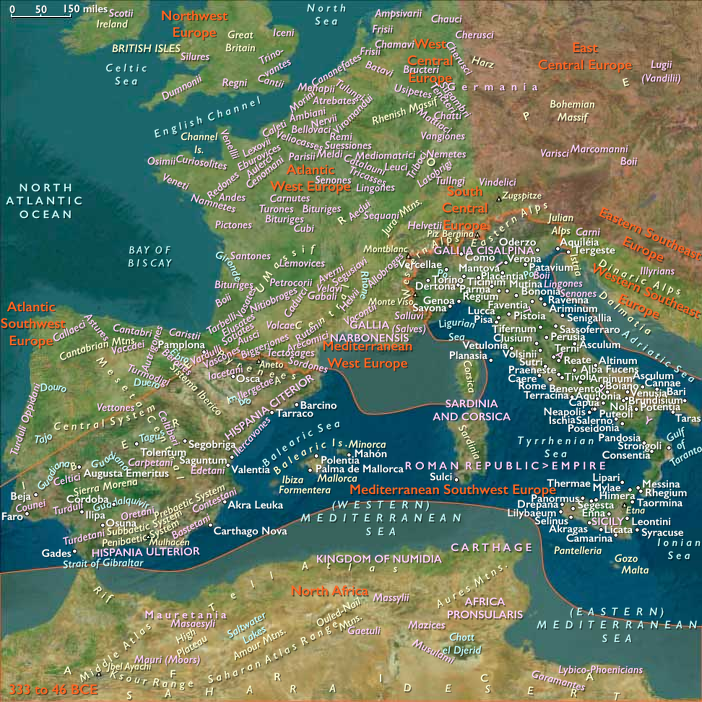
In fact, Pompey has been given the governorship of Hispania Ulterior, but has been permitted to remain in Rome to oversee the Roman grain supply as curator annonae, exercising his command through subordinates.
Ptolemy XII Auletes, fearing popular insurrection over the loss of Cyprus, flees in 58 BCE to Rome with his sister Cleopatra VII in search of political and military aid against Berenice's elder sister Cleopatra VI Tryphaena, who has become far too powerful.
He leaves his queen, Cleopatra V Tryphaena, and his eldest daughter, Berenice IV, as regents in Egypt.
Residing at Pompey's villa at Rome, he employs bribery to obtain the support of the Roman senators.
He also arranges the assassination of delegations sent by his opponents from Alexandria, where, following the death of his queen, the people have made Berenice IV sole ruler.
Aulus Gabinius, as praetor in 61, had tried to win public favor by providing games on a scale of unusual splendor, and in 58 manages to secure the consulship, although not without suspicion of bribery.
During his term of office, he aids Publius Clodius Pulcher, the tribune of the plebs, in introducing a law (the Leges Clodiae) threatening exile to anyone who executed a Roman citizen without a trial.
Cicero, having executed members of the Catiline conspiracy four years previously without formal trial, and having had a public falling out with Clodius, is clearly the intended target of the law.
Cicero argues that the senatus consultum ultimum indemnifies him from punishment, and he attempts to gain the support of the senators and consuls, especially of Pompey, who has become jealous of Cicero's prominence.
Caesar offers to protect Cicero in return for cooperation with the Triumvirate, but Cicero honorably refuses.
When legitimate aid is not forthcoming, Cicero goes into exile, arriving at Thessalonica, Greece, on May 23, 58 BCE.
The day Cicero leaves Italy into exile, Clodius proposes another law that forbids Cicero approaching within four hundred miles (six hundred and forty kilometers) of Italy and confiscates his property.
The bill is passed forthwith, and Cicero's villa on the Palatine is destroyed by Clodius' supporters, as are his villas in Tusculum and Formiae.
Cicero's property is confiscated by order of Clodius, his mall on the Palatine burned down, and its site put up for auction.
It is purchased by Clodius himself, who, not wishing his name to appear in the matter, had had someone else place the bid for him.
Clodius, becoming exhilarated with his power and importance, wastes no time enacting a substantial legislative program.
The Leges Clodiae include setting up a regular dole of free grain, which used to be distributed monthly at variously and heavily discounted prices, but is now to be given away at no charge, thereby increasing Clodius' political status.
Clodius also abolishes the right of taking the omens on a fixed day and (if they were declared unfavorable) of preventing the assembly of the comitia, possessed by every magistrate by the terms of the Lex Aelia Fufia.
He reestablishes the old social and political clubs or guilds of workmen, and the censors are forbidden from excluding any citizen from the Senate or inflicting any punishment upon him unless he has been publicly tried and convicted.
Out of personal hatred for the Lagid king Ptolemy of Cyprus, younger brother of Pharaoh Ptolemy XII Auletes, he passes a bill terminating his kingship and annexing Cyprus to the Empire.
He cleverly selects Cato the Younger to be sent to Cyprus with a special grant of praetorian command rights to take possession of the island and the royal treasures, and preside over the administrative incorporation of Cyprus into the Roman province of Cilicia.
This measure is planned both to remove Cato, potentially a serious and difficult opponent, from the City for some time (in the event, he is away for more than two years), and to turn him into an advocate for the legitimacy of Clodius' adoption and tribunate, which it also effects, later causing a great deal of friction between Cato and Clodius' bitterest enemies, especially Cicero.
Locations
People
- Aulus Gabinius
- Cato the Younger
- Cicero
- Cleopatra V of Egypt
- Cleopatra VII
- Pompey
- Ptolemy XII Auletes
- Ptolemy of Cyprus
- Publius Clodius Pulcher
Groups
Topics
Commodoties
Subjects
Regions

Subregions
Years: 58BCE - 58BCE
Locations
People
- Aulus Gabinius
- Cato the Younger
- Cicero
- Cleopatra V of Egypt
- Cleopatra VII
- Pompey
- Ptolemy XII Auletes
- Ptolemy of Cyprus
- Publius Clodius Pulcher
Groups
Topics
Commodoties
Subjects
Regions
Subregions