
Pomerania had been rather sparsely settled before …
Years: 1227 - 1227
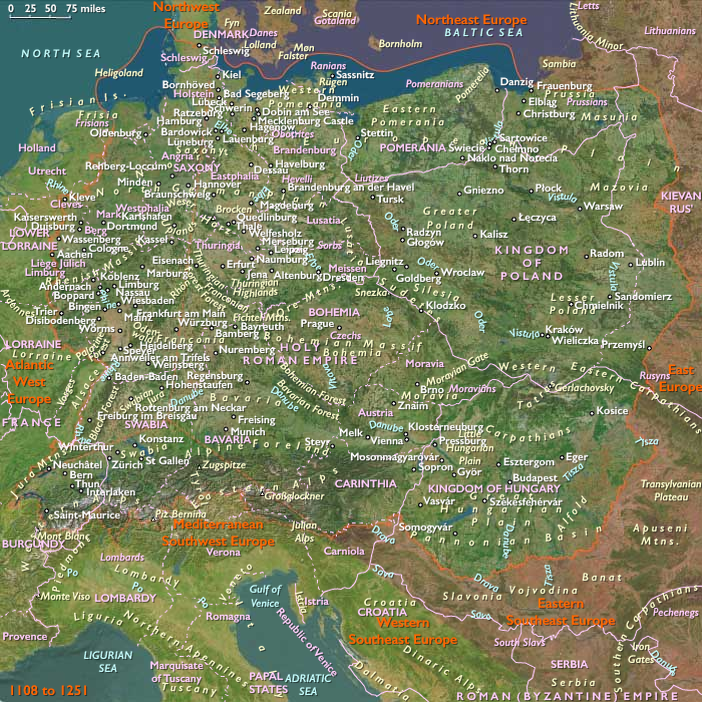
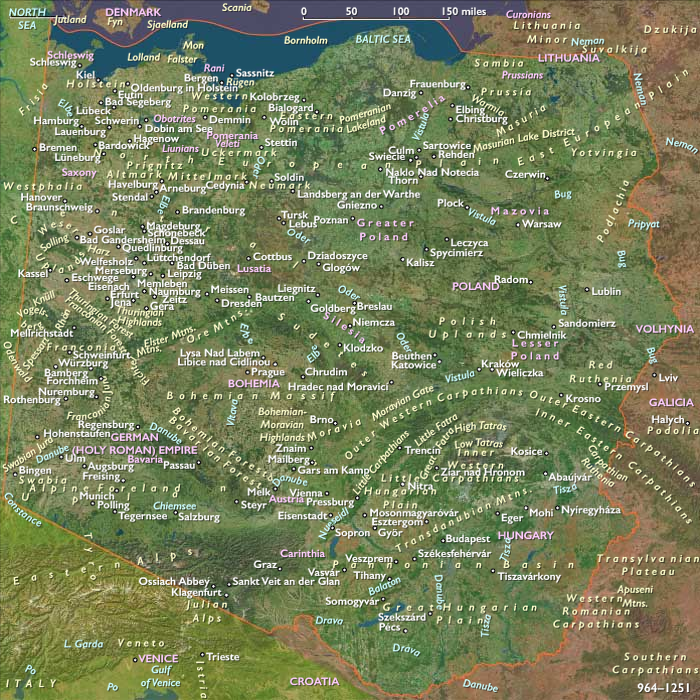
Pomerania had been rather sparsely settled before the Ostsiedlung.
A relatively dense population could be found around 1200 on the islands of Rügen, Usedom and Wollin, around the burghs of Stettin, Köslin, Pyritz (Pyritzer Weizacker) and Stargard, around the Persante river (Kolberg area), the lower Peene river, and between Schlawe and the Leba valley.
Largely unsettled were the hilly regions and the woods in the South.
The twelfth century warfare, especially the Danish raids, have depopulated many areas of Pomerania and caused severe population drops in others.
At the turn to the thirteenth century, only isolated German settlements existed, and the merchant's settlement near the Stettin burgh.
In contrast, the monasteries were almost exclusively run by Germans and Danes.
Massive German settlement has started in the first half of the thirteenth century.
Ostsiedlung is a common process at this time in all Central Europe and is largely run by the nobles and monasteries to increase their income.
Also, the settlers are expected to finish and secure the conversion of the non-nobles to Christianity.
In addition, the Danes withdraw from most of Pomerania in 1227, leaving the duchy vulnerable to its expansive neighbors, especially Mecklenburg, Brandenburg, and Henry I of Silesia.
Locations
People
Groups
- Polytheism (“paganism”)
- Germans
- Wends, or Sorbs (West Slavs)
- Polabians (West Slavic tribe)
- Denmark, Kingdom of
- Danes (Scandinavians)
- Saxony, Duchy of
- Poles (West Slavs)
- Christians, Roman Catholic
- Pomerania, Polish Duchy of
- Poland during the period of fragmentation, Kingdom of
- Brandenburg (Ascanian) Margravate of
Topics
- Ostsiedlung (German: Settlement in the East), a.k.a. German eastward expansion
- Poland, Fragmentation of
- Dano-Estonian War of 1219-27
Commodoties
Subjects
Regions
Subregions
Years: 1227 - 1227
Locations
People
Groups
- Polytheism (“paganism”)
- Germans
- Wends, or Sorbs (West Slavs)
- Polabians (West Slavic tribe)
- Denmark, Kingdom of
- Danes (Scandinavians)
- Saxony, Duchy of
- Poles (West Slavs)
- Christians, Roman Catholic
- Pomerania, Polish Duchy of
- Poland during the period of fragmentation, Kingdom of
- Brandenburg (Ascanian) Margravate of
Topics
- Ostsiedlung (German: Settlement in the East), a.k.a. German eastward expansion
- Poland, Fragmentation of
- Dano-Estonian War of 1219-27
Commodoties
Subjects
Regions
Subregions