Polygnatos’s student Micon of Athens, a Greek …
Years: 472BCE - 472BCE
Polygnatos’s student Micon of Athens, a Greek mural painter also known for his statues of athletes, executes a (now lost) figure of Callias at Olympia in 472.
Locations
People
Groups
Topics
Subjects
Regions
Subregions
Related Events
Filter results
Showing 10 events out of 65424 total
Themistocles, the son of Neocles, an Athenian of no distinction and moderate means, his mother being a Carian or a Thracian, had been the most influential politician in Athens, if not in Greece, in the year prior to the invasion of Xerxes.
Though the Greek fleet had been nominally under the control of the Spartan Eurybiades, Themistocles had caused the Greeks to fight the indecisive Battle of Artemisium, and more, it was he who brought about the Battle of Salamis, by his threat that he would lead the Athenian army to found a new home in the West, and by his seemingly treacherous message to Xerxes, whose fleet was lured into the channel between Salamis and the mainland and crushed.
This has left the Athenians free to restore their ruined city.
Sparta, on the ground that it is dangerous to Greece that there should be any citadel north of the Isthmus of Corinth which an invader might hold, has urged against this, but Themistocles has forestalled Spartan action by means of a visit to Sparta that had allowed diplomatic delays and subterfuges and enabled the work to be carried sufficiently near to completion to make the walls defensible.
He has also carried out his original plan of making Piraeus a real harbor and fortress for Athens.
Athens has thus become the finest trade center in Greece, and this, along with Themistocles' remission of the alien's tax, induces many foreign traders to settle in Athens.
After the crisis of the Persian invasion Themistocles and Aristides "the Just", with whom he had previously competed over the love of a boy, appear to have made up their differences.
One of the ten Athenian strategoi during the Greco-Persian war, Aristides has been instrumental in having Athens, rather than Sparta, become the ruling state of the Delian League.
But Themistocles had soon begun to lose the confidence of the people, partly due to his arrogance (it is said that he built near his own house a sanctuary to Artemis Aristoboulë ["of good counsel"]) and partly due to his alleged readiness to take bribes.
Diodorus and Plutarch both refer to some accusation leveled against him, and at some point between 476 and 471 he is ostracized (or banished).
The Greek art of the drama has its roots in religious festivals for the gods, chiefly Dionysus, the god of wine.
Dramatic competitions have become part of the City Dionysia in the spring.
The festival begins with an opening procession, continues with a competition of boys singing dithyrambs, and culminates in a pair of dramatic competitions.
The first competition is for the tragedians, and consists of three playwrights each presenting three tragic plays followed by a shorter comedic satyr play.
A second competition of five comedic playwrights follows, and the winners of both competitions are chosen by a panel of judges.
Aeschylus, after the death of Phrynichus, one of his chief rivals, was by 473 BCE the yearly favorite in the Dionysia, winning first prize in nearly every competition.
Often recognized as the father or the founder of tragedy, and the earliest of the three Greek tragedians whose plays survive, the others being Sophocles and Euripides, Aeschylus expands the number of characters in plays to allow for conflict among them; previously, characters had interacted only with the chorus.
No more than seven of the estimated seventy plays written by Aeschylus have survived into modern times.
Many of his works are influenced by the Persian invasion of Greece, a contemporary event, he having participated in the Greek victory at Marathon.
He dramatizes Athens's naval victory over Persia at Salamis in The Persians, his earliest preserved play, which wins first prize at the Dionysia.
Written in 472, The Persians, the oldest surviving Classical Greek play, remains a quintessential primary source of information about this period in Greek history.
Displaying surprising sympathy for the defeated invaders, Aeschylus shows Atossa, the Persian queen, suffering the blow of her son's defeat; the ambitious Xerxes, who begins as a proud conqueror, degenerates into a vengeful destroyer of his subjects' lives and property.
Sparta has taken no steps to prevent Athens rise to dominance over the Delian League.
Her interests and those of Athens do not directly clash, for Athens includes in her empire only the islands of the Aegean and the towns on its north and east coasts, which lie outside the Spartan political horizon: with the Peloponnese Athens does not meddle.
Moreover, Sparta's attention is at this time fully occupied by troubles nearer home—such as the plots of Pausanias not only with the Persian king but with the Laconian helots.
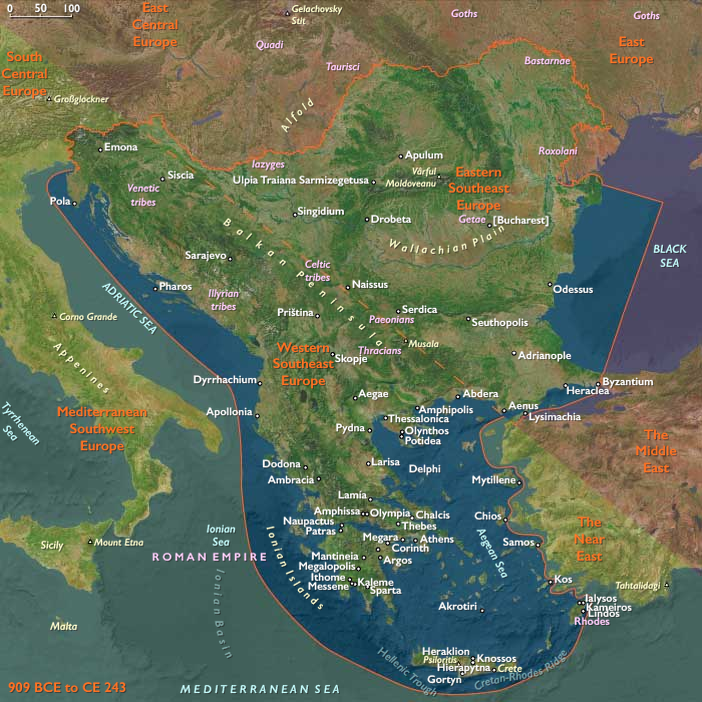
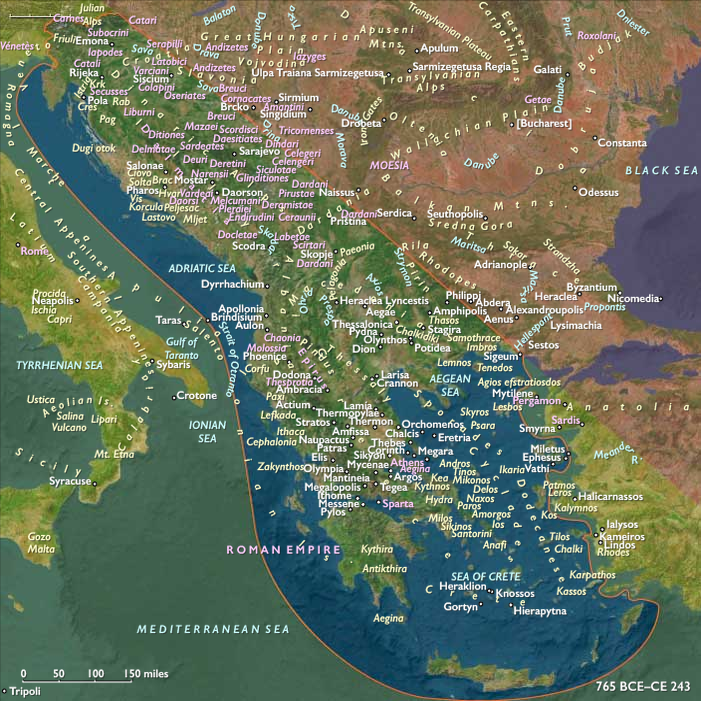
Tegea between 473 and 471, by which time Sparta’s authority in the Peloponnesus has eroded, forsakes Sparta for an alliance with Argos.
Following a Spartan attack on Tegea in an inconclusive battle, all the Arcadian cities, except Mantinea, ally against Sparta.
The Messapians, an Indo-European people who inhabit the heel of Italy (modern Apulia) and speak the Messapian language, had come most likely from Illyria; they are the most southerly tribe of the Iapygesm, a name given them by the Greek authors, who linked the tribe's origin to Dedalus's son Iapyges.
(Roman authors called thenm Apuli, Salentini, and Calabri.)
Their other tribes included the Daunii and the Peucetii.
The Peuceti, an Italic people of Oscan-Umbrian origin, probably settled together with the Dauni and Messapi in the eleventh century BCE, coming from Illyria over the Otranto channel.
Iapygians are kin to the Oenotrians, another tribe of Illyrian descent who had arrived at the beginning of the Iron Age from Illyria through the Otranto Channel to inhabit the region of Apulia, Basilicata and Northern Calabria.
In the early fifth century BCE, the Lucani move south into Oenotria, driving the indigenous tribes, known to the Greeks as Oenotrians, Chones, and Lauternoi, into the mountainous interior.
The settlement of the Greeks with the first stable colonies, such as Metapontum, founded on a native one (Metabon), had pushed the Oenotrians inland.
Taranto, founded in 706 BCE by Dorian immigrants as the only Spartan colony, has increased its power, becoming a commercial force and a sovereign city of Magna Graecia, ruling over the Greek colonies in southern Italy.
In its beginning, Taranto was a monarchy, probably modeled on the one ruling over Sparta; according to Herodotus (iii 136), around 492 BCE, king Aristophilides ruled over the city.
The expansion of Taranto has been limited to the coast because of the resistance of the populations of inner Apulia.
Taranto signs an alliance with Rhegion in 472 to counter the Messapii, Peuceti, and Lucanians, but the joint armies of the Tarentines and Rhegines are defeated near Kailìa (modern Ceglie Messapica) in what Herodotus claims to be the greatest slaughter of Greeks in his knowledge, with three thousand Reggians and uncountable Tarentines killed.

Pausanias, convicted on the bribery charge at Sparta, has fled to Tegea, in Arcadia.
Sparta's authority in the Peloponnesus has eroded by the late 470s, and Tegea forsakes Sparta for an alliance with Argos.
Following a Spartan attack on Tegea in an inconclusive battle, all the Arcadian cities ally against Sparta, with the exception of …
…Mantineia, which until the early fifth century BCE had been a cluster of five villages, but, at the suggestion of Argos, had been merged into one city.
The Argives have now recovered from the defeat at Sepeia in 494, and the temporarily exiled descendants of the casualties of Sepeia, the “sons of the slain” as Herodotus calls them, a naturally anti-Spartan group, are now back in control (after ousting the slaves).
Argos is on record as fighting a battle in perhaps the 470s, together with Arcadian Tegea, against Sparta, which also must cope with “all the Arcadians except the Mantineans” at a strictly undatable battle of Dipaieis.
Themistocles retires to Argos to make trouble for Sparta, which he views as the natural opponent of Athens.
Remaining an exile, he will eventually make his way across the Aegean to Magnesia, an inland Ionian city under Persian rule.
The city of Elis, having broken with Sparta soon after 479 BCE, adopts a democratic constitution around 471 BCE and becomes the administrative center of a union of smaller townships in the northwestern Peloponnesus.
Náxos revolts from the Delian League in 471 BCE, but Athens soon captures the island.
Naxos is believed to have been forced to tear down its walls, lose its fleet and its vote in the League.
Thucydides equates the inhabitants' loss of freedom with “enslavement”.