
Political life in thirteenth-century Milan shares the …
Years: 1277 - 1277
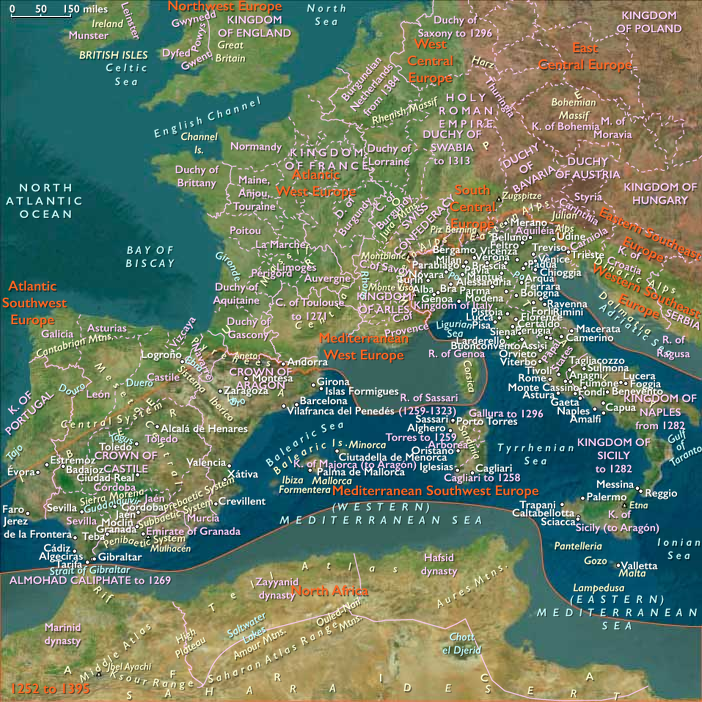
Political life in thirteenth-century Milan shares the same path of many other communes in Italy, living an increasing series of inner divisions and episodes of corruption.
The noble family of the Della Torre (or Torriani) had gained the most important political charges in the commune, this way nullifying the democratic ideals of the original medieval commune.
They had also launched a program of public works and military expansions, which however had brought the Milanese treasury to collapse; the use of often reckless mercenary units had further exacerbated the population’s ire, lending increasing support for the Della Torre family’s traditional enemies, the Visconti.
The seventy-year-old archbishop Ottone, the son of Ubaldo Visconti, lord of Massino, Albizzate and Besnate, and one Anastasia (some sources attribute her the Pirovano last name), before his accession to the archbishopric, had been assistant to the Papal legate and cardinal Ottaviano Ubaldini.
In 1260, he was Podestà of Novara.
Visconti had succeeded as archbishop of Milan to Leone da Perego, elected on July 22, 1262, by Pope Urban IV in opposition to Raimondo della Torre, bishop of Como.
The latter had thus started to publicize an alleged Visconti nearness to the heretic Cathars and charged them of high treason: the Visconti, who accused the Della Torre of the same crimes, were then banned from Milan and their properties confiscated.
The civil war that ensued, lasting for more than a decade, has caused additional damage to Milan's population and economy.
Ottone had fought for the rule of the city with the Torriani family, and especially with Napo della Torre, lord of Milan, who had denied him access to Milan and had defeated an army under Teobaldo Visconti, Ottone's nephew, at Angera in 1276.
The Milanese had destroyed most of the fortifications in the towns of Brianza north to the city, fearing they could be used as strongpoints by the rebels and their northern ally, Como.
They had however spared those of Desio, some thirty kilometers north to Milan, as there converge three important trade routes from Como, Erba and Lecco.
On January 20, five hundred Milanese heavy cavalry move to occupy Desio, where they are to be be joined by another five hundred heavy cavalry which had just pushed back a rebel attack at Civate, and by some four hundred infantry.
Likely, their strategy was to attack Visconti's vanguard army, which amounted to some twelve hundred men (most infantry and archers), easily defeating it.
Next step was the destruction of the rebel base of Como.
However, the inhabitants of Desio abandon the now hated Milanese government.
Visconti (whom, according to tradition, was warned of the occasion; while others state that the Visconti attack pushed the populace to rebellion) rushes to the town before the Milanese reinforces can arrive.
Whether Visconti had foreknowledge, or the villagers rebelled, at dawn on January 21, 1277, the surprise attack against the government forces succeeds and the village of Desio is captured.
The gates are opened, and the rebels defeat the Milanese army: Francesco della Torre is killed, while his brother Napo is jailed in the Castel Baradello at Como, where he will die the following year.
Despite the minor size of the battle, Napo's capture is a fatal blow for the della Torre party.
The Visconti easily seize Milan and place their supporters in the most important positions, gradually strengthening their power, which will last until the mid-fifteenth century.
Ottone, as effective lord of the city, will embellish it and enhance its economy.
Locations
People
Groups
- Milan, Archdiocese of
- Italy, Kingdom of (Holy Roman Empire)
- Christians, Roman Catholic
- Holy Roman Empire
Topics
Commodoties
Subjects
Regions

Subregions
Related Events
Showing 10 events out of 45604 total
Years: 1277 - 1277
Locations
People
Groups
- Milan, Archdiocese of
- Italy, Kingdom of (Holy Roman Empire)
- Christians, Roman Catholic
- Holy Roman Empire
Topics
Commodoties
Subjects
Regions
Subregions