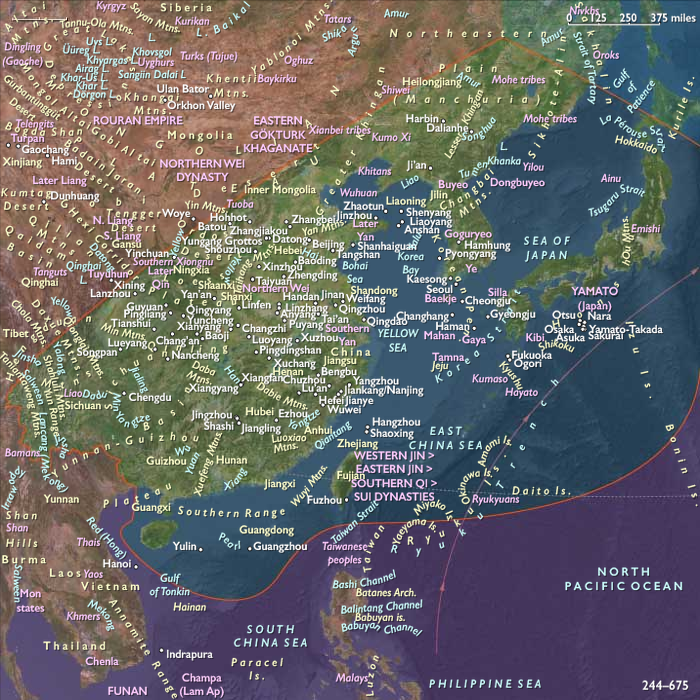
Political fragmentation retards cultural development in China. …
Years: 420 - 420
Political fragmentation retards cultural development in China.
China’s Nanjing-based Eastern Jin Dynasty is eliminated in 420.
Locations
Groups
Topics
- Migration Period
- Sixteen Kingdoms Period in China
- Civil Wars in China triggered by the Wu Hu Invasion
- Southern and Northern Dynasties Period in China
Commodoties
Subjects
Regions
Subregions
Related Events
Filter results
Showing 5 events out of 5 total
East Central Europe (1060–1071 CE): Hungarian Succession Conflicts, Polish Stabilization under Bolesław II, and Přemyslid Authority under Vratislaus II
Between 1060 and 1071 CE, East Central Europe—covering present-day Poland, Czechia, Slovakia, Hungary, and eastern parts of Germany and Austria east of 10°E and north of the defined southeastern boundary—underwent significant political transformations driven by dynastic conflicts, territorial consolidations, and deepening regional interactions. Hungary experienced serious internal succession crises following King Andrew I’s death, while Bolesław II stabilized and expanded Polish power. In Bohemia, Vratislaus II strengthened Přemyslid authority, solidifying Bohemia’s political influence in alignment with imperial interests. These developments profoundly reshaped the medieval political landscape and regional stability.
Political and Military Developments
Hungarian Succession Conflict and Internal Strife
-
After the death of King Andrew I (1060), Hungary descended into a prolonged dynastic conflict between Andrew’s sons, Solomon (r. 1063–1074), supported by the Holy Roman Empire, and his rival Béla I (r. 1060–1063). This internal turmoil destabilized Hungary and involved neighboring powers, temporarily weakening royal authority.
Polish Consolidation and Expansion under Bolesław II
-
In Poland, Bolesław II "the Bold" (r. 1058–1079) strengthened central authority, expanded Polish territorial influence into parts of Ukraine and the Baltics, and reinforced royal power through strong diplomatic alliances and strategic military campaigns.
Přemyslid Power under Vratislaus II in Bohemia
-
Duke Vratislaus II of Bohemia (r. 1061–1092) consolidated Přemyslid authority, skillfully navigating imperial politics, maintaining close relations with the Holy Roman Empire, and securing greater autonomy and political stability for Bohemia within the broader regional landscape.
Imperial Influence under Henry IV
-
Holy Roman Emperor Henry IV (r. 1056–1106) actively intervened in East Central European dynastic disputes, supporting Solomon in Hungary and strengthening relations with Vratislaus II in Bohemia, reinforcing imperial influence throughout the region.
Economic and Technological Developments
Stability and Growth of Regional Trade
-
Despite dynastic conflicts, Bohemia and Poland experienced sustained economic prosperity. Trade networks flourished, exchanging goods such as precious metals, amber, textiles, and agricultural products, linking East Central Europe firmly with broader European commerce.
Continued Urban Development and Fortifications
-
Towns in Poland (Kraków, Gniezno), Hungary (Esztergom, Székesfehérvár), and Bohemia (Prague) continued to expand and reinforce their urban fortifications, administrative structures, and market facilities, enhancing security, commerce, and governance.
Cultural and Artistic Developments
Polish Ecclesiastical Patronage under Bolesław II
-
Bolesław II actively promoted religious and cultural patronage, supporting monastic foundations, cathedral constructions, and artistic projects that significantly enriched Polish cultural and religious life, further integrating Poland into European cultural traditions.
Hungarian Cultural Continuity Amid Succession Crisis
-
Despite internal instability, Hungary maintained its ecclesiastical institutions, royal traditions, and cultural heritage. Ecclesiastical centers continued their scholarly and cultural activities, preserving Hungary’s Christian identity and traditions.
Bohemian Artistic Flourishing under Vratislaus II
-
Under Vratislaus II, Bohemia experienced significant cultural patronage, exemplified by cathedral expansions, illuminated manuscripts, and monastic institutions, reinforcing Prague’s role as a vibrant cultural and religious hub.
Settlement and Urban Development
Polish Urban Expansion and Royal Patronage
-
Bolesław II significantly expanded urban centers like Kraków and Gniezno, strengthening their roles as political, ecclesiastical, and economic centers, promoting urban prosperity and administrative effectiveness.
Hungarian Administrative Centers Amid Conflict
-
Despite succession disputes, Hungarian urban centers such as Esztergom and Székesfehérvár remained crucial royal, ecclesiastical, and commercial hubs, sustaining urban growth and administrative coherence.
Bohemian Urban Growth and Infrastructure
-
Under Vratislaus II, Prague and other Bohemian towns saw notable urban expansion, fortification improvements, and infrastructure development, solidifying Bohemia’s administrative cohesion and economic vitality.
Social and Religious Developments
Strengthening of Christian Institutions
-
Christianity solidified its dominant role in Poland, Hungary, and Bohemia, shaping societal governance, educational systems, and cultural identities. Ecclesiastical structures reinforced regional cohesion amid political uncertainty.
Aristocratic Consolidation and Dynastic Authority
-
Dynastic and aristocratic structures further strengthened throughout the region, clearly defining social hierarchies, political authority, and governance models crucial for medieval societal stability and administrative efficiency.
Long-Term Consequences and Historical Significance
The era 1060–1071 CE significantly impacted East Central Europe’s historical trajectory. Hungary’s succession crisis demonstrated the fragility of dynastic stability, while Poland under Bolesław II experienced renewed political strength and territorial expansion. In Bohemia, Vratislaus II solidified Přemyslid authority and regional influence. These developments reshaped regional politics, cultural identities, and economic structures, laying essential foundations for the enduring medieval kingdoms and states of East Central Europe.
King Andrew of Hungary has closely collaborated with his brother Béla for several years following his elevation to the Hungarian throne.
According to the Illuminated Chronicle, they together worked out a military strategy against the Germans, who were frequently invading the kingdom in the early 1050s.
The chronicler emphasizes that Andrew and Béla "lived in a great tranquillity of peace" even after Andrew fathered a son, Solomon, in 1053.
Béla had been one of the lords witnessing the deed of the foundation of the Tihany Abbey, a Benedictine monastery that his brother established in 1055.
The two brothers' good relationship had deteriorated after King Andrew had the child Solomon crowned king in 1057 or 1058.
The coronation had been the consequence of the peace negotiations with the Holy Roman Empire, because the Germans would not acquiesce in a marriage between Solomon and Judith—the sister of the young German monarch, Henry IV—unless Solomon's right to succeed his father was declared and publicly confirmed.
Andrew, determined thereafter to secure the throne for his son, had invited Béla to his manor in Tiszavárkony, and there offered his brother a seemingly free choice between a crown and a sword (the symbols of the royal and ducal power, respectively).
However, he had ordered that Béla be murdered if he chose the crown.
Having been informed of his brother's secret plan by one of his own partisans in the royal court, Béla had opted for the sword, but departed for Poland after the meeting.
He returns to Hungary, in the autumn of 1060, with Polish troops that Duke Boleslaus the Bold of Poland has provided.
Around the same time, German reinforcements arrive in Hungary to assist King Andrew against Béla.
The ensuing civil war ends with the victory of Béla, who defeats his brother in two successive battles fought at the river Tisza and at Moson.
The king is seriously injured and dies soon afterward.
His partisans take his son, the child Solomon, to Germany.
Béla is crowned king in Székesfehérvár on December 6, 1060.
He orders that "the wives and sons and all the property of all those who had followed" his nephew to Germany "should be protected and kept safe and sound", which induces many of Solomon's partisans to reconcile themselves to Béla's rule and return to Hungary.
He reforms the coinage and introduces "large coins of purest silver" into circulation.
In order to stabilize the new currency, Béla maximizes the prices and eliminates the black market.
He also orders that weekly markets should be held on Saturdays, instead of Sundays, in the kingdom.
The historian Nora Berend says that the latter measure "may have adversely affected Jewish activities", because Jews, who observed the Sabbath, could not work on Saturdays.

Béla of Hungary has attempted to conclude a peace treaty with the Holy Roman Empire.
For this purpose, shortly after his coronation, he had released all German commanders who had assisted his brother during the civil war.
However, the young German monarch's advisors had refused Béla's proposals.
In the summer of 1063, an assembly of the German princes decides to launch a military expedition against Hungary to restore young Solomon to the throne.
Béla is planning to abdicate in favor of his nephew if the latter restores his former ducatus, but he is seriously injured when "his throne broke beneath him" in his manor at Dömös.
The king—who was "half-dead", according to the Illuminated Chronicle—is taken to the western borders of his kingdom, where he dies at the creek Kinizsa on September 11, 1063.
Béla is buried in the Benedictine Szekszárd Abbey, which he had set up in 1061.
Following Béla's death, his three sons—Géza, Ladislaus and Lampert—seek refuge in Poland.
Accompanied back to Hungary by German troops, Solomon enters Székesfehérvár without resistance.
He is ceremoniously "crowned king with the consent and acclamation of all Hungary" in September 1063, according to the Illuminated Chronicle.
The same source adds that the German monarch "seated" Solomon "upon his father's throne", but did not require him to take an oath of fealty Solomon's marriage with Henry IV's sister, Judith—who is six year older than her future husband—also takes place on this occasion.
Judith, along with the Queen Mother Anastasia, becomes one of her young husband's principal advisors.
Solomon's three cousins—Géza and his brothers—had returned after the German troops had been withdrawn from Hungary.
They had arrived with Polish reinforcements and Solomon sought refuge in the fortress of Moson at the western border of his kingdom.
After the Hungarian prelates began to mediate between them in order to avoid a new civil war, Solomon and his cousins finally reach an agreement, which is signed in Győr on January 20, 1064.
Géza and his brothers acknowledge Solomon as lawful king, and Solomon grants them their father's one-time ducatus.
In token of their reconciliation, Duke Géza puts a crown on Solomon's head in the cathedral of Pécs on Easter Sunday.
However, their relationship still remains tense: when the cathedral burns down during the next night, they initially accuse each other of arson.
King Solomon and his cousins closely cooperate in the period between 1064 and 1071.
Both Solomon and Géza had been, in 1065 or 1066, present at the consecration of the Benedictine Zselicszentjakab Abbey, established by Palatine Otto of the Győr clan, a partisan of the king.
They invade Bohemia together after the Czechs plunder the region of Trencsén (Trenčín, Slovakia) in 1067.
Years: 420 - 420
Locations
Groups
Topics
- Migration Period
- Sixteen Kingdoms Period in China
- Civil Wars in China triggered by the Wu Hu Invasion
- Southern and Northern Dynasties Period in China