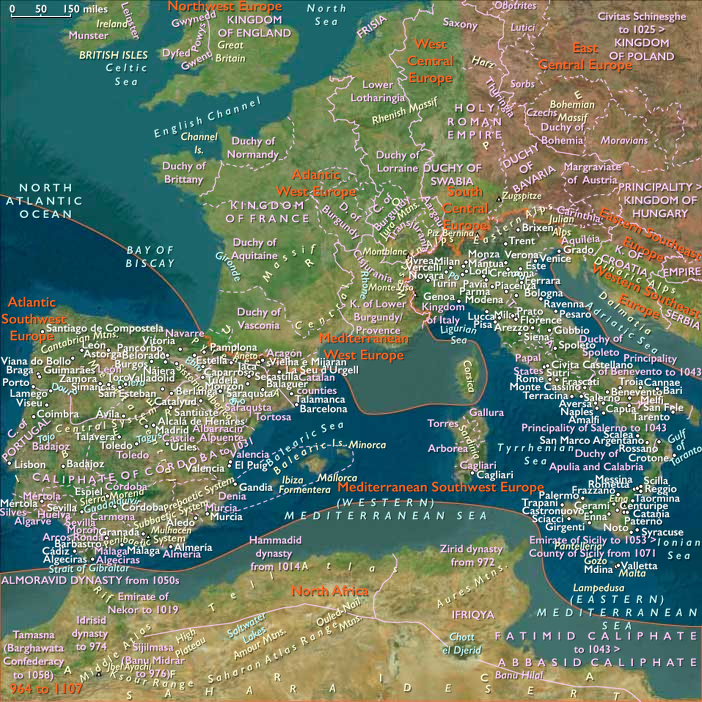
Political disturbances continue to plague Campania and …
Years: 1042 - 1042
Political disturbances continue to plague Campania and …
Locations
People
- George Maniakes
- Harald Hardrada
- Humphrey of Hauteville
- Magnus the Good
- Michael Doukeianos
- Michael IV the Paphlagonian
- William Iron Arm de Hauteville
Groups
- Lombards (West Germanic tribe)
- Christianity, Chalcedonian
- Greeks, Medieval (Byzantines)
- Saracens
- Denmark, Kingdom of
- Varangians
- Vikings
- Pechenegs, or Patzinaks
- Sicily, Emirate of
- Roman Empire, Eastern: Macedonian dynasty
- Kievan Rus', or Kiev, Great Principality of
- Normandy, Duchy of
- Normans
- Italy, Catepanate of
- Norway, independent Kingdom of
Topics
Commodoties
Subjects
Regions
Subregions
Related Events
Filter results
Showing 10 events out of 51362 total
Incursions by the Western Xia and the threat of further Liao Dynasty military actions against the Song Dynasty force an increase in tribute payments to the Liao.
The deposed Peter Orseolo had first fled to Austria, whose ruler (Margrave Adalbert) had married his sister Frowila, and approaches Emperor Henry III for help against Samuel Aba.
The new Hungarian monarch invades Austria in February 1042, but Adalbert routs Aba's troops.
Henry III launches his first expedition against Hungary in early 1042.
His forces advance north of the Danube to the river Garam (Hron, Slovakia).
The emperor plans to restore Peter, but the locals are strongly opposed.
Accordingly, the emperor appoints another (unnamed) member of the Hungarian royal family, living in exile in Bohemia, to administer the territories.
Michael V banishes his adoptive mother and co-ruler Zoe to a convent on the night of April 18 to 19, 1042, becoming sole Emperor.
His announcement of the event in the morning leads to a popular revolt; the palace is surrounded by a mob demanding Zoe's immediate restoration.
The demand is hurriedly met, and Zoe is brought back as joint-ruler with her sister Theodora, a nun.
On April 20, 1042 Theodora declares the emperor deposed, and he flees to seek safety in the monastery of the Stoudion together with his remaining uncle.
Although he had taken monastic vows, Michael is arrested, blinded, and castrated.
The popular movement that has caused the dethronement of Michael V also leads to Theodora's installment as joint empress with her sister on Easter Tuesday, 1042.
Quarrels, however, break out between the sisters; and, in order to secure her position, the sixty-four-year-old Zoë marries a man of good family who belongs to the civil party, the opponents of the military magnates, and elevates him to the throne as Constantine IX Monomachus.
Patriarch Alexius I of Constantinople had refused to officiate over a third marriage (for both spouses).
After two months of active participation in government, Theodora allows herself to be virtually superseded by Zoë's newest husband.
Constantine continues the purge instituted by Zoe and Theodora, removing the relatives of Michael V from the court.
Michael V Kalaphates dies as a monk on August 24, 1042.
His uncles John the Orphanotrophos and Constantine are blinded in 1042.
John is sent to Lesbos, where he will die on May 13, 1043.
The new emperor is pleasure-loving and prone to violent outbursts on suspicion of conspiracy.
He is heavily influenced by his mistress, Maria Skleraina, a niece of his second wife, and Maria's relatives.
In August 1042, under the influence of the Skleroi, the emperor relieves General George Maniakes from his command in Italy, and Maniakes, his accomplishments in Sicily largely ignored by the Emperor, revolts against Constantine IX, though he had been appointed catepan of Italy.
The individual particularly responsible for antagonizing Maniakes into revolt is one Romanus Sklerus.
Sklerus, like Maniakes, is one of the immensely wealthy landowners who owns large areas of Anatolia - his estates neighbor those of Maniakes and the two are rumored to have attacked each other during a squabble over land.
Sklerus owes his influence over the emperor to his famously charming sister the Sclerina, who, in most areas, is a highly positive influence on Constantine.
Finding himself in a position of power, Sklerus has used it to poison Constantine against Maniakes—ransacking the latter's house and even seducing his wife, using the charm his family for which his family is famous.
Maniakes response, when faced with Sklerus demanding that he hand command of the empires forces in Apulia over to him, is to brutally torture the latter to death, after sealing his eyes, ears, nose and mouth with excrement.
Maniakes is then proclaimed emperor by his troops (including the Varangians) in September.
Scandinavian prince Harald (called the Ruthless), the son of Sigurd Sow (Syr), a chieftain in eastern Norway, and of Estrid, mother of the Norwegian king Olaf II Haraldsson, had fought at the age of fifteen against the Danes in 1030 at the celebrated Battle of Stiklestad, in which Olaf, his half-brother, was killed.
(known during his lifetime as Olaf the Fat, he will eventually be canonized as Saint Olaf).
Fleeing to Russia with a band of exiles, Harald had served under the grand prince of Kiev, Yaroslav I the Wise.
Having entered service under Michael and Zoë, Harald has led the elite mercenary unit known as the Varangian Guard to frequent victories in Bulgaria, Italy, Sicily, and North Africa, also penetrating to Jerusalem, to which city he is said to have made a pilgrimage.
Having amassed enormous treasure and fame as a warrior, he leaves Constantinople for Kiev in 1042, supposedly because he has been refused the hand of a princess (an apparently fictional niece or granddaughter of Zoe, called Maria).

Liparit seizes the key fortress of Artanuji, thereby becoming the virtual ruler of the southern and eastern provinces of Georgia.
Bagrat IV, defeated in the battle, will not be able to restore his authority in the kingdom until 1059, forcing the renegade Duke Liparit into exile in Constantinople.
Swedish adventurer Ingvar the Far-Traveled makes a celebrated attempt to reopen the trade routes with the Muslim east.
Beside the Ingvar runestones, there are no extant Swedish sources that mention Ingvar, but there is Yngvar’s saga and three Icelandic annals that mention his death under the year 1041.
It is possible that it was King Anund Jakob or his brother and successor Emund the Old who mustered the Swedish leidang, a public levy of free farmers typical for medieval Scandinavians.
It is a form of conscription to organize coastal fleets for seasonal excursions and in defense of the realm.
The participants are evenly distributed along the husbys (royal estates), and twenty-four of the twenty-six Ingvar runestones are from Sweden (in the contemporary sense, i.e.
Svealand) and two from the Geatish district of Östergötland.
The people of Attundaland do not take part and this is probably done on purpose in order to keep a defensive army in Sweden, while the main force is away.
Anund Jacob is the brother of Ingegerd Olofsdotter, who is married to Yaroslav I of Novgorod and who had conquered Kiev in 1019 from his brother Sviatopolk.
This had been done with the help of Varangians, and according to Ingvar's saga, they had been led by Ingvar's father Eymund.
Yaroslav is currently having trouble with the Pechenegs, a nomad tribe.
The Swedish expedition has stayed for a few years in Kiev fighting against the Pechenegs, then (in 1042) they continue to the Black Sea and the Christian country, called Särkland (Georgia).
A feud between Bagrat IV and his former general, Liparit Baghvashi, a powerful duke of Kldekari, had erupted during their campaign against the Georgian city of Tbilisi (1037–1040), which is ruled by Arab emirs.
The king, advised by Liparit’s opponents, had made peace with Emir Ali ibn-Jafar, a sworn enemy of the duke, in 1040.
In retaliation, Liparit had revolted and endeavored to put Demetre, Bagrat’s half-brother, on the Georgian throne.
However, he had had no success and had ended hostilities with Bagrat, receiving the title of Grand Duke of Kartli, but giving up his son, Ioane, as a hostage of the king.
Liparit soon rises again in rebellion, requesting aid from Constantinople.
Supported by an imperial auxiliary force and an army of Kakheti (a kingdom in eastern Georgia), he releases his son and again invites the pretender prince Demetrius to be crowned king.
The latter in 1042 dies at the very beginning of the war, but Liparit continues to fight the king’s forces.
The royal army commanded by King Bagrat is joined by a Varangian detachment of one thousand men, probably a subdivision of the expedition of Ingvar the Far-Travelled.
According to an old Georgian chronicle, they had landed at Bashi, a place by the mouth of the Rioni river, in Western Georgia.
The two armies fight a decisive battle near the village of Sasireti, eastern Georgia, in the spring of 1042.
In fierce fighting, the royal army is defeated and retreats west.
According to the legendary saga about Ingvar, only one ship returned.
The twenty-six remaining rune stones testify to this, as no one mentions a surviving participant.
The most common phrases are similar to the one on the Gripsholm Runestone: “They died in the East, in Särkland.”
Liparit IV, Duke of Kldekari, had appeared on the political scene of Georgia in the late 1020s when he, as a holder of the fortress of Kldekari and later as a commander-in-chief of the royal armies, had proven himself as the defender of the boy king Bagrat IV and his regent, Dowager Queen Mariam.
His successful resistance to the invading imperial troops in 1028 and a victorious campaign against the Shaddadid dynasty of Arran in 1034 have made Liparit the most powerful noble in Georgia.
In 1038, Liparit had been on the verge of capturing the Georgian city of Tbilisi, which has been under Muslim sway for centuries, but the Georgian nobles, fearing his growing power, had thwarted the plan and persuaded the king to make peace with the emir of Tbilisi.
As a result, Liparit has turned into a sworn enemy of Bagrat and begins actively cooperating with foreign powers for vengeance.
In 1039, he had pledged his support to Bagrat’s half-brother Demetrius who enters Georgia with an imperial army to seize the crown.
Al-Duzbari has fallen out of favor of the Fatimid government in Cairo.
The Fatimid vizier had publicly condemned him, causing the army of Syria to abandon him.
Al-Duzbari has taken refuge in Aleppo, where he died in early 1042.
Not long afterwards, Thimal recovers the town, although al-Duzbari's ghulams manage to hold out in the citadel for several months.
Constantinople immediately recognizes Thimal as the ruler of Aleppo, and the Fatimids will recognize his governorship in 1045, although relations with the latter will continue to be less than friendly.
Duklja defeats another imperial attack in 1042.
Constantinople had sent a "coalition" of vassal Slavic chiefs to fight Voislav, consisting of the Župan of Bosnia, Knez (Prince) Ljutovid of Zachlumia and the Župan of Raska.
Fine suggests that under imperial dominance, "Rascia" had in the 1040s emerged as yet another Serbian state (roughly centered on what is now southern Serbia and Kosovo.
Vojislav wins a great victory against his attackers.
He overthrows Ljutovid and places the region entirely under his control.
Duklja is undoubtedly the leading Slavic state.
…Apulia, though they are southern Italy's most flourishing regions.
These regions continue to attract hordes of fortune-seeking Norman immigrants, who are to transform the political role of both regions in the following decades.
The Normans, who had first fought for Constantinople against the Muslims in Sicily, now fight in alliance with the Lombards in Apulia against the Empire.
As more Normans arrive, they carve out small principalities for themselves from their former employers.
Among the most remarkable of these Norman adventurers are the sons of Tancred de Hauteville.
The eldest, William (“Iron Arm”) de Hauteville, having successfully defeated the Greeks who controlled this region for Constantinople, is elected count of Apulia in 104 and assigned Melfi.
Years: 1042 - 1042
Locations
People
- George Maniakes
- Harald Hardrada
- Humphrey of Hauteville
- Magnus the Good
- Michael Doukeianos
- Michael IV the Paphlagonian
- William Iron Arm de Hauteville
Groups
- Lombards (West Germanic tribe)
- Christianity, Chalcedonian
- Greeks, Medieval (Byzantines)
- Saracens
- Denmark, Kingdom of
- Varangians
- Vikings
- Pechenegs, or Patzinaks
- Sicily, Emirate of
- Roman Empire, Eastern: Macedonian dynasty
- Kievan Rus', or Kiev, Great Principality of
- Normandy, Duchy of
- Normans
- Italy, Catepanate of
- Norway, independent Kingdom of