
Polish monarch Boleslaw Wrymouth makes complex arrangements …
Years: 1132 - 1143
Polish monarch Boleslaw Wrymouth makes complex arrangements intended to prevent fratricidal warfare and preserve the Polish state's formal unity.
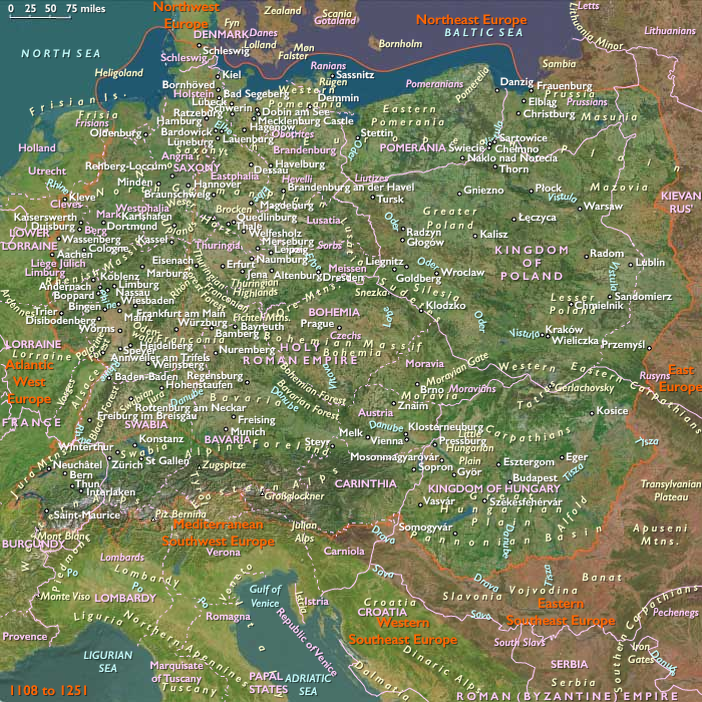
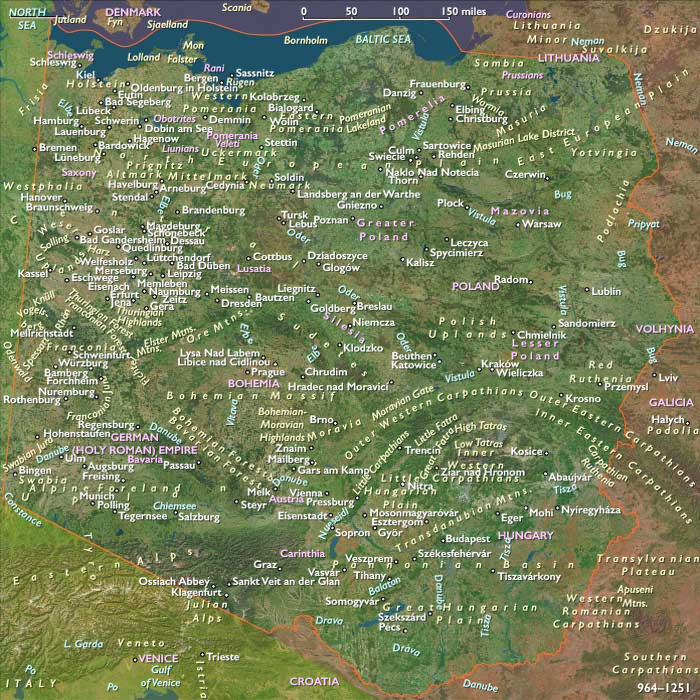
Following his concept of seniority, Boleslaw divides the country into five principalities: Silesia, Greater Poland, Mazovia, Sandomierz and Kraków.
The first four provinces are given to his four sons, who became independent rulers.
The fifth province, the Seniorate Province of Kraków, is to be added to the senior among the Princes who, as the Grand Duke of Kraków, is the representative of the whole of Poland.
The stability of the system is supposedly assured by the institution of the senior or high duke of Poland, based in Kraków and assigned to the special Seniorate Province that is not to be subdivided.
This principle breaks down within the generation of Boleslaw III's sons, when Wladyslaw II the Exile, Boleslaw IV the Curly, Mieszko III the Old and Casimir II the Just fight for power and territory in Poland, and in particular over the Kraków throne.
The external borders left by Boleslaw III at his death closely resemble the borders left by Mieszko I; this original early Piast monarchy configuration does not survive the fragmentation period.
For nearly two centuries, the Piasts will spar with each other, the clergy, and the nobility for the control over the divided kingdom.
People
- Boleslaw III Wrymouth
- Boleslaw IV the Curly
- Casimir II the Just
- Mieszko III the Old
- Wladyslaw II the Exile
Groups
- Poles (West Slavs)
- Poland of the first Piasts, Kingdom of
- Mazovia, Duchy of
- Poland during the period of fragmentation, Kingdom of
- Silesia, Duchy of
- Sandomierz, Duchy of
- Poland, Greater
Topics
Commodoties
Subjects
Regions
Subregions
Years: 1132 - 1143
People
- Boleslaw III Wrymouth
- Boleslaw IV the Curly
- Casimir II the Just
- Mieszko III the Old
- Wladyslaw II the Exile
Groups
- Poles (West Slavs)
- Poland of the first Piasts, Kingdom of
- Mazovia, Duchy of
- Poland during the period of fragmentation, Kingdom of
- Silesia, Duchy of
- Sandomierz, Duchy of
- Poland, Greater
Topics
Commodoties
Subjects
Regions
Subregions