Poland’s Prince Boleslaw, from 992 to 994, …
Years: 994 - 994
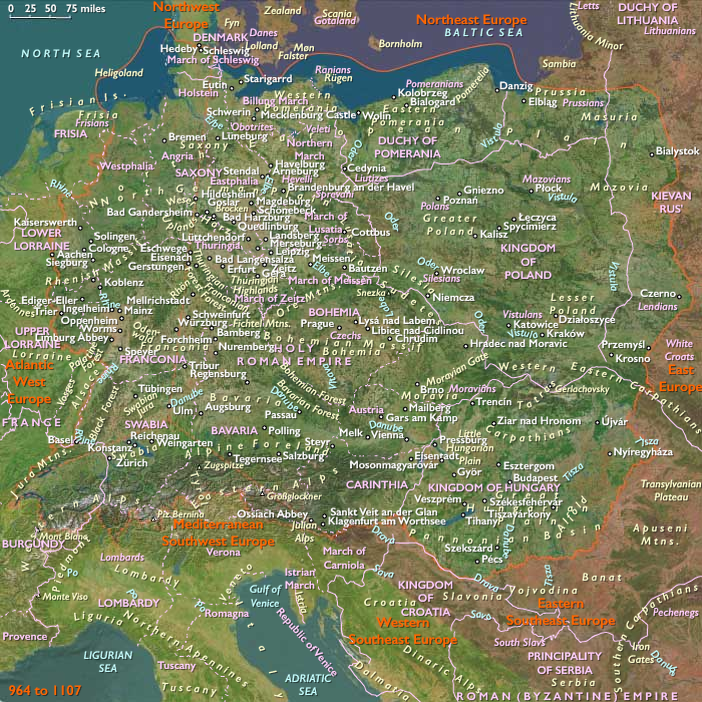
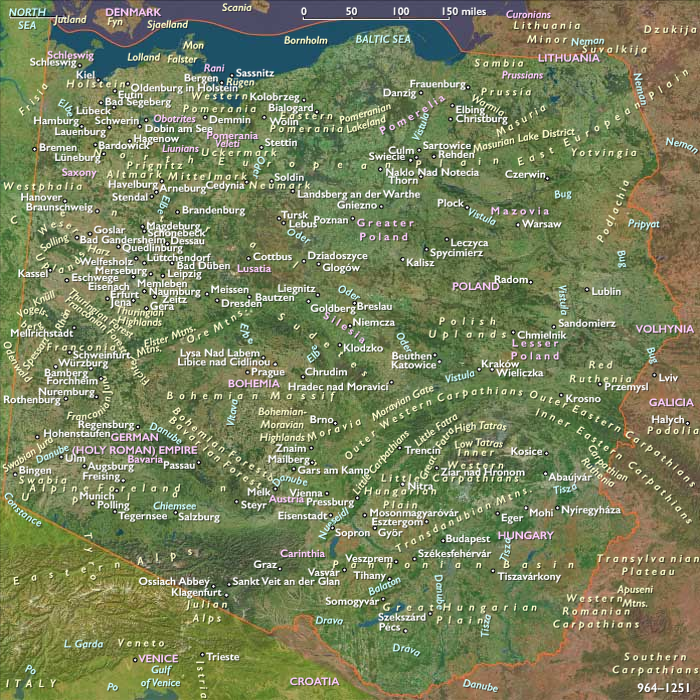
Poland’s Prince Boleslaw, from 992 to 994, incorporates lands inhabited by the Slavic Pomeranians along the Baltic Sea.
Locations
People
Groups
- Prussians, Old, or Baltic (Western Balts)
- Slavs, West
- Poland, Principality of
- Poles (West Slavs)
- Pomerania, Polish Province of
Commodoties
Subjects
Regions
Subregions
Related Events
Filter results
Showing 10 events out of 52184 total
Law in the Liao Dynasty is applied differently in the Northern and Southern Chancelleries.
The Northern Chancellery, governed by the Xiao consort clan, retains a distinctive Khitan-steppe character.
The Yelu clan, who govern the Southern Chancellery, are considerably more sinified in character.
Initially, justice had not been delivered in an evenhanded fashion to the Chinese inhabitants of the empire.
This is reported to having changed from 989.
Beginning in 994, Khitans having committed one of ten grave crimes will be punished according to Chinese law.
This is indicative of a transition from “ethnic law” to “territorial law.”
Henry of Schweinfurt is the son of Berthold and Eilika (Eiliswintha or Eila) of Walbeck.
His father's parentage is not known with certainty, but he may have been a son of Arnulf, Duke of Bavaria.
Henry is Bavarian, whoever his grandfather.
Henry has held a succession of countships after his father's death in 980.
He is appointed marchio, like his father, of the Bavarian Nordgau in 994.
The Fatimid governor of Damascus, the Turkish general Manjutakin, had besieged Apamea in 993/994.
Michael Bourtzes, the imperial doux of Antioch, comes forth to relieve the city.
The two armies meet across two fords on the Orontes River near Apamea on September 15, 994.
Manjutakin sends his forces to attack Bourtzes’s Hamdanid allies across one ford while pinning the main imperial force down on the other.
His men succeed in breaking through the Hamdanids, turn around and attack the imperial force in the rear.
The imperial army panics and flees, losing some five thousand men in the process.
This defeat leads to the direct intervention of emperor Basil II, and Bourtzes' dismissal from his post and his replacement by Damian Dalassenos as magistros.
This post is one of the most important military positions in the Empire, as its holder commands the forces arrayed against the Fatimid Caliphate and the semi-autonomous Muslim rulers of Syria.
The Chola Dynasty, a Tamil dynasty that rules primarily in southern India, had originated in the mid-ninth century in the fertile valley of the Kaveri River.
The Cholas are to remain at the height of their power continuously from the later half of the ninth century until the beginning of the thirteenth century.
Karikala Chola had been the most famous among the early Chola kings, followed by Aditya I, Parantaka I, and Rajaraja Chola I, under whom the dynasty becomes a military, economic and cultural power in Asia.
The southern kingdoms of the Pandyas, Cheras and the Sinhalas are often allied against the Cholas, and this had been the case when Rajaraja came to the throne in 985.
He has spent the past seven or eight years organizing and augmenting his army and in preparing for military expeditions, initially against the combined Pandya and Chera armies.
The first military achievement of Rajaraja’s reign is the campaign in the Kerala country in about 994, in which Rajaraja is said to have destroyed a fleet in the port of Kandalur, which appears to have been situated in the dominions of the Chera King Bhaskara Ravi Vallaman Thiruvadi.
Inscriptions found around Thanjavur show that frequent references are made to the conquest of the Chera king and the Pandyas in Malai-nadu (the west coast of South India).
Kandalur-Salai, which later inscriptions claim to have belonged to the Chera king, was probably held by the Pandyas when it was conquered by Rajaraja.
Some years' fighting apparently is to be necessary before the conquest can be completed and the conquered country sufficiently settled and its administration properly organized.

The Chola general Raja Raja, warring against the Pandyas, seizes their king Amarabhujanga and captures the port of Virinam.
To commemorate these conquests, Raja Raja assumes the title Mummudi-Chola, (the Chola king who wears three crowns—the Chera, Chola and Pandya).
Al-Mansur adopts the title of al-Malik al-Karim, or Noble King, in 994, while the ineffectual caliph continues as nominal chief of state.
Leopold I, Margrave of Austria, travels to Würzburg in 994 to mediate a dispute between his cousin Henry of Schweinfurt and Bishop Bernward von Rothenburg of Würzburg, one of whose knights Henry had seized and blinded.
At a tournament held on July 8, Leopold is hit in the eye by an arrow directed at his cousin.
Two days later, on July 10, Leopold dies from his injuries.
He is buried in Würzburg.
The authority of Adelaide of Italy, grandmother of Otto III, has gradually waned until Otto reaches the age of fourteen in 994.
At an assembly of the Imperial Diet held in Solingen in September 994, Otto is granted the ability to fully govern the kingdom without the need of a regent.
Adelaide is now free to devote herself exclusively to works of charity, notably the foundation or restoration of religious houses.
The young king’s mental gifts are considerable, and have been carefully cultivated by Bernward, afterwards bishop of Hildesheim, and by Gerbert of Aurillac, archbishop of Reims, so that he is called "the wonder of the world."
The information we have about the historical Olaf Tryggvason is sparse.
He is mentioned in some contemporary English sources and some skaldic poems.
The oldest narrative source mentioning him briefly is Adam of Bremen's Gesta Hammaburgensis ecclesiae pontificum from around 1070.
Two Latin sagas of Olaf Tryggvason will be written in the 1190s in Iceland Oddr Snorrason and Gunnlaugr Leifsson.
Snorri Sturluson gives an extensive account of Olaf in Heimskringla of about 1230, using Oddr Snorrason's saga as his main source.
The accuracy of these late sources is not taken at face value by modern historians and their validity is a topic of some debate.
According to the sources, Olaf had fought at an early age in Viking battles in Russia, Denmark, and the Netherlands, then joined in raids on the English coast.
Olaf attacks the Orkney Islands in 994, forcibly converting the Orcadian Vikings to the Christian faith.
Olaf Tryggvason, the posthumous son of a petty king and an alleged grandson of Harald Finehair, Norway’s first king, has acquired fame and wealth as a Viking leader.
Already a baptized Christian, he is at twenty-six in 994 confirmed as Christian in a ceremony at Andover; King Ethelred stands as his sponsor.
After receiving gifts, Olaf promises "that he would never come back to England in hostility."
Olaf leaves England for Norway and, indeed, is never to return, though "other component parts of the Viking force appear to have decided to stay in England, for it is apparent from the treaty that some had chosen to enter into King Æthelred's service as mercenaries, based presumably on the Isle of Wight."
Years: 994 - 994
Locations
People
Groups
- Prussians, Old, or Baltic (Western Balts)
- Slavs, West
- Poland, Principality of
- Poles (West Slavs)
- Pomerania, Polish Province of