
Poland of the thirteenth century is no …
Years: 1253 - 1253
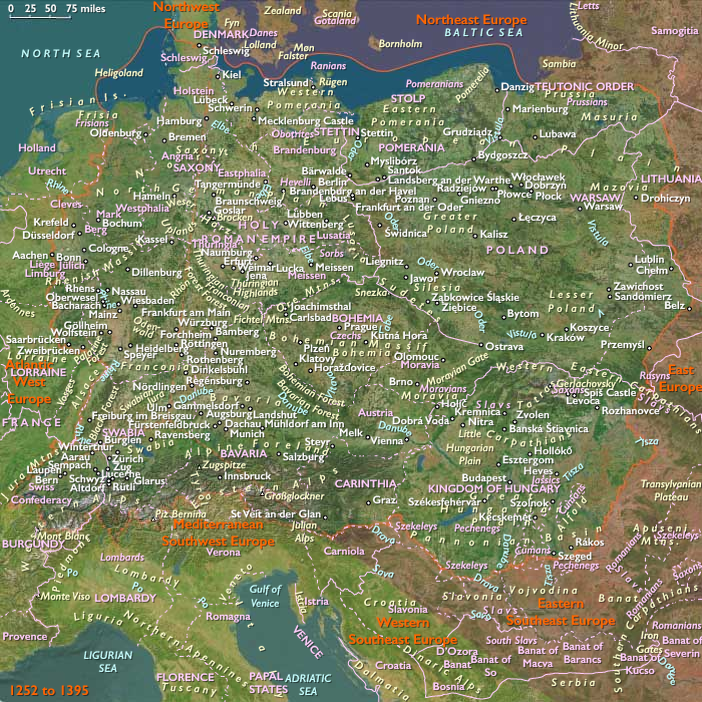
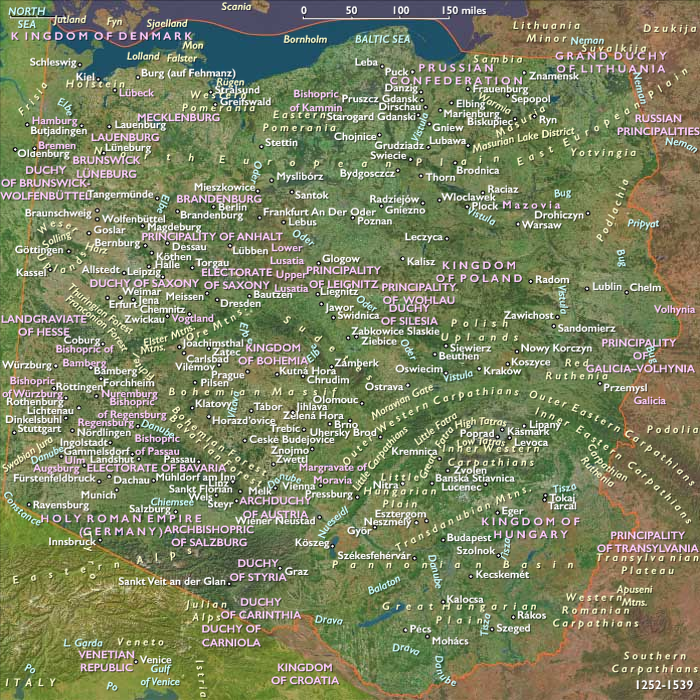
Poland of the thirteenth century is no longer one solid political entity, the sovereignty of the former state having become diffused among a number of smaller independent political units, with only the common bonds of language, race, religion and tradition.
At the death of Ladislaus Odonic Plwacz, duke of Greater Poland, Przemysl, his son by Jadwiga of Pomerania, daughter of Mściwój I, duke of Eastern Pomerania, had inherited the part of Greater Poland controlled by Ladislaus and become duke of Ujście; subsequently he strove to recover the remaining part of Greater Poland.
In 1241, after the death of Henry II the Pious, duke of Silesia at the battle of Legnica, Przemysl and his brother Boleslaus had acquired the duchies of Poznań and Gniezno, and subsequently managed to conquer also the parts of Greater Poland once controlled by Silesia.
In 1244 he had married Elizabeth, Henry’s daughter.
In exchange, he obtained by Wladylaw, duke of Opole, the reincorporation of Kalisz into Greater Poland.
Przemysl had become duke of Poznań and Kalisz in 1247, but had been forced by the local nobility to leave Kalisz to Boleslaus.
He had also obtained Santok (Zantoch) by Boleslaw II the Bald and allied with Bogufal II, bishop of Poznań.
In 1249, he had again exchanged territories with his brother, giving him Gniezno and becoming duke of Poznań and Kalisz.
For unknown reasons, Przemys had had Boleslaus arrested in 1250, becoming in this way the sole ruler of Greater Poland (Poznań, Gniezno et Kalisz) until in 1253, when Boleslaus is freed and given Kalisz and Gniezno.
Locations
People
Groups
- Poles (West Slavs)
- Pomerania, Polish Duchy of
- Poland during the period of fragmentation, Kingdom of
- Silesia, Duchy of
- Poland, Greater
- Brandenburg (Ascanian) Margravate of
Topics
Subjects
Regions
Subregions
Years: 1253 - 1253
Locations
People
Groups
- Poles (West Slavs)
- Pomerania, Polish Duchy of
- Poland during the period of fragmentation, Kingdom of
- Silesia, Duchy of
- Poland, Greater
- Brandenburg (Ascanian) Margravate of
Topics
Subjects
Regions
Subregions