
Much Polish land lies under foreign occupation …
Years: 1252 - 1395
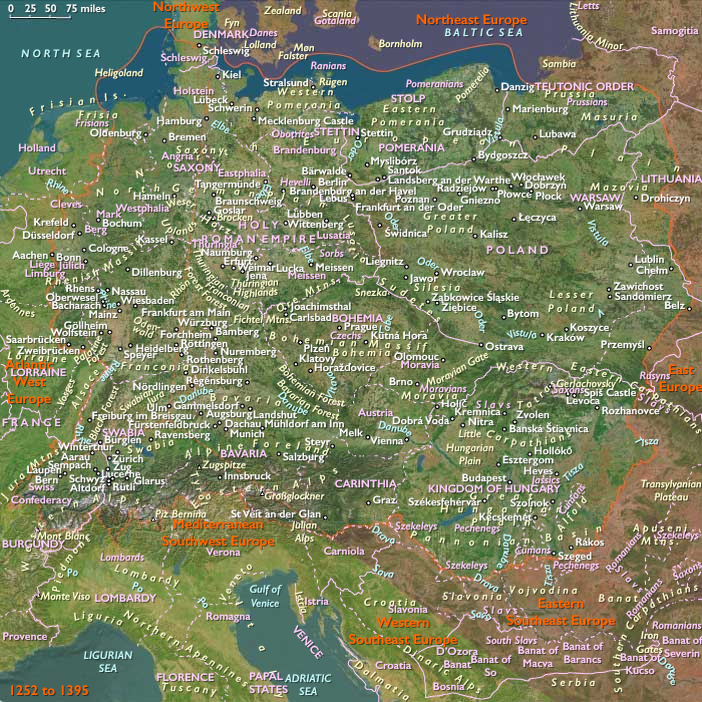
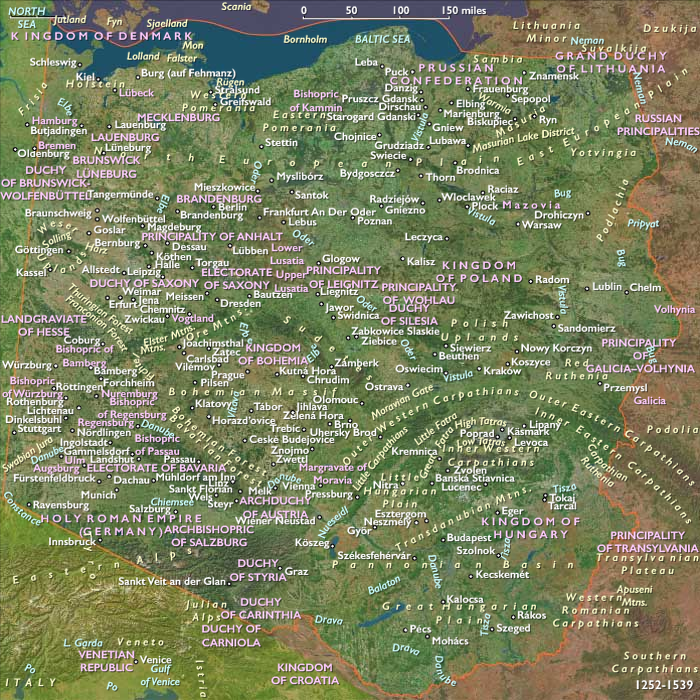
Much Polish land lies under foreign occupation as the fourteenth century opens (two-thirds of it is ruled by Bohemia in 1300).
The continued existence of a united, independent Poland seems unlikely.
In the fourteenth century, after a long period of instability and growing menace from without, the Polish state experiences a half century of recovery under the last monarchs of the house of Piast.
By 1320 Wladyslaw Lokietek (r. 1314-33), called the Short, has manipulated internal and foreign alignments and reunited enough territory to win acceptance abroad as king of an independent Poland.
His son Kazimierz III (r. 1333-70) will become the only Polish king to gain the sobriquet "great."
In foreign policy, Kazimierz the Great strengthens his country's position by combining judicious concessions to Bohemia and the Teutonic Knights with eastward expansion.
While using diplomacy to win Poland a respite from external threat, the king focuses on domestic consolidation.
He earn his singular reputation through his acumen as a builder and administrator as well as through foreign relations.
Two of the most important events of Kazimierz's rule are the founding of Poland's first university in Kraków in 1364, making that city an important European cultural center, and his mediation between the kings of Bohemia and Hungary at the Congress of Kraków (also in 1364), signaling Poland's return to the status of a European power.
Lacking a male heir, Kazimierz is the last ruler in the Piast line.
The extinction of the dynasty in 1370 leads to several years of renewed political uncertainty.
Nevertheless, the accomplishments of the fourteenth century begin the ascent of the Polish state toward its historical zenith.
Locations
People
Groups
- Poles (West Slavs)
- Poland during the period of fragmentation, Kingdom of
- Bohemia, Kingdom of
- Teutonic Knights of Prussia, or Monastic state of the Teutonic Knights (House of the Hospitalers of Saint Mary of the Teutons in Jerusalem)
- Poland of the later Piasts, Kingdom of
Subjects
Regions
Subregions
Years: 1252 - 1395
Locations
People
Groups
- Poles (West Slavs)
- Poland during the period of fragmentation, Kingdom of
- Bohemia, Kingdom of
- Teutonic Knights of Prussia, or Monastic state of the Teutonic Knights (House of the Hospitalers of Saint Mary of the Teutons in Jerusalem)
- Poland of the later Piasts, Kingdom of
Subjects
Regions
Subregions