
Plutarch gives the numbers advancing on Italy …
Years: 102BCE - 102BCE
Plutarch gives the numbers advancing on Italy as three hundred thousand armed fighting men, and much larger hordes of women and children.
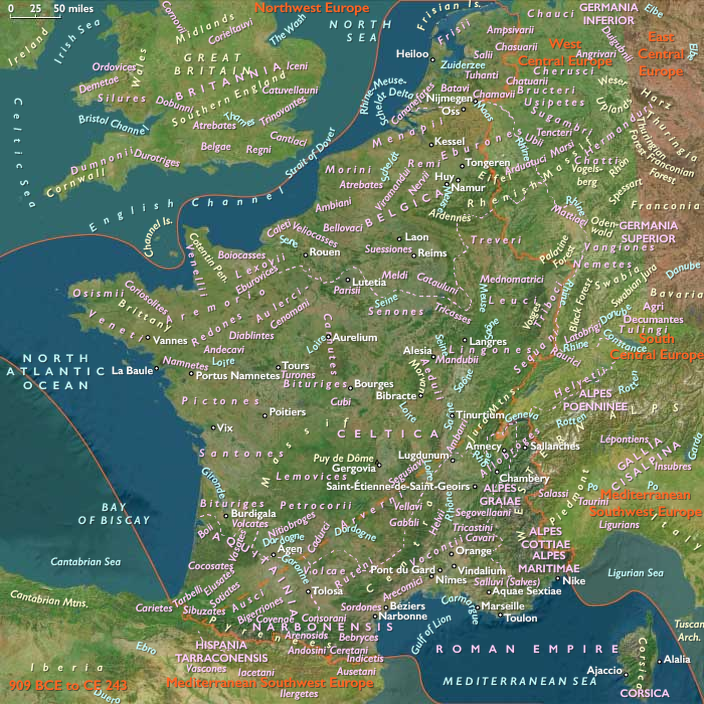
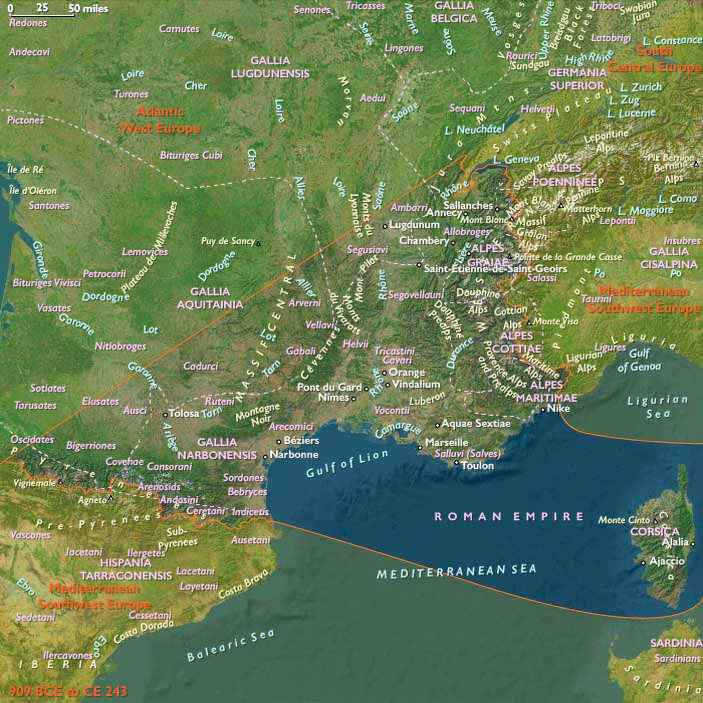
The barbarians divide themselves into two bands, and it falls to the Cimbri to proceed through Noricum in the interior of the country against Catulus, and of a passage there, while the Teutones and Ambrones are to march through Liguria along the seacoast against the consul Gaius Marius, who has set up camp on the Rhône.
Marius, choosing his ground carefully, builds a well-fortified camp on the top of a hill near Aquae Sextiae, where he lures the Teutons and their allies the Ambrones into attacking him.
During their attack they are ambushed from the rear by a select force of five cohorts which Marius had hidden in a nearby wood The Roman accounts claim that in the ensuing massacre ninety thousand Teutons were slain and twenty thousand, including their King Teutobod, were captured.
The only surviving reports are Roman, but certainly the complete annihilation of the Teutons and Ambrones speaks to the crushing nature of their defeat.
The captured women commit mass suicide, which passes into Roman legends of Germanic heroism (Jerome, letter cxxiii.8, CE409): By the conditions of the surrender three hundred of their married women were to be handed over to the Romans.
When the Teuton matrons heard of this stipulation they first begged the consul that they might be set apart to minister in the temples of Ceres and Venus; and then when they failed to obtain their request and were removed by the lictors, they slew their little children and next morning were all found dead in each other's arms having strangled themselves in the night.
Plutarch mentions (Marius 10, 5-6) that during the battle, the Ambrones began to shout "Ambrones!"
as their battle-cry; the Ligurian troops fighting for the Romans, on hearing this cry, found that it was identical to an ancient name in their country which the Ligurians often used when speaking of their descent, so they returned the shout, "Ambrones!".
Marius takes one hundred thousand prisoners.
Plutarch tells us that Ambrones alone numbered more than 30,000 and were the most warlike division of the enemy, who had earlier defeated the Romans under Manlius and Caepio.
The Ambrones have been destroyed.
Although Caesar mentions that the remnants of the Cimbri and Teutons formed a new tribe in Belgic Gaul, the Aduatuci, he does not mention any remnants of the Ambrones.
Aquae Sextiae has only evened the score, however: while the Teutons have been eliminated, the Cimbri remain a formidable threat.
Locations
People
Groups
Topics
- Classical antiquity
- Roman Age Optimum
- Roman Republic, Crisis of the
- Cimbrian War
- Aquae Sextiae, Battle of
Commodoties
Subjects
Regions
Subregions
Related Events
Showing 10 events out of 14 total
Years: 102BCE - 102BCE
Locations
People
Groups
Topics
- Classical antiquity
- Roman Age Optimum
- Roman Republic, Crisis of the
- Cimbrian War
- Aquae Sextiae, Battle of
Commodoties
Subjects
Regions
Subregions