
Plato writes two dialogues in 356 BCE: …
Years: 356BCE - 356BCE
Plato writes two dialogues in 356 BCE: the Timaeus and the Critias, the earliest known reference to Atlantis.
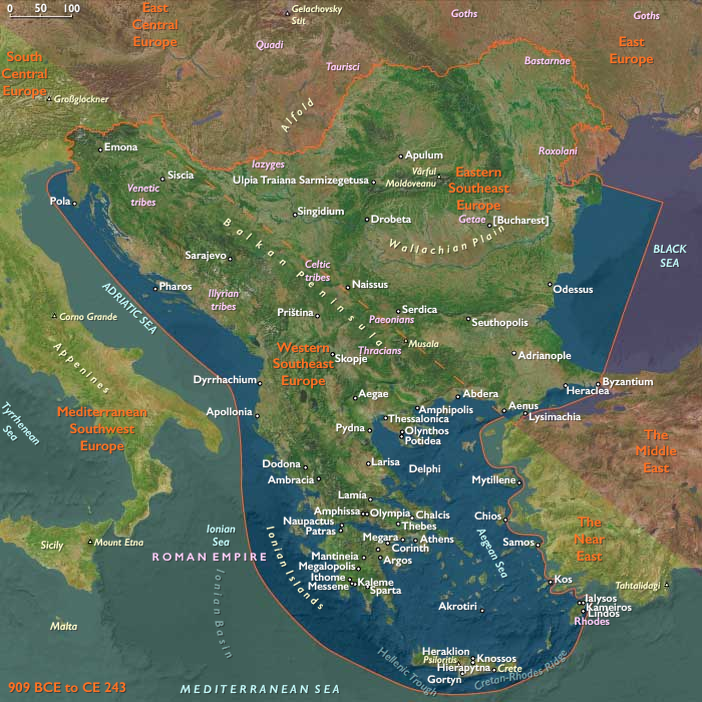
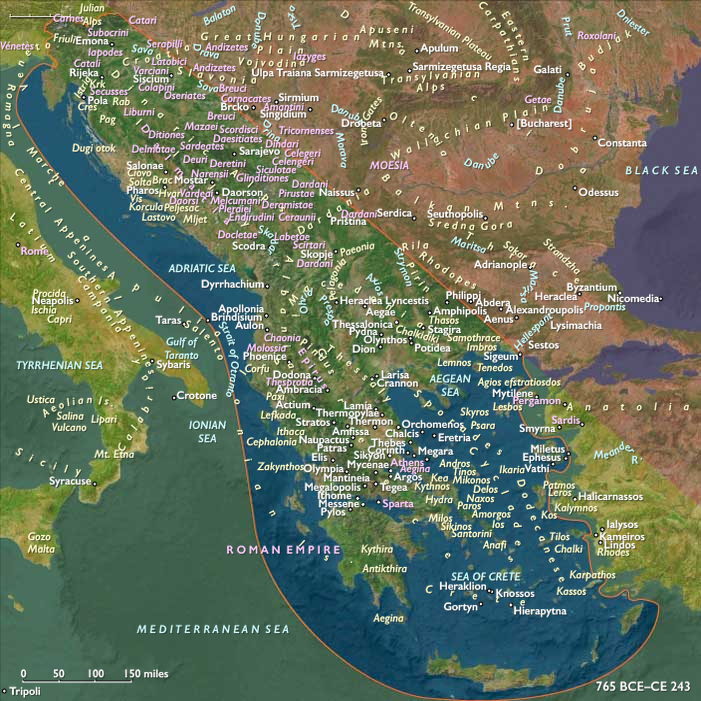
In the Timaeus, which presents a semi-mythical description of the origin and nature of the universe, Plato recounts the tale of Egyptian priests who two-hundred years earlier had reportedly described Atlantis as a powerful island empire seeking to dominate the Mediterranean world more than nine thousand years before Plato's time.
The Atlantans’ plans for expansion were ended only when Athens defeated their army.
Shortly afterward, a violent earthquake caused Atlantis to sink beneath the ocean.
Greatly influenced by Pythagorean number theory, Plato describes in the Timaeus the soul of the world as structured according to the musical ratios that the Pythagoreans see as governing forces in the cosmos as well as in sounds.
Plato applies the name Demiurge—the Greek word for artisan or craftsman—to God the creator, the divine craftsman who brought order out of a primeval chaos.
According to Plato, our world is but an imperfect copy of the real world of ideas impressed onto matter by the Demiurge; the universe is thus a combination of matter and perfect ideas.
In the Critias, Plato characterizes Atlantis as possessed of an ideal political system.
Locations
People
Groups
Topics
Subjects
- Origins
- Writing
- Environment
- Faith
- Theory
- Government
- Custom and Law
- Mystery
- Mythology
- Mathematics
- Cosmology
Regions
Subregions
Years: 356BCE - 356BCE
Locations
People
Groups
Topics
Subjects
- Origins
- Writing
- Environment
- Faith
- Theory
- Government
- Custom and Law
- Mystery
- Mythology
- Mathematics
- Cosmology
Regions
Subregions