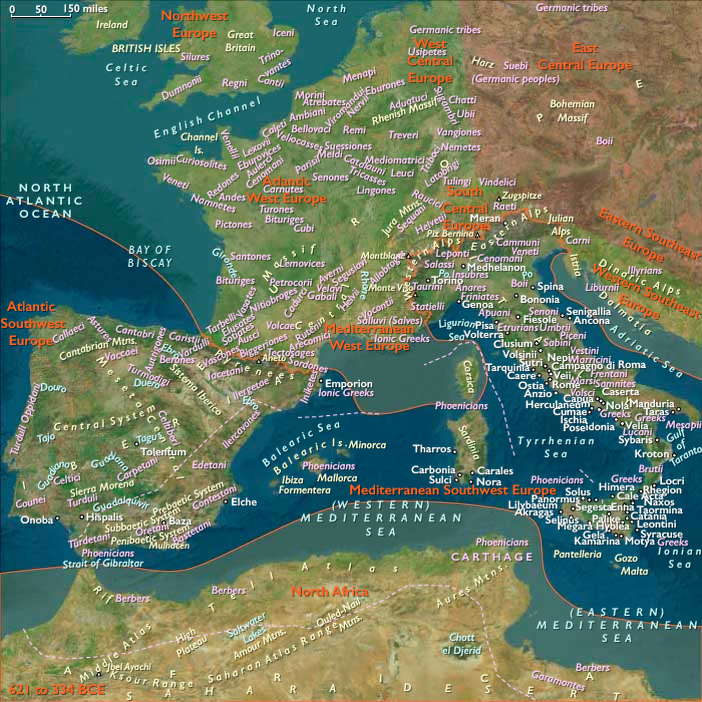
Plato returns to Syracuse in 361 BCE, …
Years: 361BCE - 361BCE
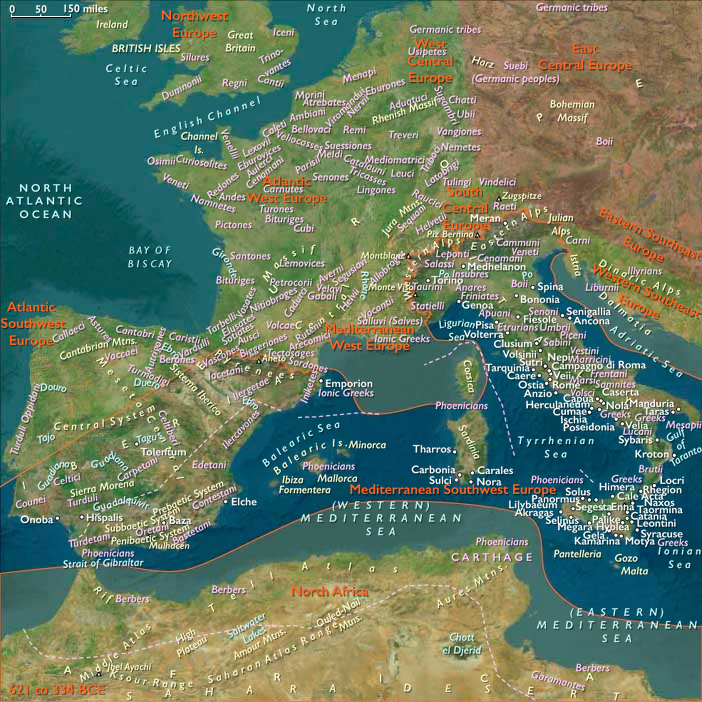
Plato returns to Syracuse in 361 BCE, but his visit with Dionysius proves even more disastrous than the first, and he returns to the Academy the following year.
Xenocrates, a student of Plato’s, may have accompanied him in the latter's political adventures in Sicily.
Locations
People
Groups
- Greece, classical
- Sicily, classical
- Italy, classical
- Carthage, Kingdom of
- Magna Graecia
- Syracuse, Corinthian city-state of
Topics
- Iron Age Europe
- Iron Age Cold Epoch
- Classical antiquity
- Sicilian Wars, or Carthaginian-Syracusan Wars
- Sicilian War, Second, or Second Carthaginian-Syracusan War
Commodoties
Subjects
Regions
Subregions
Related Events
Filter results
Showing 10 events out of 41 total
This age’s “Balkanization” of the Balkans is laid in this era, at great human and material cost.
At the era’s beginning, there are five Balkan states: Greece, Albania, Yugoslavia, Romania, and Bulgaria.
“Ethnic cleansing,” a phrase that will enter public consciousness during this era, begins with the violent Bulgarization campaign directed against ethnic Turks in Bulgaria, while Turkey hovers near the brink of war with Greece and Bulgaria, engendering cooperation between these two former enemies.
When the Soviet Union finally collapses in 1991, the Moldavian S.S.R becomes the independent state of Moldova and the second, postwar Yugoslavia begins to break apart as four of its constituent republics—Slovenia, Croatia, Macedonia, and Bosnia & Herzegovina—fight for independence from the dominant Serbian republic.
When the dust has settled and the blood has dried, only Montenegro remains in the Yugoslav federation.
At the same time, Greece, Romania, and Bulgaria shed their socialist governments—the latter two imprison or execute their former leaders—and even Albania, having increasingly walled itself off over its several decades of independence, begins to retreat from its peculiarly isolationist brand of Stalinism and let in the light of the outside world.
Eastern Southeast Europe (1984–1995 CE): Collapse of Socialism, National Fragmentation, and Post-Cold War Transitions
Political and Geopolitical Developments
The period from 1984 to 1995 marked a dramatic shift in Eastern Southeast Europe as decades of socialist rule unraveled. The death of Yugoslav leader Josip Broz Tito in 1980 had already weakened Yugoslavia's fragile unity, but tensions intensified sharply after 1984. By the late 1980s, Yugoslavia's federal structure struggled to contain rising nationalism among its constituent republics, notably Serbia, Croatia, Slovenia, and Bosnia-Herzegovina.
In Romania, Nicolae Ceaușescu’s regime became increasingly isolated due to severe austerity policies and human rights abuses. His harsh rule culminated in the Romanian Revolution of December 1989, sparked by protests in Timișoara and leading to Ceaușescu's dramatic overthrow and execution. Romania subsequently struggled through political instability as it transitioned toward democratic governance.
In Bulgaria, longstanding leader Todor Zhivkov was forced out in 1989, ending decades of loyal alignment with the Soviet Union. The fall of Zhivkov led to multiparty elections, constitutional reforms, and a gradual but turbulent transition toward parliamentary democracy and market economy.
Yugoslavia's disintegration, however, became the dominant regional crisis. Slovenia and Croatia declared independence in June 1991, quickly triggering military conflicts. In Bosnia-Herzegovina, the declaration of independence in 1992 sparked intense ethnic warfare, leading to prolonged atrocities and sieges, notably the brutal siege of Sarajevo. The international community struggled to mediate, with United Nations peacekeepers unable to prevent mass human rights violations.
Economic and Social Developments
Economic transitions in the region were tumultuous. In Romania, the post-Ceaușescu era revealed severe economic deterioration and shortages, leading to rapid liberalization and privatization programs that initially exacerbated unemployment and social inequality.
Bulgaria faced economic hardship due to the collapse of Comecon markets. Rapid privatization policies aimed at establishing market mechanisms triggered inflation, unemployment, and declining living standards, prompting significant emigration westward.
Yugoslavia's breakup destroyed its integrated economy. Warfare devastated industries, infrastructure, and agriculture across Croatia and Bosnia-Herzegovina. Economic sanctions imposed on Serbia and Montenegro in response to their military actions worsened poverty and social distress. Massive displacement due to ethnic conflict created refugee crises across and beyond the region.
Cultural and National Identities
The collapse of socialism allowed suppressed national identities to resurface strongly, often fueling conflict. In Yugoslavia, historical ethnic and religious tensions were manipulated by nationalist leaders, notably Serbian President Slobodan Milošević, whose promotion of Serb nationalism played a key role in the wars that followed. Nationalist rhetoric intensified, emphasizing distinct cultural and historical narratives that justified territorial claims and violent conflict.
In Bulgaria and Romania, transitions allowed freer cultural expression, prompting debates over national histories and identities that had been censored under communist rule. The Bulgarian Turks, for example, reclaimed cultural rights lost during the 1980s "Revival Process," when Zhivkov’s regime forced assimilation.
International Involvement and Influence
With the end of the Cold War and the Soviet Union’s collapse in 1991, Eastern Southeast Europe found itself at a geopolitical crossroads. The European Union, the United States, and NATO emerged as influential actors, shaping regional stability and integration processes. EU involvement grew significantly, offering economic aid, diplomatic mediation, and prospects of integration, seen as crucial to stabilizing the region.
In Yugoslavia, international involvement intensified following widespread atrocities. NATO’s 1995 bombing campaign against Bosnian Serb positions, combined with U.S.-led diplomacy, culminated in the Dayton Accords, ending the Bosnian War and establishing a complex power-sharing arrangement among ethnic groups in Bosnia-Herzegovina.
Key Developments (1984–1995)
-
1989: Overthrow of Nicolae Ceaușescu in Romania; removal of Todor Zhivkov in Bulgaria, marking end of communist regimes.
-
1991: Slovenia and Croatia declare independence, igniting conflicts.
-
1992: Outbreak of war in Bosnia-Herzegovina, leading to prolonged ethnic violence and international intervention.
-
1995: NATO intervention and the Dayton Accords establish peace and power-sharing in Bosnia-Herzegovina.
Long-Term Consequences and Historical Significance
The period 1984–1995 profoundly reshaped Eastern Southeast Europe, dismantling socialist structures and redefining national identities. The violent breakup of Yugoslavia left deep social and economic scars and established patterns of political fragmentation that continue to impact regional stability. Romania and Bulgaria began challenging transitions toward democracy and market economies, setting paths toward eventual EU integration. Overall, this era decisively ended Cold War alignments and opened new, though troubled, chapters of national self-determination and European integration in the region.

Catholic Croats, Orthodox Serbs, and Muslim Slavs live side by side in the multiethnic republic of Bosnia and Herzegovina.
Croatia and Slovenia's declarations of independence and the warfare that has ensued have created an awkward position for Bosnia and Herzegovina and its three constituent peoples.
Bosnians are divided on the issue of whether to stay with the Yugoslav federation, a position favored overwhelmingly among Serbs, or seek independence, which Bosniaks and Croats favor overwhelmingly.
Bosnia issues a declaration of sovereignty in October of 1991.
The ruling party in the Republic of Croatia, the Croatian Democratic Union (Croatian: Hrvatska demokratska zajednica, HDZ), organized and controlled the branch of the party in Bosnia and Herzegovina, the Croatian Democratic Union of Bosnia and Herzegovina (the "HDZ-BiH").
By the latter part of 1991, the more extreme nationalist elements of the HDZ-BiH, under the leadership of Mate Boban, Dario Kordić and others, with the support of Franjo Tuđman and Gojko Šušak, have taken effective control of the party, and on November 18, 1991, proclaimed the existence of the Croatian Community of Herzeg-Bosnia, as a separate "political, cultural, economic and territorial whole," on the territory of Bosnia and Herzegovina.
The Republic of Bosnia and Herzegovina holds a referendum for independence from Yugoslavia, which passes on on February 29, 1992; the great majority of Bosnian Serbs have boycotted it.
With a voter turnout of sixty-four percent, ninety-eight percent of which vote in favor of the proposal, Bosnia and Herzegovina becomes an independent state.
Local Serb militias, with the assistance of the Yugoslav People's Army, initially had carved out several autonomous regions in Bosnia, which are consolidated in March 1992 into the Serbian Republic of Bosnia and Herzegovina, or Republika Srpska.
Open warfare breaks out in Sarajevo on April 6 following a tense period of escalating tensions and sporadic military incidents between the forces that are loyal to the government of Bosnia, Croatian units attempting to secure a union among Croatia and Croat-majority areas of the republic, and a secessionist Serb army.
The destructive use of “ethnic cleansing” (depopulating areas of a particular ethnic group) by irregular Serb troops to gain a stronghold in places with a mixed population creates a flood of refugees.
The most brutal chapter in the breakup of Yugoslavia is the bitter and protracted Bosnian civil war, which begins several months later than fighting in the republics of Slovenia and Croatia.
Serbian leaders like Slobodan Milosevic channel arms and military support to the Serb minority in Bosnia under the guise of protecting them.
Serb forces besiege Croats and Muslims in Sarajevo from May 1992.
Foreign governments respond ...
… with a United Nations security council resolution in May 1992 that imposes stricter economic sanctions (not always tightly enforced) than those that had been imposed in 1991 to keep fuel and weapons from Serbia and Montenegro.
International recognition of Bosnia and Herzegovina results in the official withdrawal of the Yugoslav People's Army (JNA) from the republic's territory, although their Bosnian Serb members merely join the Army of Republika Srpska.
Armed and equipped from JNA stockpiles in Bosnia, supported by volunteers and various paramilitary forces from Serbia, and receiving extensive humanitarian, logistical and financial support from the Federal Republic of Yugoslavia, Republika Srpska's offensives in 1992 manage to place much of the country under its control.
Rebel Serbs shell Dubrovnik in July 1992.
Years: 361BCE - 361BCE
Locations
People
Groups
- Greece, classical
- Sicily, classical
- Italy, classical
- Carthage, Kingdom of
- Magna Graecia
- Syracuse, Corinthian city-state of
Topics
- Iron Age Europe
- Iron Age Cold Epoch
- Classical antiquity
- Sicilian Wars, or Carthaginian-Syracusan Wars
- Sicilian War, Second, or Second Carthaginian-Syracusan War