Pope Pius IX finally establishes a council …
Years: 1847 - 1847
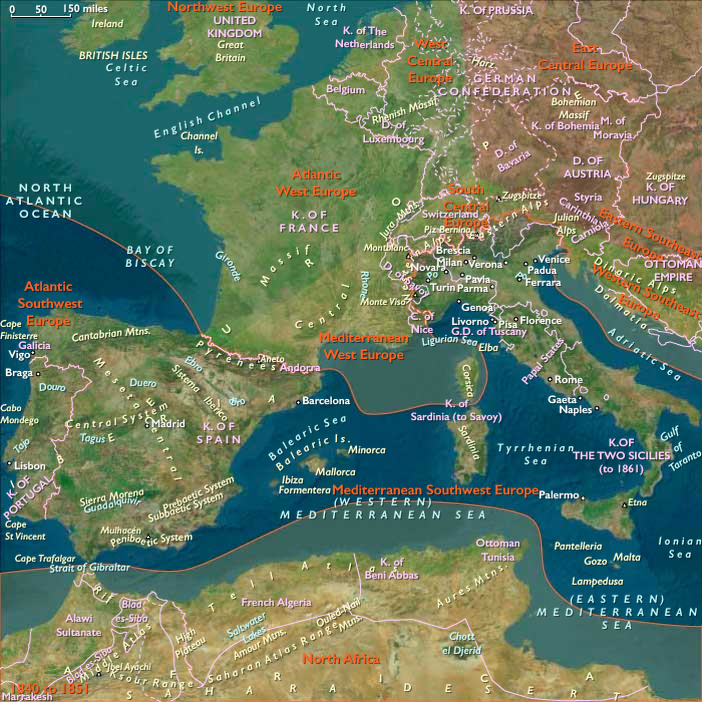
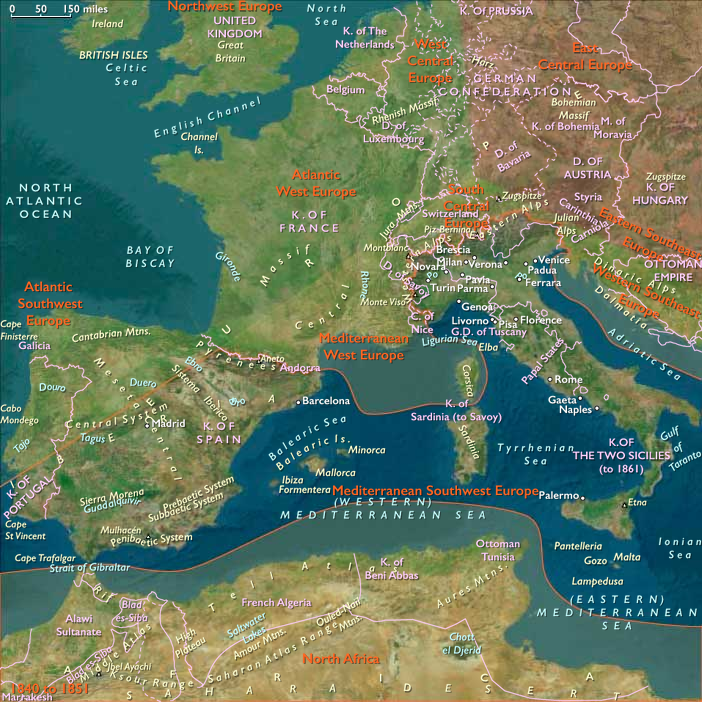
Pope Pius IX finally establishes a council of state in 1847.
Although only advisory, the council gives the laity a voice in the affairs of state.
Locations
People
Groups
Topics
Commodoties
Subjects
Regions
Subregions
Related Events
Filter results
Showing 10 events out of 16926 total
The influx of white settlers in the Oregon Territory brings new diseases to the the Cayuse and other native peoples, including a severe epidemic of measles in 1847.
The native's lack of immunity to new diseases and limited health practices leads to a high mortality rate, with children dying in striking numbers.
The zealous conversion attempts by the Whitmans, as well as the recovery of many white patients, fosters the belief among the Native Americans that Whitman is causing the death of his native patients.
According to some contemporaries, including the Reverend Henry H. Spalding, the situation is aggravated by ongoing animosity between the Protestant missionaries and local Catholic priests.
Mount Guntur or Gunung Guntur, an active stratovolcano in western Java, is part of a complex of several overlapping stratovolcanoes about ten kilometers (six point two miles) northwest of the city of Garut.
The last eruption was in 1847. At an elevation of 2,249 m (7,379 ft), Mount Guntur rises about 1,500 m (4,900 ft) above the plain of Garut.
It has produced frequent explosive eruptions in the first half of nineteenth century, making it one of the most active volcanoes of western Java.
The name Guntur means "thunder" in the Indonesian language.
October –
The Thai-Annamese War ends inconclusively in 1847.
The Cambodian King continues to pay tribute to the Annamese Emperor.
China's economic tensions, military defeats at Western hands, and anti-Manchu sentiments all combine to produce widespread unrest, especially in the south.
South China had been the last area to yield to the Qing conquerors and the first to be exposed to Western influence.
The southern Chinese province of Guangdong, the homeland of the Taiping people, is beset with accelerating social unrest.
After the first Opium War, government prestige declines, and officials lose their capacity to reconcile communal feuding.
The greatest among such conflicts is that between the native settlers and the so-called guest settlers: the clannish, industrious Hakka, a Han subgroup who had migrated in the late twelfth century from North China, to Kwangsi and western Guangdong, mainly from eastern Guangdong.
Hong Xiuquan, founding ruler of the Heavenly Kingdom, the youngest son of four children in a poor but proud Hakka family, had shown early signs of great intelligence, and his entire village sponsored him in his studies, hoping that he would eventually pass the Confucian civil service examination, enter the government bureaucracy, and bring wealth and honor to his family and friends.
Hung, an epileptic, had failed the civil service examination several times however, and, influenced by Christian teachings, had a series of visions and believed himself to be the son of God, the younger brother of Jesus Christ, sent to reform China.
His schoolmate Feng Yunshan, an able organizer, utilizes Hong's ideas to organize a new religious group, the Pai Shang-ti Hui ("God Worshipers"), which he forms among the impoverished miners, charcoal workers and peasants of central Kwangsi, most of whom belong to the Hakka.
In 1847, Hung joins Feng and the God Worshippers, and is immediately accepted as the new leader of the group.
Conditions in the countryside are deplorable, and sentiment runs high against the foreign Manchu rulers of China.
As a result, Hung and Feng begin to plot rebellion.
Hong's movement—perhaps under the impact of Protestant missions—is quite austere, and it opposes magic, idols, and belief in spirits.
He considers the New Testament to be authoritative for his new sect, and its rapid growth-aided by connections with other revolutionary movements-soon results in a genuine danger to the Manchu emperor.

The European Economic Depression and Agricultural Crises (1845–1848) Deepen
By 1847, Europe remained mired in economic depression and agricultural collapse for a third consecutive year, exacerbating food shortages, unemployment, and political unrest. The cumulative effects of failed harvests, industrial decline, and financial instability pushed societies to the brink, intensifying revolutionary pressures that would erupt in 1848.
The Agricultural and Industrial Crisis Worsens (1847)
-
Persistent Crop Failures and Starvation
- The potato blight (Phytophthora infestans) continued to devastate harvests, worsening famine conditions, particularly in Ireland, Scotland, and parts of Germany.
- Grain production remained insufficient, leading to record-high food prices and escalating urban and rural distress.
- Mass migration increased, as populations fled hunger-stricken regions for cities or emigrated abroad.
-
Industrial Collapse and Unemployment
- Factories continued to close, particularly in Britain, Belgium, and Germany, as demand for manufactured goods remained weak.
- Wage cuts and mass layoffs fueled resentment among urban workers, increasing radicalism in industrial centers.
-
Financial Panic and Banking Failures
- A wave of banking collapses swept through Europe, further destabilizing economies.
- The financial crisis restricted credit availability, worsening investment declines and deepening economic stagnation.
Intensifying Social and Political Consequences
-
Widespread Hunger and Revolts
- Food riots and looting erupted across France, Italy, and the German states, as authorities struggled to control growing unrest.
- Governments' failure to provide relief eroded confidence in ruling elites.
-
Mounting Pressure for Political Reform
- Calls for constitutional government, expanded suffrage, and social protections grew louder.
- The worsening economic and social crisis radicalized both urban workers and sections of the middle class, accelerating political mobilization.
The Approaching Revolutions of 1848
By 1847, the prolonged economic downturn and food shortages had pushed Europe to the edge of revolt. The inability of governments to respond effectively to the suffering of their populations further weakened monarchies and conservative regimes. As economic desperation turned to political agitation, the stage was set for the Revolutions of 1848, which would soon sweep across the continent.
Among the liberal critics condemning Nikolai Gogol’s reactionary Selected Passages from Correspondence is the influential Vissarion Belinsky, now the foremost Russian literary critic and a leader of the progressive intelligentsia.
Widely known for his annual surveys of Russian literature and essays on major figures of Russian and world literature, Belinsky has attempted to synthesize his conception of literature as an organ of social progress with German idealist aesthetics.
A committed revolutionary, Belinsky believes that literature should, if necessary, sacrifice artistic excellence to social values.
Hermann von Helmholtz, with several other associates in the sciences, particularly Emil duBois-Reymond and Karl Ludwig, forms the so-called 1847, or mechanistic, school of physiology, which attempts to explain physiological phenomena in terms of chemistry and physics.
Helmholtz completes a series of papers published between 1843 and 1847 in which he applies these principles to animal heat and muscle contraction, then outlines the physical and philosophical basis of the law of the conservation of energy (a hot topic at this time) “On the Conservation of Energy.”
The Transylvanian Diet in 1847 enacts a law requiring the government to use Magyar.
Transylvania's Romanians protest in vain.
Serbian culture has made significant strides in the eighteenth and nineteenth centuries.
Dositej Obradovic, Vuk Karadzic (1787-1864), and other scholars have accelerated a national renaissance.
Obradovic had spread the Enlightenment to the Serbs through his translations and autobiography.
Collections of Serbian folk songs and poems edited by Karadzic in the 1820s and 30s have awakened pride in national history and traditions.
Karadzic, having also overcome clerical opposition to reform the Cyrillic alphabet and the Serbian literary language, translates the New Testament in 1847.
His work widens the concept of Serbian nationhood to include language as well as religious and regional identifications.