
Pietro Tribuno, immediately after his succession, had …
Years: 891 - 891
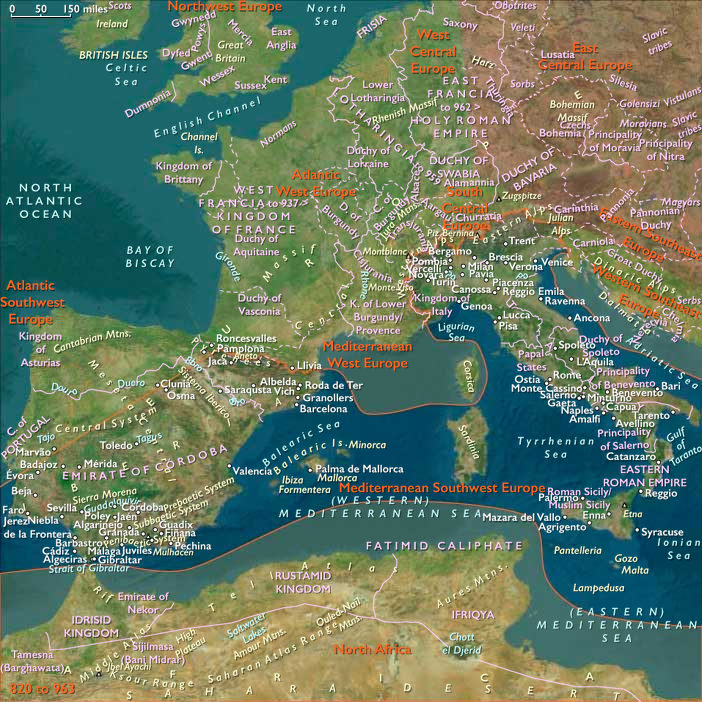
Pietro Tribuno, immediately after his succession, had begun negotiations with the successors of Charles the Fat.
In 888, he had negotiated a treaty with Arnulf of Carinthia and again in 891.
The first treaty had secured for the duchy the jurisdiction over Venetian citizens abroad.
The intent of this clause was to increase Venetian trade in the Carolingian Empire by extending to such merchants who did so trade the protection of their own laws.
The economic benefits are immediate and the 890s will see growth in Venice's relatively new iron industry.
Meanwhile, land reclamation continues apace.
Locations
People
Groups
Commodoties
Subjects
Regions
Subregions
Related Events
Filter results
Showing 10 events out of 53695 total
The imperial treasury is being drained with the defeat against Li Keyong, and the campaign against Chen in a stalemate—the imperial army had put Xichuan's capital Chengdu under siege and caused a terrible famine within the city, but has not been able to capture it— and Emperor Zhaozong decides to end the Xichuan campaign as well.
He pardons Chen and recalls Wei, while ordering Gu and Wang (for whom he had created a Yongping Circuit out of parts of Xichuan territory) back to their circuits.
Wang is unwilling to accept this result, however, and he intimidates Wei into returning to Chang'an by himself, while Wang continues the siege of Chengdu.
Chen and Tian surrender to Wang in autumn 891, and Wang takes over Xichuan Circuit.
Raids by the Cretan Saracens had resumed in about 884, during which time the Cretans have been joined by North African and Syrian fleets.
The Peloponnese in particular suffer considerably from their raids, but also Euboea and the Cyclades: the island of Patmos comes under Cretan control; Naxos, probably along with the neighboring islands of Paros and Ios, is forced to pay them tribute; and Elafonisos and Cythera off the southern coast of the Peloponnese are also occupied.
As the Muslim presence leaves generally few material or literary traces, the list of islands at one time controlled or occupied by them could well be longer.
The impact of this new wave of Arab raids is nevertheless felt across the Aegean, where some islands are deserted altogether, and elsewhere coastal sites are abandoned for better protected inland locations.
After ibn Hafsun is defeated near the castle of Polei in 891 and loses several cities, Abdullah massacres all the Christians, while the Muslims of the conquered cities are pardoned.
Ibn Hafsun moves his headquarters back to Bobastro in 891 after his defeat by the forces of Abdallah ibn Muhammad at the Battle of Poley.
The Iron Crown of Lombardy is being fought over between Guy III of Spoleto and Berengar of Friuli.
Berengar had been crowned king in 887, but Guy had in his turn been crowned in 889.
While Pope Stephen V supports Guy, crowning him Roman Emperor in 891, Arnulf has thrown his support behind Berengar.
Pope Stephen dies in autumn 891; Formosus succeeds him.
Born at Ostia, he had become Cardinal Bishop of Portus in 864.
He had undertaken diplomatic missions to Bulgaria (866) and France (869 and 872), and he had persuaded Charles the Bald, King of the Franks, to be crowned as emperor by the Pope in 875.
He had been a candidate for the papacy as early as 872, but due to political complications he had left Rome and the court of Pope John VIII that year.
John had convened a synod, and Formosus had been ordered to return or be excommunicated on charges that he had aspired to the Bulgarian Archbishopric and the Holy See; had opposed the emperor and had deserted his diocese without papal permission; had despoiled the cloisters in Rome; and had performed the divine service in spite of the interdict.
The condemnation of Formosus and others was announced in July 872.
In 878, the sentence of excommunication was withdrawn after he promised never to return to Rome or exercise his priestly functions.
In 883, John's successor Marinus I had restored Formosus to his suburbicarian diocese of Portus.
Formosus is elected Pope on 6 October 891.
According to The Catholic Encyclopedia, the vote for Formosus was unanimous.
Shortly after Formosus' election, he is asked to intervene in Constantinople, where the Patriarch Photius has been ejected and Stephen, the son of Emperor Basil I, has taken the office.
Formosus refuses to reinstate those who had been ordained by Photius, as his predecessor, Stephen V, had nullified all of Photius' ordinations.
However, the eastern Bishops determine to recognize Photius' ordinations nonetheless.
Formosus also immediately immerses himself in the dispute between Odo, Count of Paris, and Charles the Simple for the French crown; the Pope sides with Charles, and zealously exhorted Odo (at this time holding the crown) to abdicate on Charles' behalf, to no avail.
The Battle of Leuven (891): Arnulf of Carinthia’s Decisive Victory Over the Vikings
In September 891, Arnulf of Carinthia, King of East Francia, repels a major Viking invasion at the Battle of Leuven, securing one of the most significant Frankish victories against the Norse in the late 9th century. This decisive battle effectively ends large-scale Viking incursions into the Low Countries and Lotharingia.
The Viking Invasion and the Battle of Leuven
- The Vikings had established a strong presence in the Low Countries, using the Scheldt, Meuse, and Rhine rivers to raid deep into Frankish lands.
- In 891, a large Viking force, possibly numbering several thousand warriors, invades Lotharingia, hoping to expand their plundering operations.
- Arnulf of Carinthia, determined to halt the Norse advance, raises an East Frankish army and meets them at Leuven (modern-day Belgium).
- The battle is a Frankish rout, with Arnulf’s forces slaughtering the Viking army, securing an overwhelming victory.
- According to the Annales Fuldenses, the bodies of the dead Northmen blocked the flow of the river, a testament to the scale of Viking losses.
Aftermath and Significance of the Victory
- Arnulf’s victory effectively ends Viking incursions into Lotharingia, as the Norse no longer pose a major military threat in the region.
- To further secure the area, Arnulf builds a new fortress on an island in the Dijle River, reinforcing his hold over Leuven and its surrounding territory.
- The battle strengthens Arnulf’s authority as King of East Francia, demonstrating his military capability and leadership.
- This victory contributes to the gradual decline of Viking activity in the Carolingian world, as Norse forces increasingly shift their focus toward England and Ireland.
Legacy of the Battle of Leuven (891)
- One of the last major Viking defeats on the continent, marking the waning of Viking power in Frankish lands.
- Secured the Low Countries for East Francia, preventing further Norse encroachments.
- Reinforced Arnulf’s legitimacy as ruler, paving the way for his later imperial coronation as Holy Roman Emperor in 896.
Arnulf’s decisive victory at Leuven in 891 stands as one of the greatest Frankish victories against the Vikings, ensuring that Lotharingia and East Francia would remain free from Norse domination for the remainder of the Carolingian period.
Arnulf of Carinthia: Victories Against the Slavs and Defeat at Maastricht (890–891)
Arnulf of Carinthia, King of East Francia (887–899) and later Holy Roman Emperor (896), was a militaristic ruler, known for his aggressive campaigns against external threats rather than diplomacy.
Victory Over the Slavs in Pannonia (890)
- In 890, Arnulf successfully defeats the Slavs in Pannonia, securing the eastern frontier of East Francia.
- His campaign targets Great Moravia, whose ruler, Svatopluk I, had previously been an ally of the Carolingians but had grown too powerful.
- Arnulf supports Svatopluk’s rivals, using the Magyars (Hungarians) as mercenaries to weaken Moravian control over Pannonia.
- His victory temporarily stabilizes the region, but Magyar forces will soon become a threat to East Franciathemselves.
Danish Invasion of Lotharingia and the Battle of Maastricht (891)
- In 891, while Arnulf is focused on the east, a Danish Viking force invades Lotharingia, taking advantage of Frankish military preoccupation with the Slavs.
- The Danes engage an East Frankish army at Maastricht, delivering a crushing defeat to Arnulf’s forces.
- This Viking victory underscores the continued threat of Norse incursions, even as Arnulf is occupied with defending the empire’s borders.
Aftermath: Retaliation at the Battle of Leuven (891)
- Later in 891, Arnulf rallies his forces and defeats the Vikings at Leuven, effectively halting further Danish incursions into Lotharingia.
- His victory at Leuven restores East Frankish dominance in the Low Countries and solidifies his reputation as a warrior-king.
Legacy of Arnulf’s Military Campaigns (890–891)
- Slavic wars weaken Great Moravia, but also introduce the Magyars into the power struggles of Central Europe, setting the stage for their future invasions of East Francia.
- Danish victory at Maastricht shows that the Viking threat remains potent, but Arnulf’s later victory at Leuven secures his kingdom’s defenses.
- His reliance on military action over diplomacy defines his reign, making him one of the last Carolingian rulers to effectively defend his realm against external enemies.
Arnulf’s campaigns in 890 and 891 demonstrate his military skill, but also reveal the growing challenges facing the Carolingian world, as both Vikings in the west and Magyars in the east begin to destabilize its borders.
Alfred, a learned layman, encourages learning, employs court scholars, and begins personally translating several books into English.
These include Pope Gregory I's Pastoral Care, Saint Augustine's Soliloquies, Orosius's Seven Books of History against the Pagans, Boethius's Consolation of Philosophy, and (possibly) the Ecclesiastical History of the Venerable Bede, adding to each of these (except Soliloquies) his own commentary.
In his efforts to ensure that his countrymen have the opportunity to become literate, Alfred relies upon the bishops of the Anglo-Saxon church both to teach and to seek out students.
Between the restoration of London and the resumption of large scale Danish attacks in the early 890s, Alfred's reign is rather uneventful.
The relative peace of the late 880s had been marred by the death of Alfred's sister, Æthelswith, who died in 888 en route to Rome.
In the same year, the Archbishop of Canterbury, Æthelred, had also passed away.
Guthrum, or Athelstan by his baptismal name, Alfred's former enemy and king of East Anglia, died one year later and was buried in Hadleigh, Suffolk.
Guthrum's passing marks a change in the political sphere Alfred deals with, creating a power vacuum that in the following years will stir up other power–hungry warlords eager to take his place.
The quiet years of Alfred's life are coming to a close, and war is on the horizon.
The half-century-long colonization of some of the Hawaiian Islands by Polynesians from the Marquesas Islands and Tahiti is complete by 900.
The Hawaiian Islanders have established an economy based on “ahupuaa,” land units that extend from mountaintop to the sea.
Hawaiian religion, developed by at least 900, is based on a belief in gods existing in all forces and objects; a taboo, or “kapu,” system provides rules for maintaining the political and social order.
The Hawaiian Islanders’ hereditary ruling class, called the “alii nui,” reigns over the common people, who are primarily fishermen and farmers.
