
Jacob Obrecht, a master of polyphony, organizes …
Years: 1505 - 1505
Jacob Obrecht, a master of polyphony, organizes his warmly expressive melodies into perfectly proportioned phrases, and makes frequent use of sequences, canonic passages, and periodic and clear-cut cadences.
An ordained Dutch priest and one of the leading composers of the Early Renaissance, he is Josquin's greatest contemporary.
Obrecht's compositions, primarily sacred, include about two dozen masses and an equal number of motets.
He bases most of his masses on a cantus firmus, either a plainsong melody or a secular song.
He also writes chansons, although most of his secular pieces have Dutch texts or titles.
What little is known of Obrecht's origins and early childhood comes mostly from his motet Mille quingentis.
The only son of Ghent city trumpeter Willem Obrecht and Lijsbette Gheeraerts, his mother died in 1460 at the age of twenty, and his father in 1488 in Ghent.
Details of his early education are sparse, but he probably learned to play the trumpet, like his father, and in so doing learned counterpoint and how to improvise over a cantus firmus.
He is likely to have known Antoine Busnois at the Burgundian court, and certainly knew his music, since Obrecht's earliest mass shows close stylistic parallels with the elder composer.
A scholar, composer and clergyman, Obrecht seems to have had a succession of short appointments, two of which ended in less than ideal circumstances.
There is a record of his compensating for a shortfall in his accounts by donating choirbooks he had copied.
Throughout the period he was held in the highest esteem both by his patrons and by his fellow composers.
Tinctoris, writing in Naples, singles him out in a shortlist of contemporary master composers —all the more significant because he was only twenty-five when Tinctoris created his list, and on the other side of Europe.
Erasmus of Rotterdam had served as one of Obrecht's choirboys around 1476.
While most of Obrecht's appointments were in Utrecht, Antwerp, Bruges, and Cambrai in the Low Countries, he has made at least two trips to Italy.
Ercole had heard Obrecht's music, which is known to have circulated in Italy between 1484 and 1487, and said that he appreciated it above the music of all other contemporary composers; consequently he had invited Obrecht to Ferrara for six months in 1487.
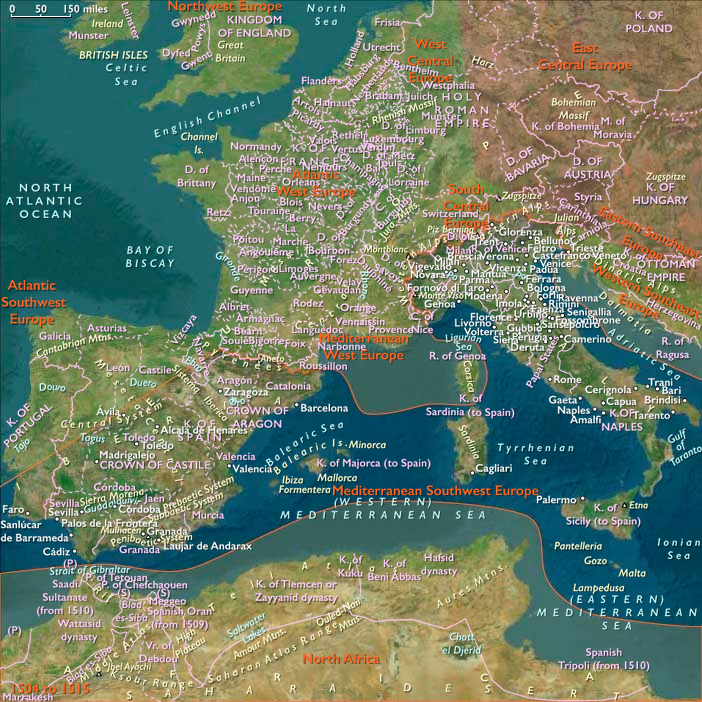
In 1504 Obrecht had returned to Ferrara to join the city’s ducal chapel, but on the death of the Duke at the beginning of the next year he becomes unemployed.
In what capacity he stays in Ferrara is unknown, but he dies in the outbreak of plague here just before August 1, 1505.
Locations
People
Groups
- Papal States (Republic of St. Peter)
- Flanders, County of
- Christians, Roman Catholic
- Ferrara, Duchy of
Topics
Subjects
Regions
Subregions
Related Events
Showing 10 events out of 39547 total
Years: 1505 - 1505
Locations
People
Groups
- Papal States (Republic of St. Peter)
- Flanders, County of
- Christians, Roman Catholic
- Ferrara, Duchy of
Topics
Subjects
Regions
Subregions