Order is restored in Anatolia by the …
Years: 621BCE - 478BCE
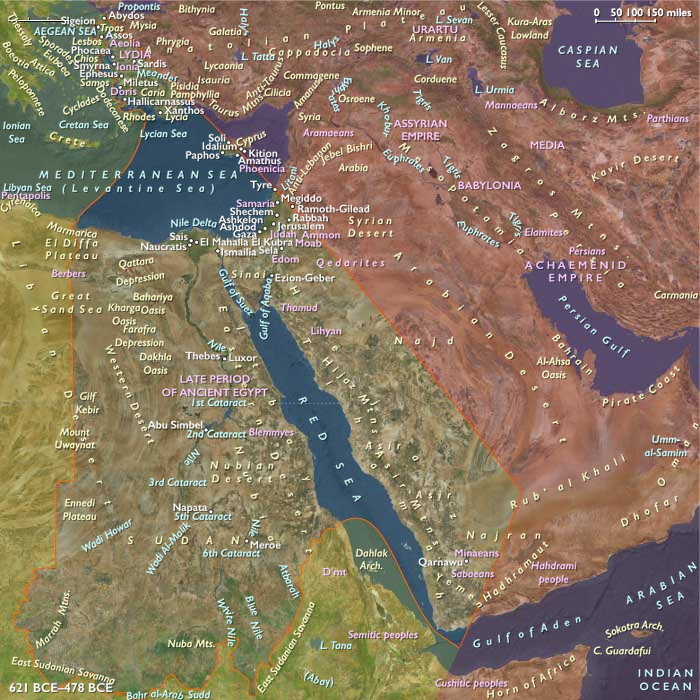
Order is restored in Anatolia by the Lydians, a Thracian warrior caste who dominate the indigenous peasantry and derive their great wealth from alluvial gold found in the tributaries of the Hermus River (Gediz Nehri).
Such Lydian kings as Croesus control western Anatolia from their court at Sardis until their kingdom falls to the Persians in 546 BCE.
Locations
People
Groups
Topics
- Younger Subboreal Period
- Iron Age, Near and Middle East
- Iron Age Cold Epoch
- Classical antiquity
- Median-Lydian War of 590-585 BCE
- Persian Conquests of 559-509 BCE
- Persian-Lydian War of 547-546 BCE
Commodoties
Subjects
Regions
Subregions
Related Events
Filter results
Showing 10 events out of 66140 total
The founder of the Vietnamese nation, according to the earliest traditions, was Hung Vuong, the first ruler of the semilegendary Hung dynasty (2879-258 BCE, mythological dates) of the kingdom of Van Lang.
Hung Vuong, in Vietnamese mythology, was the oldest son of Lac Long Quan (Lac Dragon Lord), who came to the Red River Delta from his home in the sea, and Au Co, a Chinese immortal.
Lac Long Quan, a Vietnamese cultural hero, is credited with teaching the people how to cultivate rice.
The Hung dynasty, which according to tradition ruled Van Lang for eighteen generations, is associated by Vietnamese scholars with Dong Sonian culture.
An important aspect of this culture by the sixth century BCE is the tidal irrigation of rice fields through an elaborate system of canals and dikes.
The fields are called Lac fields, and Lac, mentioned in Chinese annals, is the earliest recorded name for the Vietnamese people.
Maritime East Asia (621–478 BCE): Age of Philosophy and Technological Advancements
Between 621 BCE and 478 BCE, Maritime East Asia—comprising lower Primorsky Krai, the Korean Peninsula, the Japanese Archipelago below northern Hokkaido, Taiwan, and southern, central, and northeastern China—experiences profound philosophical development, significant technological innovations, and continued political decentralization during the late Spring and Autumn period.
Confucius and the School of Literati
The philosophical tradition with the most lasting impact on Chinese civilization emerges prominently in this era: the School of Literati (ru), more commonly known in the West as Confucianism. Founded by Confucius (551–479 BCE), also known as Kong Zi or Master Kong, this school advocates an ethical society modeled after the early Zhou Dynasty’s idealized social and political order. Confucius teaches that societal harmony relies upon clearly defined roles and relationships, famously summarizing his philosophy as, "Let the ruler be a ruler and the subject a subject." However, he emphasizes that rulers must embody virtue and moral rectitude.
Confucian teachings crystallize around the figure of the junzi, originally meaning "ruler's son" but later evolving to signify a morally superior, cultivated gentleman. The written foundations of Confucian thought are preserved in the Confucian Classics, which become the ideological backbone for traditional Chinese society for millennia.
Iron Age and Technological Progress
Technological advancement accelerates significantly during this period, marked by the widespread adoption of ironworking around 600 BCE. Iron technology transforms agriculture, warfare, and daily life through the production of durable weapons, tools, and farm implements. This technological leap is accompanied by an increased emphasis on formal education, particularly among officials and the elite classes, spurring intellectual and administrative sophistication that supports expanding bureaucracies.
Hundred Schools of Thought
Amidst ongoing fragmentation and military conflict among competing feudal states, a flourishing intellectual environment emerges, later known as the era of the Hundred Schools of Thought. This period, spanning the Spring and Autumn through Warring States periods, sees intense philosophical debate and the rise of itinerant scholars who serve as advisers to regional rulers on governance, military strategy, and diplomacy. This intellectual vibrancy profoundly shapes cultural and social values in China and throughout East Asia, influencing thought systems that endure into modern times.
Cultural and Social Developments
The literary and cultural landscape evolves, exemplified by compilations like the Shih Jing, an anthology of poems and songs reflecting life in northern China between approximately 1000 and 600 BCE. These texts offer critical insights into the language and society of early China. Additionally, historical records from the Zhou dynasty indicate that institutions such as prostitution are already established within Chinese society, reflecting complex social dynamics.
Artistic craftsmanship continues to thrive, with late Zhou bronzes becoming increasingly sophisticated, notably featuring ornate gold and silver inlays, especially on decorative bronze mirrors crafted from about 600 BCE onward.
Decline of Centralized Zhou Power
Politically, the Eastern Zhou kings maintain nominal control over a limited royal domain centered on Luoyang, while real power is exercised by increasingly independent hereditary nobles. Important political decisions and military actions are deliberated at regular assemblies of prominent feudal princes, with one occasionally elevated as hegemon to lead collective forces. Nonetheless, centralized authority steadily erodes as vassal states grow stronger and more contentious, laying the groundwork for further fragmentation.
Legacy of the Age: Intellectual and Technological Transformation
Thus, the age from 621 to 478 BCE marks a significant period of intellectual innovation, technological advancement, and deepening political fragmentation. The emergence of Confucian thought and the Hundred Schools philosophy profoundly shape future social structures, governance, and cultural developments, establishing a lasting legacy that continues to influence Maritime East Asia profoundly.

The body of thought that will have the most enduring effect on subsequent Chinese life is that of the School of Literati (ru), often called the Confucian school in the West.
The written legacy of the School of Literati is embodied in the Confucian Classics, which are to become the basis for the order of traditional society.
Confucius (551-479 BCE), also called Kong Zi, or Master Kong, looks to the early days of Zhou rule for an ideal social and political order.
He believes that the only way such a system can be made to work properly is for each person to act according to prescribed relationships.
"Let the ruler be a ruler and the subject a subject." he says, but he adds that to rule properly a king must be virtuous.
To Confucius, the functions of government and social stratification are facts of life to be sustained by ethical values.
His ideal is the junzi (ruler's son), which comes to mean gentleman in the sense of a cultivated or superior man.
Ironworking technology appears in China by about 600 BCE, at which point formal education becomes more widespread among Chinese officials and members of the wealthier classes.
China’s Iron Age is taken to last until the beginning of Early Imperial China and the rise of the Qin Dynasty in the third century BCE.
The Hundred Schools of Thought are philosophers and schools that flourish from 770 to 221 BCE during the Spring and Autumn period and the Warring States period, an era of great cultural and intellectual expansion in China.
This period, fraught with chaos and bloody battles, is also known as the Golden Age of Chinese philosophy because a broad range of thoughts and ideas are developed, discussed freely, and refined during this period, in a phenomenon that has been called the Contention of a Hundred Schools of Thought.
This will profoundly influence lifestyles and social consciousness up to the present day in East Asian countries.
Itinerant scholars, who are often employed by various state rulers as advisers on the methods of government, war, and diplomacy, characterize the intellectual society of this period.
Kung-Fu-tzu, or Confucius, who teaches social ethics in China in the late sixth and early fifth centuries BCE, founds the ethical system that bears his name, basing his doctrine on the recognition of individual fate.
He incorporates elements of traditional Chinese folk religions and emphasizes aristocratic social virtues and behavior in accord with divine principles.
Old Chinese has been reconstructed from a large number of poems and songs, many of which are anthologized in the Shih Jing, an anthology of northern Chinese songs, compiled between about 1000 and about 600 BCE.
The earliest historical reference to prostitution in China dates from the Zhou dynasty, by which time it is already a well-established institution.
Late Zhou bronzes, including the backs of bronze mirrors produced from about 600 BCE, are sometimes inlaid with gold and silver.
The Spring and Autumn period in China enters its final age.
The name of the period, which roughly corresponds to the first half of the Eastern Zhou dynasty (from the second half of the eighth century BCE to the first half of the fifth century BCE), comes from the Spring and Autumn Annals, a chronicle of the state of Lu between 722 BCE and 481 BCE, which tradition associates with Confucius.
China is ruled by a feudal system, under which the Zhou dynasty kings hold nominal power over a small Royal Domain, centered on their capital (modern Luoyang), and grant fiefdoms over the rest of China to several hundreds of hereditary nobles, descendants of members of the Zhou clan, close associates of the founders of the dynasty, or local potentates.
The most important feudal princes (known later as the twelve princes) meet during regular conferences, where important matters, such as military expeditions against foreign groups or offending nobles are decided.
One prince is sometimes declared hegemon during these conferences and assumes leadership over the armies of all feudal states.
The vassal states grow strong and belligerent as the Zhou kings lose control.
Years: 621BCE - 478BCE
Locations
People
Groups
Topics
- Younger Subboreal Period
- Iron Age, Near and Middle East
- Iron Age Cold Epoch
- Classical antiquity
- Median-Lydian War of 590-585 BCE
- Persian Conquests of 559-509 BCE
- Persian-Lydian War of 547-546 BCE