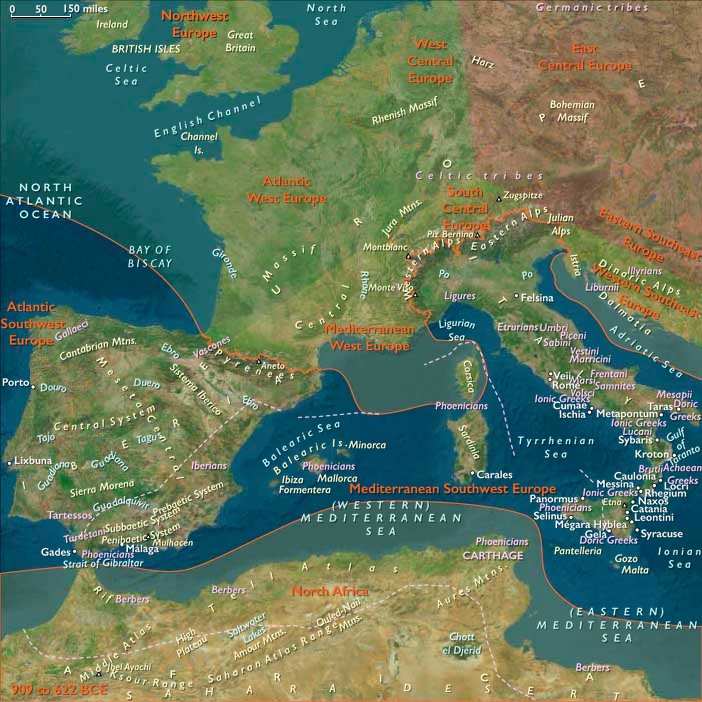
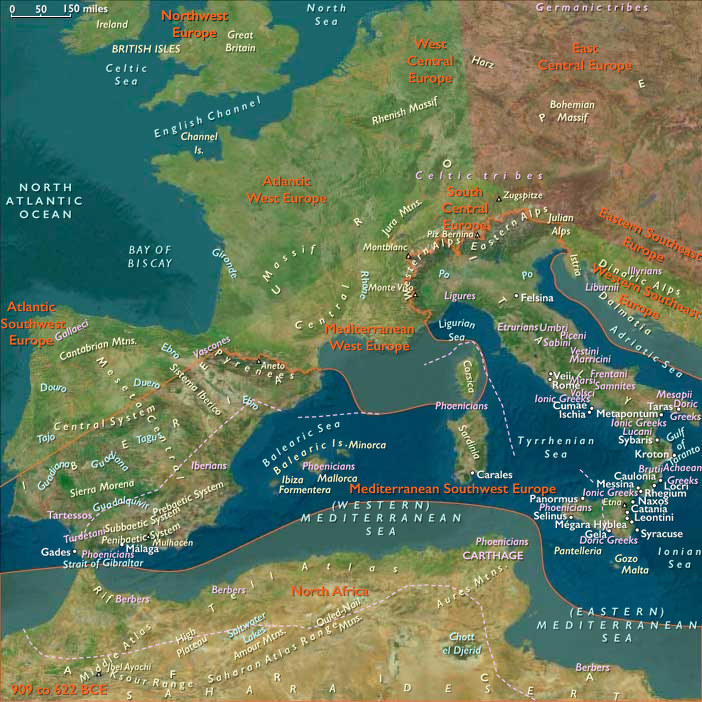
Phoenicians become Sardinia's first recorded settlers around …
Years: 801BCE - 790BCE
Phoenicians become Sardinia's first recorded settlers around 800 BCE.
Locations
Groups
Topics
Subjects
Regions
Subregions
Related Events
Filter results
Showing 10 events out of 66552 total
Humans may have first begun riding the horse not long after domestication, possibly as early as 4000 BCE, though the evidence is disuputed.
The nomadic Scythians in the Eurasian Steppes are the probable developers of the saddle.
It is not known precisely when riders first began to use some sort of padding or protection, but a blanket attached by some form of surcingle or girth was probably the first "saddle," followed later by more elaborate padded designs.
The earliest saddles, simple pads attached with a surcingle, are seen by 800 BCE.
The Middle East, 801 to 790 BCE: The Destruction of Hasanlu and Urartian Expansion
The era 801 to 790 BCE witnesses significant turmoil and cultural shifts in the northern regions of the Middle East, notably marked by the violent destruction of the settlement at Hasanlu, an important Iron Age site in northwestern Iran. Hasanlu's Iron II culture had developed strong ties to Mesopotamia and northern Syria, reflecting robust trade networks and potential political influence from these major regional powers.
Around 800 BCE, Hasanlu is subjected to a devastating raid, most likely by forces from the rising kingdom of Urartu, located around Lake Van. This attack leaves the fortified settlement ravaged and abandoned. Archaeological findings provide stark evidence of the violence: over one hundred and fifty human victims, many displaying signs of mutilation and execution, have been uncovered amidst the ruins. Among these remains, twenty-one skeletons, possibly trapped looters, lie amidst the debris of a burned citadel, illustrating the chaotic and desperate final moments of the city's inhabitants.
A significant discovery from Hasanlu’s destruction is an elaborate gold bowl, which one of the victims was found clutching. The bowl, decorated with intricate mythical scenes in relief, indicates Hasanlu’s artisans' sophisticated craftsmanship and exposure to imported styles, notably from areas around the Caspian Sea. This artifact symbolizes the extensive cultural and trade connections Hasanlu enjoyed before its tragic end.
Following its destruction, Hasanlu’s High Mound becomes the site of an Urartian fortress, marking Urartu's expanding influence. A robust fortification wall, supplemented by evenly spaced defensive towers, is constructed around the site, signaling a strategic shift in regional power dynamics. Urartu, rising as a significant regional force, begins to assert itself more boldly against the traditional powers of Mesopotamia.
Thus, the era from 801 to 790 BCE is characterized by significant regional conflict and shifting political control, exemplified by the violent demise of Hasanlu and the ascendance of Urartu as a formidable presence in the geopolitics of the Middle East.

The Iron II culture of Hasanlu has close ties to Mesopotamia and northern Syria.
Some have suggested that this indicates the settlement had come under the control of a foreign power, or experienced an influx of new occupants, or perhaps made internal changes to its political system.
Raiding forces from, probably, Urartu ravage and burn the fortified settlement about 800, after which the site is abandoned.
Over one hundred and fifty human victims will be found by archaeologists where they had been slain.
Some victims were mutilated and distributions of other bodies and the wounds they received suggest mass executions.
Skeletal remains of twenty-one individuals—perhaps looters trapped in the fire—lie (for nearly twelve hundred years, until their discovery) among the debris of the burned citadel.
One skeleton still clutches a gold bowl adorned with mythical scenes in relief of religious worship.
The bowl, made from imported raw materials, is executed in a technique reminiscent of objects found near the Caspian Sea.
Its use of local stylistic elements combined with foreign motifs suggests that artisans at Hasanlu were exposed to imported objects and that its inhabitants actively engaged in trade.
Following Hasanlu's destruction, the High Mound is used as the site for an Urartian fortress.
A fortification wall with towers at regular intervals is constructed around the edges of the High Mound.
The Near East (801–790 BCE): Resurgence in Israel and Resolution in Egypt
Israel’s Revival Under Jeroboam II
In the northern kingdom of Israel, the era from 801 to 790 BCE is marked by the ascension and impactful reign of Jeroboam II, son of Jehoash. Though minimally detailed by the Deuteronomic historian, archaeological evidence and secondary historical sources depict Jeroboam II as a notably successful monarch. His reign initiates a significant territorial and economic revival, restoring Israel’s boundaries to their ancient extent and reclaiming territories previously lost to Aram-Damascus.
Under Jeroboam II, Israel experiences a marked period of economic prosperity. Increased trade, political stability, and internal development characterize this time, restoring Israel’s status as a major power in the region. Jeroboam II’s effective governance fosters a brief but influential resurgence of northern Israelite strength, temporarily reversing the decline experienced during previous reigns.
Resolution of Egypt’s Dynastic Rivalries
In Egypt, the prolonged period of dynastic conflict reaches a decisive turning point during the thirty-ninth year of Shoshenq III’s reign. After sustained internal warfare, Osorkon B (later known as Osorkon III) decisively defeats rival factions and consolidates power over Middle and Upper Egypt. His victory puts an end to the longstanding factional struggles that had fragmented the country, effectively stabilizing southern Egypt.
With this triumph, Osorkon III establishes a Libyan dynasty in Upper Egypt, initiating a line of succession that includes his successors Takelot III and Rudamun. This dynastic consolidation effectively partitions Egypt into clearly defined spheres of influence, with Shoshenq III’s rule confined to Lower Egypt, while Osorkon III’s newly founded dynasty firmly controls the south. This resolution brings relative stability, albeit in a divided Egypt, after decades of internal conflict.
Summary of the Era
The era 801–790 BCE is marked by contrasting developments: a notable resurgence of Israel under Jeroboam II, who restores stability and territorial expansion, and a decisive resolution of Egypt’s dynastic conflicts, culminating in the establishment of Osorkon III’s Libyan dynasty. These parallel developments reshape political alliances and regional dynamics, offering both kingdoms temporary reprieve and renewed strength in the Near East.
Israel's next king, Jeroboam II, although little mentioned by the Deuteronomic historian, appears to be a major monarch, reestablishing the northern kingdom's ancient boundaries and fostering a period of economic prosperity.
The two royal factions of Egypt squabble consistently and the conflict is only resolved in Year Thirty-Nine of Shoshenq III, when Osorkon B comprehensively defeats his enemies.
He proceeds to found the Upper Egyptian Libyan Dynasty of Osorkon III – Takelot III – Rudamun.
The Greek alphabet emerges in the late ninth century BCE or early eighth century BCE.
Another, unrelated writing system, Linear B, had been in use to write the Greek language during the earlier Mycenaean period, but the two systems are separated from each other by a hiatus of several centuries, the so-called Greek Dark Ages, which end around 800 BCE.
The Greeks have adopted the alphabet from the earlier Phoenician alphabet, a member of the family of closely related West Semitic scripts.
The most notable change made in adapting the Phoenician system to Greek is the introduction of vowel letters.
According to a definition used by some modern authors, this feature makes Greek the first "alphabet" in the narrow sense, as distinguished from the purely consonantal alphabets of the Semitic type, which according to this terminology are called "abjads".
The Middle East, 789 to 778 BCE: Assyrian Expansion into Armenia
During the brief era of 789 to 778 BCE, the Assyrian Empire, under the reign of Shalmaneser IV, continues its assertive territorial expansion, notably extending into regions of what is today modern Armenia. Shalmaneser IV, succeeding the military-focused policies of his predecessors, consolidates Assyrian power in strategically significant northern territories, thus solidifying Assyrian control over critical borderlands.
The incorporation of Armenian territories represents both a strategic and economic achievement for Assyria. These newly conquered areas offer valuable resources, including metal deposits and fertile land, crucial for maintaining Assyria's expansive military and construction activities. Shalmaneser IV's success in Armenia further underscores Assyria's dominance over neighboring kingdoms and reinforces its reputation as a formidable military power capable of projecting influence far beyond its core region.
Despite the brevity of this era, the territorial acquisitions in Armenia under Shalmaneser IV have lasting implications for regional dynamics. The strengthening of Assyrian presence in the north effectively counters the rising influence of Urartu, Assyria's principal rival in the region, setting the stage for ongoing geopolitical tensions in subsequent decades.
Thus, the era from 789 to 778 BCE highlights Assyria’s continued territorial ambitions and strategic military successes, significantly shaping the evolving political landscape of the Middle East.
Shalmaneser IV, who reigns from at least 824 BCE, successfully incorporates portions of what is today Armenia into the Assyrian empire.
The Near East (789–778 BCE): Expansion of Judah under Uzziah
The period 789–778 BCE in the Near East witnesses the long and influential reign of Uzziah (also known as Azariah), king of Judah. According to the Hebrew Bible, Uzziah ascends the throne around 791 BCE, ruling for an impressive fifty-two years; however, Assyrian records present a slightly shorter reign of approximately forty-two years, spanning 783–742 BCE. Regardless of this chronological discrepancy, his tenure represents a significant era in Judah’s history.
Uzziah proves to be a capable and ambitious ruler, known particularly for his military successes and territorial expansion. Early in his reign, Uzziah undertakes a successful military campaign against the Philistines, capturing the strategically significant city of Ashdod (2 Chronicles 26:6). This victory not only enhances Judah's geopolitical influence but also expands its control over critical trade routes along the Mediterranean coast, further strengthening its economic foundations.
Simultaneously, in the northern kingdom, Jeroboam II continues his prosperous reign in Israel around 785 BCE, overseeing sustained economic growth and territorial consolidation.
Thus, between 789 and 778 BCE, Judah under Uzziah emerges as a powerful regional actor, mirroring the resurgence taking place concurrently in the northern kingdom under Jeroboam II. This era reflects a notable phase of renewed strength and stability for both Hebrew kingdoms, despite lingering differences and underlying tensions.