
Phoenician colonists from the Levant establish Carthage …
Years: 909BCE - 766BCE
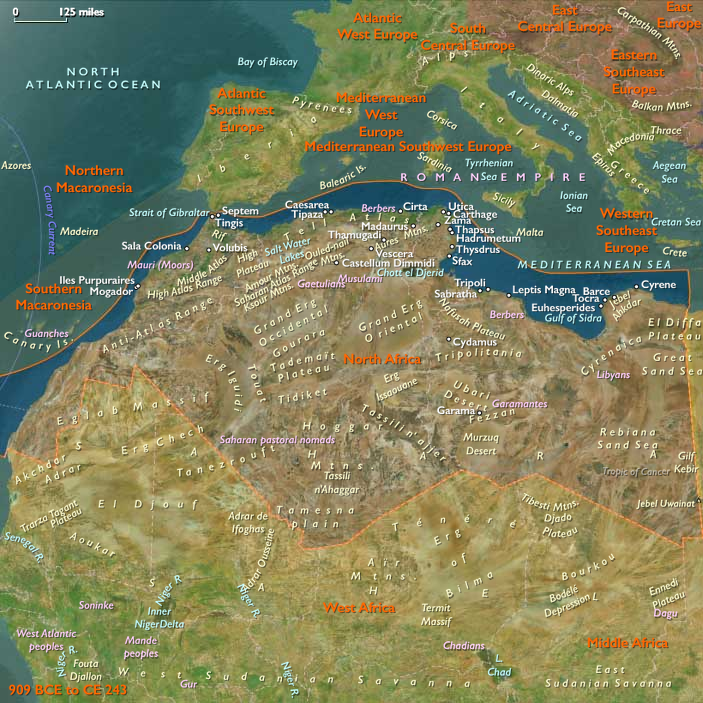
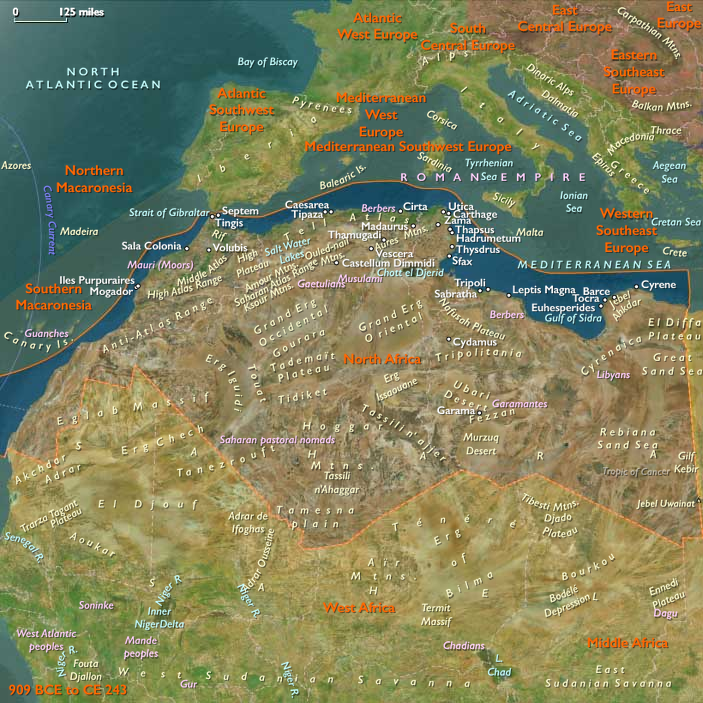
Phoenician colonists from the Levant establish Carthage in 814 BCE, according to Roman sources.
Archaeological evidence of settlement on the site of Carthage before the last quarter of the eighth century BCE has yet to be found.
Historians over the centuries will give various dates, both for the foundation of Carthage and the foundation of Rome.
Appian, in the beginning of his Punic Wars, will claim that Carthage was founded by a certain Zorus and Carchedon, but Zorus looks like an alternative transliteration of the city name Tyre and Carchedon is simply the Greek form of Carthage.
Philistos of Syracuse will datethe founding of Carthage to about 1215 BCE, while the Roman historian Appian will date the founding fifty years prior to the Trojan War (i.e., between 1244 and 1234 BCE, according to the chronology of Eratosthenes).
The Roman poet Virgil will imagine that the city's founding coincides with the end of the Trojan War.
However, it is most likely that the city was founded sometime between 846 and 813 BCE.
The Phoenicians brought with them the city-god Melqart.
The historical study of Carthage is problematic.
Because its culture and records were destroyed by the Romans at the end of the Third Punic War, very few Carthaginian primary historical sources survive.
While there are a few ancient translations of Punic texts into Greek and Latin, as well as inscriptions on monuments and buildings discovered in North Africa, the main sources are Greek and Roman historians, including Livy, Polybius, Appian, Cornelius Nepos, Silius Italicus, Plutarch, Dio Cassius, and Herodotus.
These writers belonged to peoples in competition, and often in conflict, with Carthage.
Greek cities contested with Carthage for Sicily, and the Romans fought three wars against Carthage.
Not surprisingly, their accounts of Carthage are extremely hostile; while there are a few Greek authors who took a favorable view, these works have been lost.
Legend has the founding Carthaginians as followers of Queen Dido (Elissa, or "Alissar"), an exiled princess of Tyre.
The person of Dido can be traced to references by Roman historians to lost writings of Timaeus of Tauromenium, who lived in Sicily from about 356 to 260 BCE.
Timaeus made Carchedon's wife Elissa the sister of King Pygmalion of Tyre.Elissa's brother, King Pygmalion of Tyre, had murdered her husband, the high priest.
Elissa escaped the tyranny of her own country, founding the "new city" of Carthage and subsequently its later dominions.
Details of her life are sketchy and confusing, but the following can be deduced from various sources.
According to Justin, Princess Elissa was the daughter of King Matten of Tyre (also known as Muttoial or Belus II).
When he died, the throne was jointly bequeathed to her and her brother, Pygmalion.
She married her uncle Acherbas (also known as Sychaeus), the High Priest of Melqart, a man with both authority and wealth comparable to the king.
This led to increased rivalry between religion and the monarchy.
Pygmalion assassinated Acherbas in the temple and kept the misdeed concealed from his sister for a long time, deceiving her with lies about her husband's death.
At the same time, the people of Tyre called for a single sovereign, causing dissent within the royal family.
In the Roman epic by Virgil, the Aeneid, Queen Dido, the Greek name for Queen Elissa, is first introduced as an extremely respected character.
In just seven years, since their exodus from Tyre, the Carthaginians have rebuilt a successful kingdom under her rule.
Her subjects adore her and present her with a festival of praise.
Her character is perceived by Virgil as even more noble when she offers asylum to Aeneas and his men, who have recently escaped from Troy.
A spirit in the form of the messenger god, Mercury, sent by Jupiter, reminds Aeneas that his mission is not to stay in Carthage with his newfound love, Dido, but to sail to Italy to found Rome.
Virgil ends his legend of Dido with the story that, when Aeneas tells Dido, her heart broken, she orders a pyre to be built where she falls upon Aeneas' sword.
As she lay dying, she predicted eternal strife between Aeneas' people and her own: "rise up from my bones, avenging spirit" (4.625, trans. Fitzgerald) she says, an invocation of Hannibal.
The details of Virgil's story do not, however form part of the original legend and are significant mainly as an indication of Rome's attitude towards the city she had destroyed.
At its peak, Carthage will come to be called the "shining city," ruling three hundred other cities around the western Mediterranean and leading the Phoenician (or Punic) world.
Locations
Groups
Topics
- Younger Subboreal Period
- Greek Dark Ages
- Phoenician colonization
- Iron Age, Near and Middle East
- Iron Age Cold Epoch
Subjects
Regions
Subregions
Years: 909BCE - 766BCE
Locations
Groups
Topics
- Younger Subboreal Period
- Greek Dark Ages
- Phoenician colonization
- Iron Age, Near and Middle East
- Iron Age Cold Epoch
Subjects
Regions
Subregions